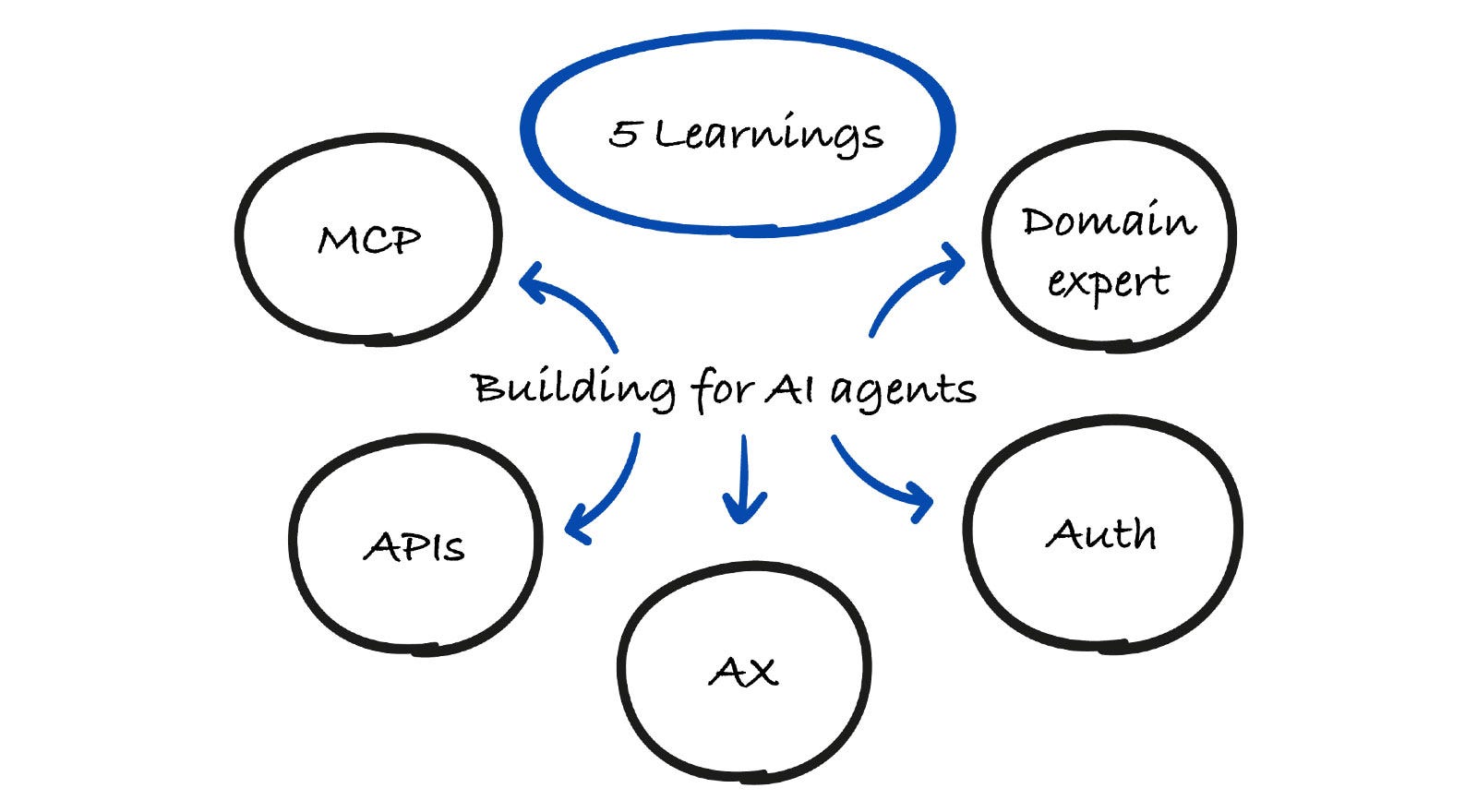
5 Learnings Building Canva for AI Agents
Full recording and insights from the talk from Anwar Haneef, GM & Head of Ecosystem, Canva, at the Engineering Leadership LIVE event in San Francisco.
This week’s newsletter is sponsored by Blitzy.
Blitzy is the first autonomous software development platform with infinite code context, enabling Fortune 500 companies to ship 5x faster from Figma design to production code.
It’s engineered specifically for enterprise-scale codebases due to its deep understanding of your codebase and design standards. This can clear years of tech debt, execute large-scale refactors, or deliver new features quickly.
Some of Blitzy’s core features:
Self-improving knowledge graph: Maps millions of lines of code and their dependencies to create a live understanding of your codebase.
Figma integration: Turns Figma designs into responsive, pixel-perfect frontend code that connects to your backend.3
Agent orchestration: 3,000+ specialized agents plan, build, and validate production-ready code.
Result: 80% of the work delivered autonomously, 5× faster. If you are working on an enterprise-scale codebase, I’d definitely recommend checking them out!
Thanks to Blitzy for sponsoring this newsletter. Let’s get back to this week’s thought!
Intro
Last month, together with my friends from Augment Code, we hosted an event called: Engineering Leadership LIVE in San Francisco. It was a blast, and there were so many insightful discussions we had!
As part of the event, we also had 4 talks.
Gregor Ojstersek, CTO & Author, Engineering Leadership newsletter
Talk: AI-Native Engineering Leadership
Vinay Perneti, VP of Engineering, Augment Code
Talk: We Thought AI Transformation Was About Adopting Agents. We Were Wrong.
Andrew Churchill, CTO, Weave
Talk: What Actually Works: AI Coding Patterns from the Top 1% of Teams
Anwar Haneef, GM & Head of Ecosystem, Canva
Talk: Your Product’s Next User Might Be an AI Agent. What Engineering Leaders Need to Know.
Today, I am sharing the overview and the recording of Anwar Haneef’s talk at the event.
Recording of the talk at the event
You can watch/listen to the talk below, or you can keep reading for the insights.
Let’s start!
The shift from UI to building for AI agents
Canva has recently made a shift from focusing just on UI (user interface), to focusing on building for AI agents.
They introduced various AI features on their platform, they’ve built an MCP Server so that you can search, create, edit, manage assets, and also publish from your preferred interface.
Additionally, they also created (still creating) different AI connectors, so you can use ChatGPT or Claude to start creating a design from the conversation. I believe that’s been a great decision from their side. Embracing the changes, instead of sticking to what used to work for them.
This is a very similar shift to what Salesforce has made. Just Salesforce made it a lot more sensational, with the question: “Why should you ever log into Salesforce again?”.
I wrote about the shift in this article:
Now, let’s go more into building for AI agents.
3 main questions everyone building products is asking these days
Will agents replace my product?
How do I build integrations that agents can find?
Do I build my own agents or become a tool agents use?
At Canva, they focus a lot more on the second question and ask themselves: “How do we ensure agents reach for us?”. Anwar described the reasoning with 3 important shifts they see happening in the industry.
These shifts are:
Behavior shift
Humans browse UIs, agents call APIs. If your value is locked behind a graphical interface, agents can’t find it.
Distribution shift
Agents are the new surface, and you need to treat them as the new first-class citizen.
A similar shift Anwar mentioned was the shift when people started using mobile phones to browse websites and use mobile apps.
The companies that really embraced that change and built their products to have a great experience using mobile phones, won in that era.
Value shift
People pick your product a lot of times for subjective reasons: a beautiful interface, colors, or a friend recommended the product to them.
Agents are objective. They don’t care about beautiful interfaces or colors. They only care if your product can do what it needs to do, reliably at that moment in time. That’s also why domain expertise is really important these days.
With these shifts, and also that the barrier of entry for creating designs has significantly lowered, they want to make it as easy as possible for everyone to create great designs, even outside of their primary graphical interface. That’s where AI agents come in.
Building for this shift, they made a lot of learnings throughout the process. Here are the top 5 learnings from building for AI agents.
1. Treat your MCP setup as a living system
When they built their MCP integration for the first time, they made a lot of mistakes. And the reason was that they wanted to get it out as soon as possible to get to the market quickly and to see what the feedback would be from everyone. This created problems over time when they needed to scale.
That’s nothing new in terms of how software should be developed: Get out the MVP → see if there is traction → improve. What I’d mention is the important part here is to treat building a MCP setup as a standalone product, not a one-time thing.
Anwar mentioned that, especially the hosting decisions, the hosting provider, and how they hosted, became a bottleneck over time.
2. Just because you are using MCP, it doesn’t mean you should neglect your API
MCP is only the surface, and if the underlying API is poorly scoped or designed, it makes it a LOT harder to debug issues. So, they needed to focus on revamping their API design in order to debug issues correctly.
It’s a lot harder to debug MCP directly, and a lot easier to work with APIs, so that’s how they were able to build MCP reliability over time.
The reason is that APIs are deterministic. You send a request, inspect the request/response, log everything, replay failures, and debug. With it, you are able to replicate issues reliably.
MCP introduces another layer. Instead of your application calling an API directly, an LLM decides when and how to use tools. When something goes wrong, it's harder to tell where the issue is: the LLM making a wrong choice, or the issue was with the MCP client, the MCP server, or the underlying API.
3. Agents can be quite picky
The way agents call your service can be quite different from what you originally anticipated. The reason is that the LLMs are the ones that decide the order of calls and how they are going to approach solving your particular request.
And also, as you know, LLMs are nondeterministic, which means that there might be a different output to the same input. You can’t fully anticipate the response.
Anwar’s advice is to treat the Agent Experience as a first-class citizen, and focus on making it as good as possible. Similarly to how User Experience (UX) has been a big focus point for many companies in the past, now Agent Experience is the one that needs the biggest attention.
4. Treat authentication and identification as a first-class product feature
As Anwar mentioned, authentication was a constant friction with every integration across multiple platforms for them. They didn’t treat it entirely as a first-class product feature, and because of that, it was slowing them down.
As a result, they needed to invest more time in their auth setup afterward, and it slowed them down when integrating with other platforms, which would not be an issue if they invested more time into it right from the start.
5. Your product should be a domain expert, not jack of all trades
Agents will look for tools and products that are considered to be “leading experts” in certain areas. If you try to be best at everything, you will likely be best at nothing, and agents won’t even know you exist.
In Canva’s case, they focused on being one of the leading products for design and also optimized the use of their tools for AI agents.
So, the question for you, building a certain product, and want to get recommended either in AI’s output or by AI agents’ default choice:
What is that one thing that your product does really well, which distinguishes it from others, so that AI agents would recommend your product?
The agentic era is the biggest growth opportunity of the decade
Similar to the shift that we’ve seen with mobile and even before, with desktops and personal computers becoming a new norm, the AI era is the next big shift in our industry and can be a huge growth opportunity.
These are the 3 areas that Anwar suggests for anyone to focus on, building a certain product, to be successful at this time:
Make Agent Experience a first-class experience
Don’t try to match the user experience and agent experience, instead, build your product in a way that can be easy to consume and easy to discover by agents.
Anchor bets to observed shifts
Don’t just build for where the market is today, make sure to focus also on where it might be going. Watch how users are adopting AI, how agents are improving, and what new behaviors are emerging.
The biggest opportunities come from identifying these shifts early and building products that align with how people and AI agents will work in the future, rather than simply improving existing workflows.
Invest in your domain expertise
Focus on your differentiation, and ensure that you are focusing on trying to be the best at what you do, not trying to be the best at various different things. Agents always look for specific tools and products which can solve 1 problem really well.
Last words
Let’s end this article with the following:
AI agents are becoming a new distribution channel, and the question is no longer just whether people can find and use your product, but whether AI agents can too.
Special thanks to Anwar for sharing his insights in his talk at the Engineering Leadership LIVE event in San Francisco.
Liked this article? Make sure to 💙 click the like button.
Feedback or addition? Make sure to 💬 comment.
Know someone that would find this helpful? Make sure to 🔁 share this post.
Whenever you are ready, here is how I can help you further
Join the Cohort course Senior Engineer to Lead: Grow and thrive in the role here.
Interested in sponsoring this newsletter? Check the sponsorship options here.
Take a look at the cool swag in the Engineering Leadership Store here.
Want to work with me? You can see all the options here.
Get in touch
You can find me on LinkedIn, X, YouTube, Bluesky, Instagram or Threads.
If you wish to make a request on particular topic you would like to read, you can send me an email to info@gregorojstersek.com.
This newsletter is funded by paid subscriptions from readers like yourself.
If you aren’t already, consider becoming a paid subscriber to receive the full experience!
You are more than welcome to find whatever interests you here and try it out in your particular case. Let me know how it went! Topics are normally about all things engineering related, leadership, management, developing scalable products, building teams etc.