


Senior Engineer to Lead: Grow and thrive in the role (2 days left to enroll)

It’s getting close to the start of the January’s cohort-based course. It’s going to start in 2 days.
In the course, we particularly focus on the development of much needed people / communication and leadership skills in order to grow from engineer to leader.
If you are not enrolled yet, you have 2 days left!
Looking forward to seeing some of you there.
Let’s get back to this week’s thought!
Intro
I’ve done a lot of freelance projects for clients over the years, from building web, mobile and all the way to desktop apps.
That has enabled me to gain a lot of experience in a short amount of time.
I thought about scaling the operations and actually go from me, working on such projects to expanding and creating a service-based company.
But haven’t made that jump and rather focused on progressing in my full-time roles.
For everyone thinking about potentially doing that or you already have a (service-based) tech company, this article is going to be a great read for you!
I recently met with Aleš Čadež for a coffee and we talked about many different things, especially regarding the challenges a company and also engineering teams face when scaling.
I’m happy to have him on as a guest author today. I’ve asked him to share his 5 main learnings on scaling a tech company with us.
Aleš is a fellow Slovene and the Co-founder & CEO of Kaldi → a service-based tech company that builds digital products from discovery to scale.
Let me say a few words about the company before we dive into Aleš’s learnings.
Kaldi went from 5 to 35 people in 5 years
As mentioned above, Kaldi is a service-based tech company from Slovenia and they particularly focus on building products for clients (mostly startups & scaleups).
The company was founded by two engineers, who dealt with the pain points of scaling and in recent years went from 5 to 35 people altogether in the company.
People in the company are in the fields of engineering, product design and project management. This enables them to have all the necessary experts to build products based on the client’s needs.
And building + scaling a service-based company is quite different than a product-based one. It’s a lot less predictable and you can’t just quickly expand the operations.
Now that we know a bit more about the company, let’s get into particular learnings.
Aleš, over to you!
Learning #1: Focus on vision and align strategy to it
Imagine a scene where two engineers who like working on interesting and challenging projects start a business. The only “vision” is to “work on such projects”.
Soon, they have too much work and they hire a couple of colleagues/friends.
Everyone is working hard, coding and building fancy features on projects that “come around”. Recipe for the happy life of a bunch of engineers right?
Not so much.
Soon these questions start comming up:
Why are we doing what we’re doing?
Why work on this project and not on the other?
Should we hire new people or say no to new projects? Ditch existing projects?
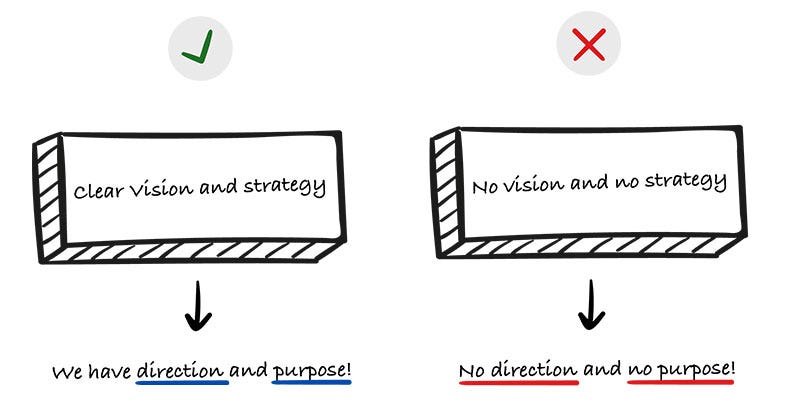
With no vision and strategy, there is no direction and no purpose.
Through the mixture of pure luck and reading a lot of books, we stumbled upon a book “Traction: Get A Grip On Your Business” by Gino Wickman and it’s Vision Traction Organizer (aka VTO) → A canvas for setting the company vision, strategy and short term goals.
It has helped us to make a step forward and finally start thinking about what we’re actually building.
We (two co-founders) spent evenings and weekends thinking and talking about what kind of company we actually want to build.
Once we aligned and wrote it down, it became so much easier to make decisions (still a lot of wrong ones).
Learning #2: Understand & align business goals with clients
No matter how much you want the product you’re building for a client to succeed, being a service-based company, you’ll always be seen as an outsider with different business goals.
That’s why it’s important to find the alignment between you and the client. You can do that in 3 steps:
Understand business goals and limitations of the client
Use the initial alignment meetings to really understand the client and ask the right questions. Try to thoroughly understand their pain points and motivation behind their needs.
That will position you as a business partner that understands the business at the high level.
Communicate your engagement and goals clearly
Make sure that the client understands why you’re going into this relationship and what particular things are you offering. Make sure that the expectations are clear.
Find common goals
When architecting the business relationship, try to find common goals when preparing the proposal. What outcomes are a success for both parties?
Book recommendation for negotiations and finding common goals: “Getting to Yes” by Roger Fisher and William Ury.
