


Senior Engineer to Lead: Grow and thrive in the role (less than 10 days left to enroll)
It’s getting close to the start of the March cohort of the course Senior Engineer to Lead: Grow and thrive in the role. We start on March 11!
Here is what students of the last cohort are saying:

If you wish to learn the competencies needed to grow and thrive in the Lead role (Tech Lead (Staff), Team Lead, EM), this would be a great course for you.
Looking forward to seeing some of you there!
Let’s get back to this week’s thought.
Intro
The number one misconception that people may think is that adding new people to the team will make the progress linearly better.
I’ve formed and scaled many different teams and orgs and it’s never been the case where adding a new person or a new team would increase productivity relative to how many new people we add.
Especially not in the beginning, but with the right approach we can optimize the productivity and ensure that with every new person and the team that we add, there will be increase of business value.
Things that help with this the most?
It’s all about creating a good culture, inspiring teamwork, creating a good onboarding experience + empowering and uplifting your people.
Lucky for us, we have Chaitali Narla with us today as a guest author.
She is a former Engineering Director at Google and today, she is sharing the lessons learned when she was tasked at Google to set up a whole new global org.
Let’s go straight into it. Chaitali, over to you!
In January of 2020, I hit an exciting milestone
My leadership gave me the green light to hire and grow a team of 30 in Bangalore, India.
Until then, I had only led a team on the US West Coast and I felt excited to learn how to build and manage a team in another country.
I did my homework to prepare for this opportunity → I talked to my coach, got mentorship from people who had done this before, and read recommended books.
A month later, I had to make my own playbook.
No one had done what I was about to attempt: building a new team halfway across the world during a pandemic. Everyone was working from home, and travel was impossible!
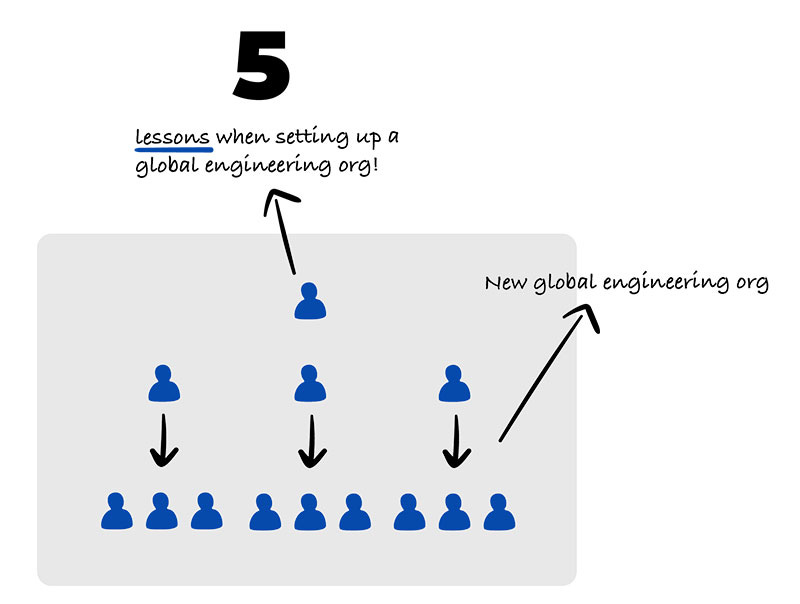
Today, I’ll share five lessons for leaders of global organizations.
Lesson 1: Create moments
I really like the Heath Brothers' books, especially The Power of Moments. This book explores how short, intense experiences can surprise us, lift us up, and even change who we are.
I doubted that the usual "assign a buddy" system would help our new hires ramp up while working from home during the pandemic. Especially when their buddy would be in a timezone 12 hours away.
We made a list of starter projects for each quarter, then we paired every new hire in India with an experienced engineer from the US. Working together on projects this way created stronger moments of connection between them.
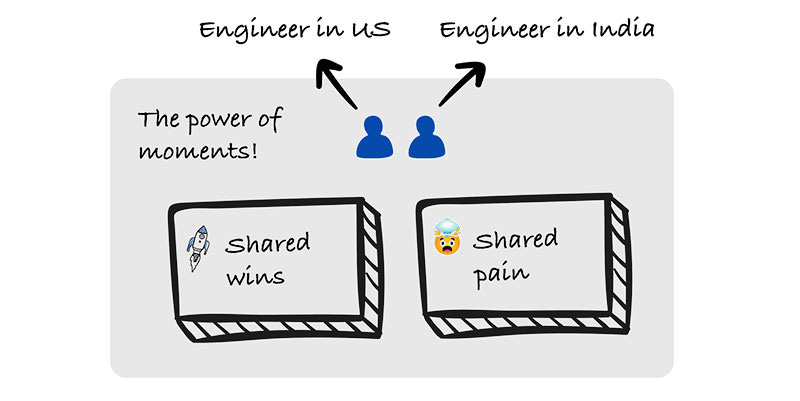
Another example was creating moments of shared pain. We changed the team meeting time each month → This way, everyone could feel how tough it was to meet late at night or early in the morning.
This built shared pain and empathy, leading to stronger bonds between both teams!
Lesson 2: Repetition builds culture
A great team builds culture through repetition.
As a leader, you need to know what ideas you want as the foundation of your culture, then you need to find many everyday moments to say or show those ideas.
I realized early that to build an inclusive culture in my organization, we needed to change some practices from optional to necessary. Hand raises in video calls and notes shared after meetings were two practices.
For a year or more, I asked for hand raises before speaking during meetings and I also requested written notes after each meeting.
Another investment I made was doing frequent small group coffee chats.
Keeping the group small → no more than 20 people, was key to fostering open dialogue. We rotated the timings for these as well to give everyone in the US and India equal opportunity to join. These chats were another channel to cultivate team culture.
I began using “our global team” for the whole organization and for specific areas, I'd say “the US team” or “the India team”. This was instead of “the remote team” or “the offshore team”.
Others caught on to this lingo, and it became part of our team culture over time!