


Intro
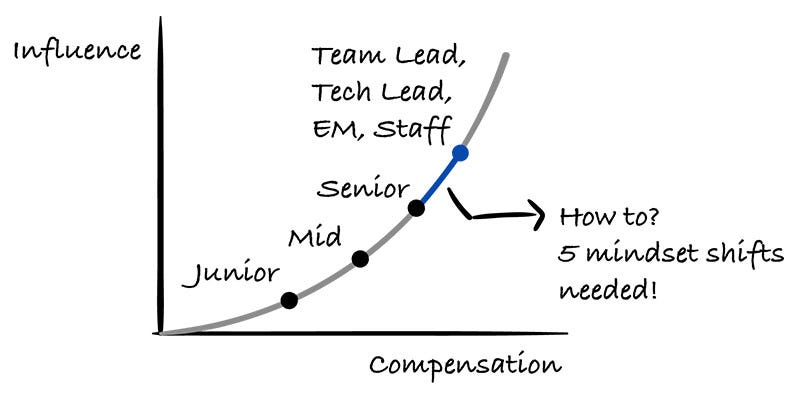
Growing from an engineer to a lead role requires a mindset shift.
You become a multiplier for the team and helping others around you becomes one of the main priorities.
You are not judged by your individual contribution anymore. The overall success of the team and projects is what becomes important.
Lucky for us, we have Gábor Till with us today as a guest author. He grew from an engineer to Lead Engineer and then to Engineering Manager in his career in the engineering industry.
Gábor will be sharing 5 mindset shifts needed in order to grow from engineer to leader and most importantly become a leader that everyone appreciates.
Let’s go straight into it. Gábor, over to you!
I believed that if I was good at coding, architecture, and problem-solving, then leadership was the natural next step
I thought that being a leader would be easy. I’d simply tell others how to solve these problems.
That was a huge mistake.
As engineers, we work with structured tasks. Our to-do lists are full of clear action points: develop a feature, fix a bug, review a pull request. Every task has requirements and acceptance criteria.
But when I became a manager, my to-do list changed. Suddenly, my work was no longer about writing code, it was about making sure the team worked efficiently, that people felt safe, and that collaboration was smooth.
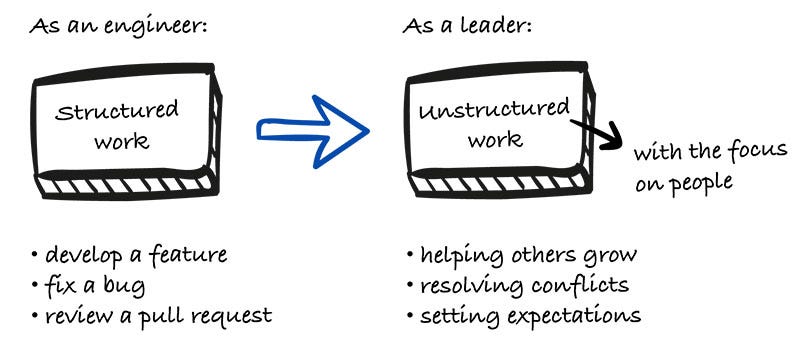
My daily responsibilities shifted to helping others grow, resolving conflicts, setting expectations, and making decisions with incomplete information. The work became less about technical challenges and more about people.
I quickly realized that my technical skills, once my most valuable asset, were now the least useful tool in my new role.
Whatever kind of leader you want to be → team lead, engineering manager, staff engineer, or something else, you need to understand this:
Tech leadership is more about people than technology.
Being a great engineer won’t automatically make you a great leader. But in this article, I’ll show you what you can do to bridge the gap → the mindset shifts needed to thrive in the role!
Let’s go straight into the first one.
1. Focus on enabling others first instead of you solving problems yourself
As engineers, we’re wired to solve problems. We analyse issues, break them down, and come up with solutions. You’re probably experienced enough to provide quick answers, but one of the worst things you can do is jump in and fix everything yourself.
This is a mistake many engineers-turned-managers make, and I was no exception. Early on, when junior engineers struggled, I would sit down with them, discuss the problem, and immediately rewrite their code. Problem solved, right?
Not really.
My role in these situations should have been to guide them through the process, asking the right questions and answering them in a way that helps them find a solution. In short, to help them develop problem-solving skills.
Instead of teaching them, I sidelined them. Even though I explained what I was doing, the team saw me as someone who would take over instead of guide them.
One of the biggest mistakes I made was when stress from an approaching deadline got to me. I reviewed a feature a junior had written and, in front of the whole team, said, "This code is crappy."
The room went silent.
I had crushed the morale of an engineer who was doing his best.
Shift in mindset
As a leader, your job is to develop people, not just software. Instead of solving problems yourself, guide your team to find solutions.
Ask questions like:
What have you tried so far?
What options do you see?
The key is to encourage them to think critically instead of waiting for answers. Pair-programming, asking questions, and treating them as equals will build their confidence and skills over time.
2. Stop assuming everyone thinks like an engineer
As engineers, we rely on logic, data, and structured decision-making. But leadership isn’t just about engineering, it involves product managers, designers and business stakeholders, all of whom think differently.
Early in my career, I got frustrated when non-technical stakeholders didn’t understand why a feature took longer than expected. My default response was to explain it in technical details.
I talked about architectural constraints, API limitations, and database bottlenecks. To me, it made perfect sense. But to them? It was a cryptic language.
I still remember complaining to my engineering colleagues, saying, "These people have no idea what we’re doing!"
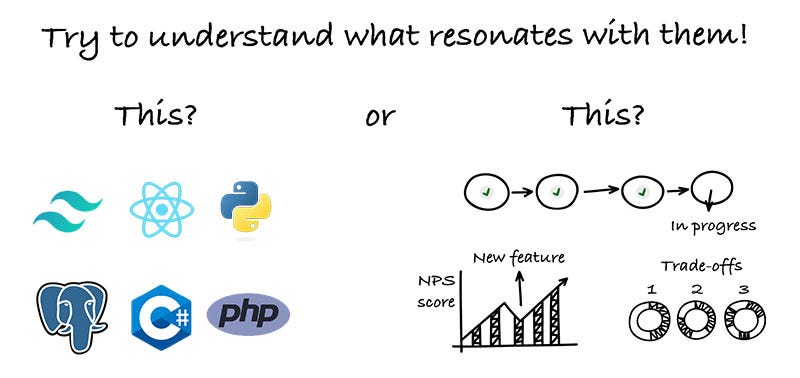
Looking back, I realize how immature that was. The product team didn’t need to understand the tech stack. They needed a simple, clear explanation of trade-offs and timelines.
Shift in mindset
Learn to communicate based on your audience.
When talking to engineers, provide technical details. When you're talking to executives or product teams, focus on impact, trade-offs and timelines.
Another great technique is storytelling.
Instead of dumping data, frame it as a story:
"Remember the last time we rushed a feature and had to spend two sprints fixing it? If we take an extra sprint now, we can avoid that."
This makes technical decisions easier for non-engineers to understand.