

Intro
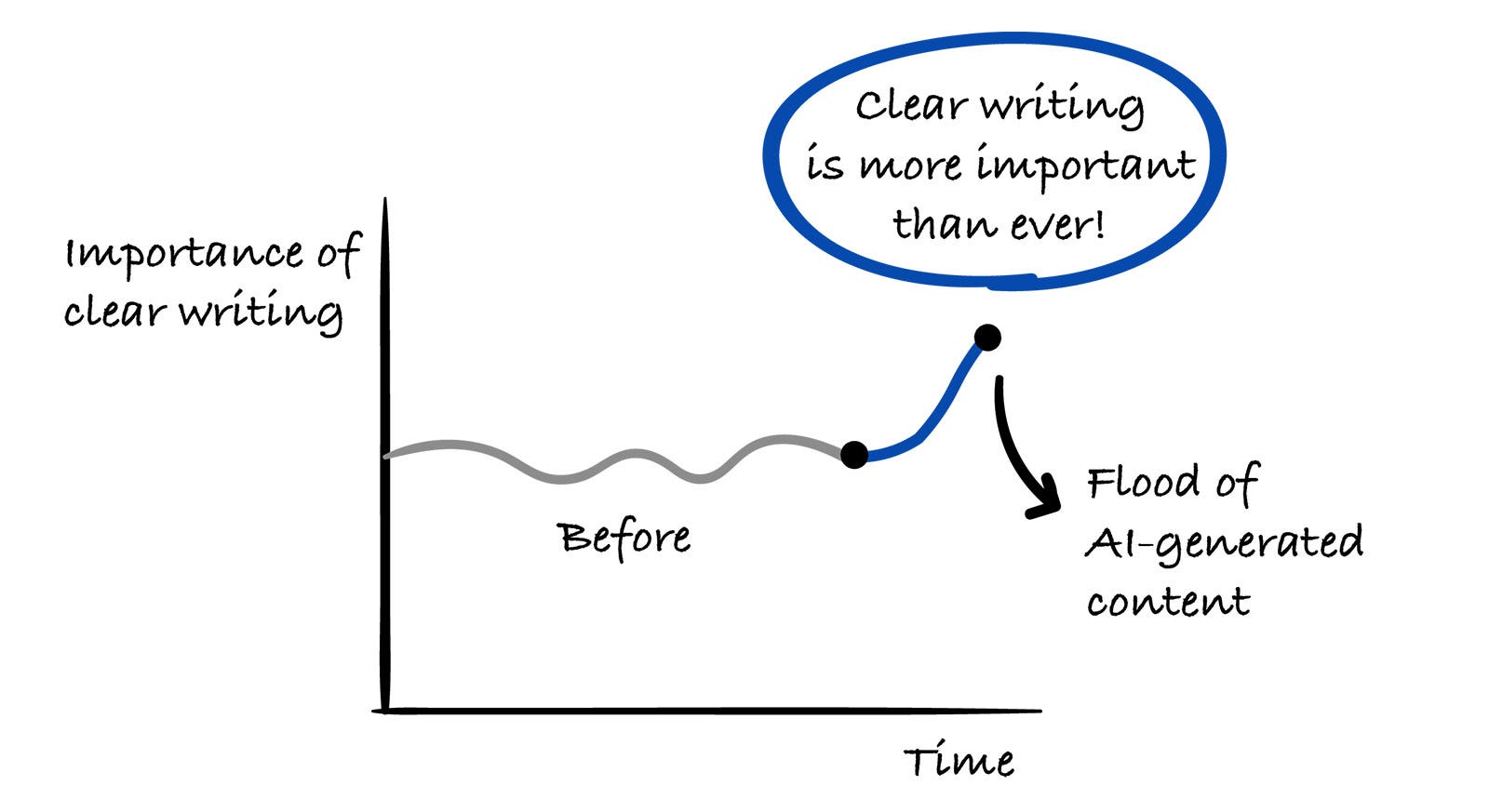
If you go on any social media these days, you can quite quickly spot AI-generated posts or comments, and it’s really becoming frustrating. As soon as I see that, I immediately go to something else, and I lose a bit of credibility for that person.
And it’s the same with AI-generated emails, messages, articles, or even ADRs and tech specs. While there is certainly a time and place where AI-generated writing makes sense, the problem comes when people expect to read human, thoughtful writing, but instead they get AI-generated text, with no substance.
Imagine asking a question to your colleague, and they just copy & paste an AI-generated response, without even taking the time to edit it. It’s very similar to just submitting a PR full of AI code slop, without taking the time to edit, and putting all the work on reviewers to try finding the issues.
In today’s article, we’ll go through why AI-generated writing is problematic, its use cases + how you can write clearly, develop your own style, and communicate in a way that gets the response you’re looking for.
This is an article for paid subscribers, and here is the full index:
- Why is AI-generated writing problematic?
- Another example, the problem with AI-generated code
- AI is not the issue, the issue is doing “half-done” work
- AI-generated writing is fine if the expectation is aligned with that
- Brevity is more important than ever
🔒 How to write clearly?
🔒 Develop your style of writing
🔒 Know your audience
🔒 Different tips and tools that can help you
🔒 Last words
Let’s start!
Why is AI-generated writing problematic?
As mentioned a bit in the intro, it’s not that AI-generated text is problematic by default, the problematic part is the misalignment between expectations.
Here is a good example:
You go to the cinema to watch a new movie that has been advertised as the “next must-see movie”, and you have high expectations of it. Great story, thoughtful scripts, great cast, etc. You are excited.
But then the movie starts, and things go sideways quickly. Generic story, generic graphics, generic cast, etc. The movie was actually AI-generated. What are your thoughts?
You are not happy about it because your expectations were different.
And it’s very similar with AI-generated emails, messages, blog posts, etc. You get a bad taste in your mouth if you expected to read thoughtful writing, while in reality you read AI-generated writing.
Let’s go to another example that I regularly see being problematic, especially for engineers who are reviewing code.
Another example, the problem with AI-generated code
What I am seeing and also hearing happening regularly, especially with less experienced engineers, is the following:
They are assigned a task, and they use a certain AI coding tool, use their agent mode to finish the task, and then they don’t go the extra mile to actually understand what has been changed and ensure the changes are made within the guidelines of the codebase.
They open the PR, and because they didn’t actually take the time to read and edit the code, this puts a lot of pressure on reviewers to find all the mistakes and completely shifts the work on them.
There may be a lot of comments on PRs, and it takes a lot of time to review correctly. And even in some cases, engineers give up and just approve the PR, which makes things a lot worse in the long run.
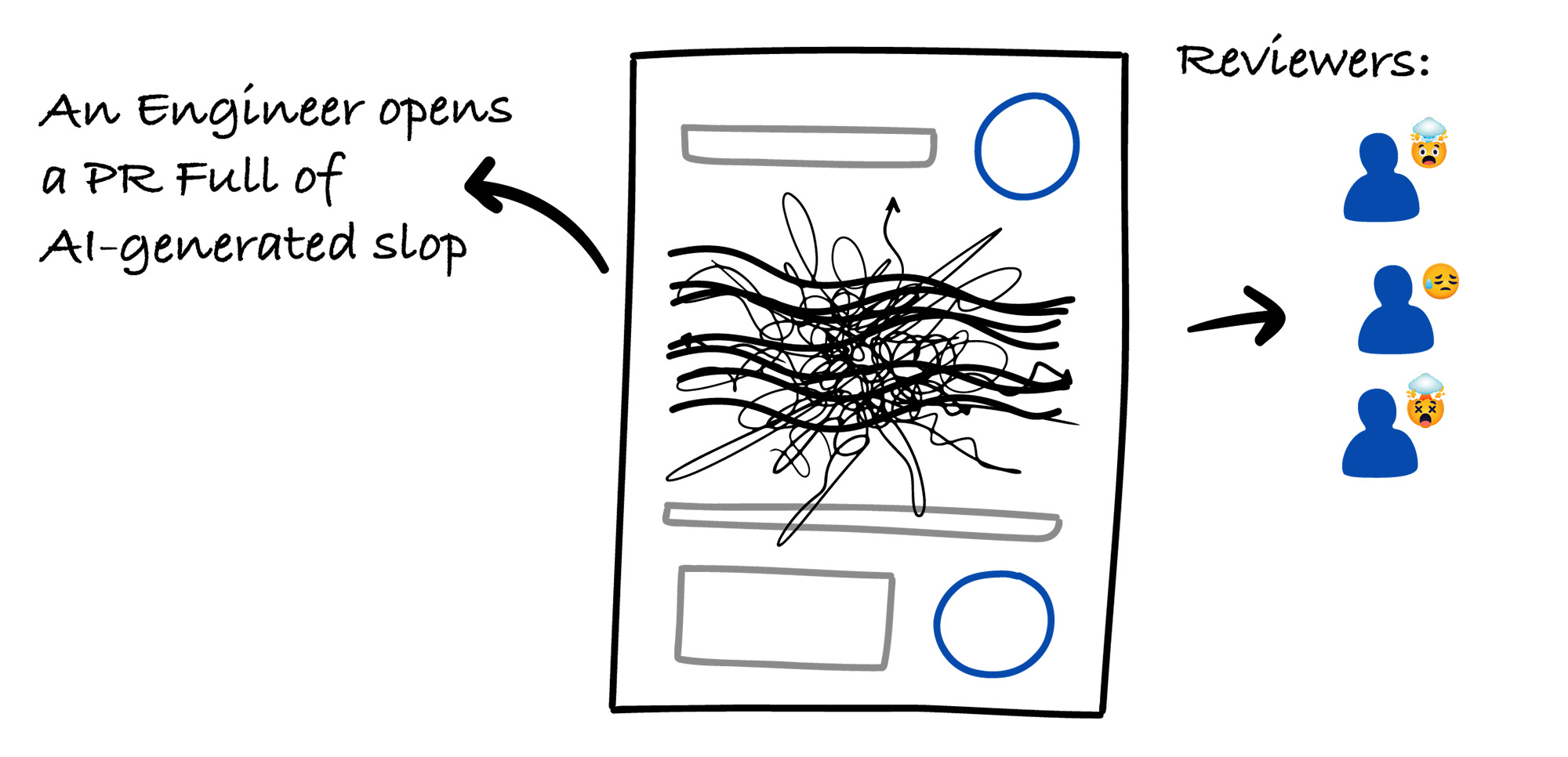
For me, personally, if I see a PR opened full of AI-generated slop, that particular engineer would lose a lot of credibility in my eyes. Or even worse, if they mention that the mistake is there “because of AI”.
Every good engineer should know and realize that overall accountability is on them to ensure that good-quality code is delivered and not look to shift the accountability elsewhere.
Of course, I get it, we all make mistakes, but at the end of the day, submitting a full PR of AI-generated slop or blaming AI for a mistake is not a good look.
AI is not the issue, the issue is doing “half-done” work
This is the core message that I want to get across in this article.
As soon as you send a message or open a PR where you just copy & paste the first AI-generated output and didn’t actually take the time to ensure it’s done to the correct quality, you lose credibility.
Even if you don’t receive the feedback directly, you are going to be perceived differently, and if you do this for a longer amount of time, you’ll end up having a bad reputation, which can be quite problematic, especially these days with a lot of layoffs happening across the industry.
So, always ask yourself, am I doing the work that is perceived to be good quality? Or am I just doing the minimal effort work?
If you’re doing the second, it’s time to really reconsider your priorities. Your reputation is one of the most important things, and how people perceive you really goes a long way.
Now, let’s get to an important point, where AI generated writing is totally fine.
AI-generated writing is fine if the expectation is aligned with that
There are definitely use cases where AI-generated text is fine, like, for example, if everyone is aligned that the tech spec or ADR will be fully AI-generated, and you keep improving it with prompts.
Additionally, if there is a clear PR template prepared, where everyone generates the description with AI, that’s totally fine as well.
But the problem comes when you’re trying to share AI-generated writing masked as your own. Like responding to PR review comments with AI, or responding to Slack messages with purely AI-generated text.
Or even writing full blog posts, articles with AI, that’s fully unacceptable from my perspective. Maybe some people would read it, but me, I won’t.
That’s also the reason why all the articles on this newsletter are going to be written in my style, which I developed in close to 4 years of writing online.
Now that we understand where AI-generated text is fine versus not, let’s go through the importance of clear writing and brevity.
Brevity is more important than ever
What brevity means is to use the right amount of words (no fluff) to communicate an idea clearly. It’s being concise and clear with your written communication.
It means that you can put yourself in the shoes of your reader(s) and write it in a way that resonates with them.
Brevity is a sign of respect for the reader’s time.
This is the post that I posted on LinkedIn earlier this week, which shares an example of brevity (from 2014):
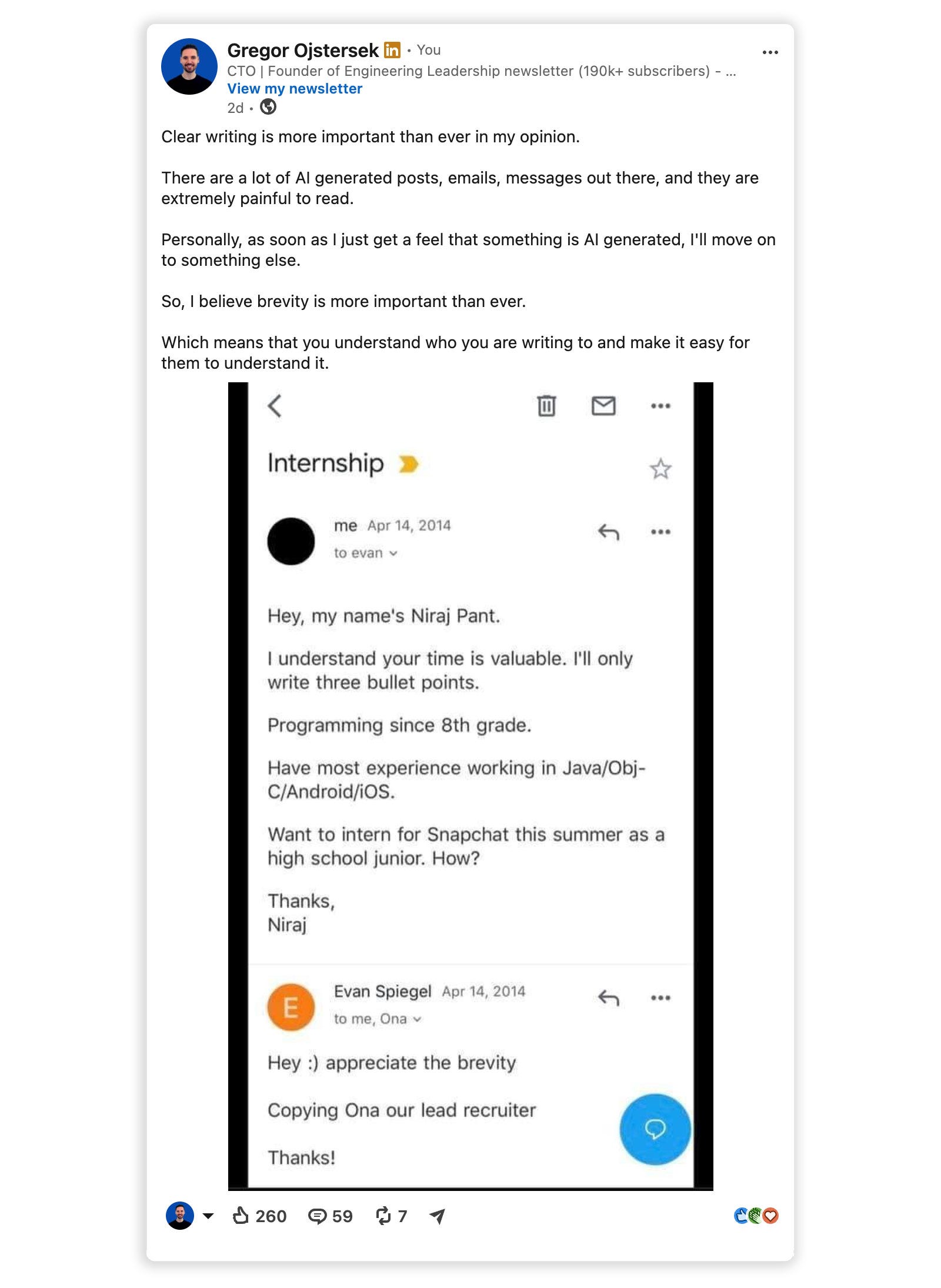
In this situation, it worked. Niraj got the response from Evan, which resulted in a positive one.
What’s important to mention here is that I wouldn’t bet on sending a cold email like that in 2026 and expect to get a similar response.
A lot of people, especially recruiters or hiring managers, have already seen this before (as it’s been quite a popular picture shared across social media in recent years). And it’s a bit of a cliché.
But what’s important is that it worked for Niraj back in 2014. And that’s how you need to think about writing.
Ask yourself: How can I write in a way that would get me the desired response?
This is the art of brevity. Knowing who your audience is and how to frame it in a way that would resonate with them the most.
Let me share some examples and tips for clear written communication next.