


Intro
I’ve been actively posting on LinkedIn for 2.5 years now → I started very simple, with 2 posts/week and as I got more comfortable, I increased the cadence, which I now post daily.
It has given me so many opportunities that I wouldn’t have imagined it to be possible 2.5 years ago. From meeting like-minded people like John Crickett, Jordan Cutler, Caleb Mellas, Daniel Moka to name a few.
To public speaking opportunities in San Francisco, Amsterdam, Katowice and Gdansk. And all the way to different full-time/fractional opportunities being offered to me, just because people found my posts to be insightful.
Lucky for us, we have John Crickett today with us. He is a seasoned engineering professional who has worked both as a senior IC (Staff+) and a senior manager (VP, Head of Software Development).
He is going to be sharing how to stop being invisible and be able to get opportunities on LinkedIn. This is going to be a 2-part article and the second part will be shared next week on Sunday.
I have known John for a while now and we did a number of different collaborations together, including he’s been a guest author on this newsletter 3 times already!
Here are the articles we did together:
Become the engineer everyone wants to work with (paid article)
12 ways to become a CTO (paid article)
Become a better engineer by working on side projects (paid article)
And now, I am happy to have him on for the 4th and the 5th time.
John, over to you!
In March 2022, I accepted a new job → they found me through LinkedIn
I’ve been on LinkedIn since May 2003 and it’s been a great way to network and keep in touch with past colleagues, but this was the first time a recruiter had found me, though it looked like I’d landed a dream job.
I was going to build and manage a growth engineering team - combining my interest in software engineering with my interest in marketing.
Sadly, it turned out that a dream job was just that, a dream.
By the time I started the role in May 2022 the world had changed, layoffs were sweeping the tech industry and it was clear the new organisation was facing the possibility of layoffs too.
By July 2022 I knew it was a case of when, not if.
So excited by the ease with which I landed a dream job through LinkedIn - just by being on it - I started looking again, but things had changed.
Fortunately, the value of a good network hadn’t and by the time I knew I was being laid off, I had a new role more or less lined up.
That’s when I knew I needed to take LinkedIn more seriously
Reminded once again of the power of networking and the global reach of LinkedIn I knew I needed to take it more seriously. I started checking it every few days and making the odd post and a few comments.
By February 2023 I’d begun to see that posting led to attention and facing the upcoming end of the contract I was in, I began to post more frequently. Then in March 2023 I went all in and committed to writing daily.
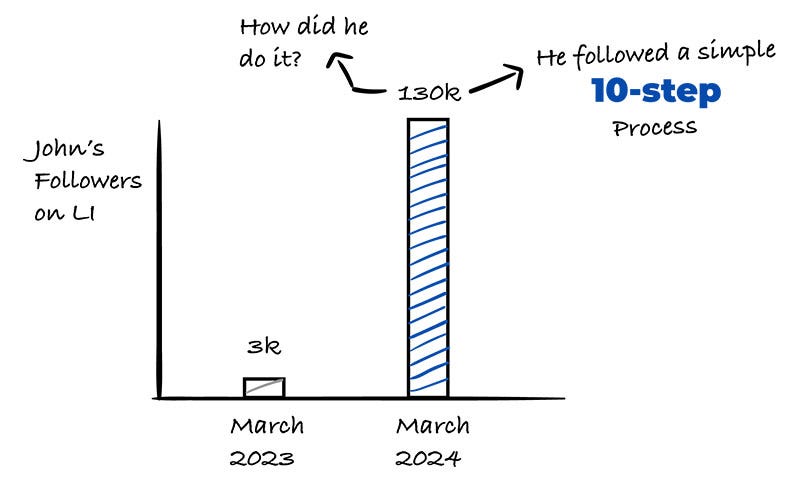
I was going to turn my 3k followers into a way to get opportunities to come to me!
12 Months later, in March 2024 I had over 130,000 followers on LinkedIn.
I’d launched the Coding Challenges newsletter and grew it to over 40,000 subscribers and I had lots of inbound opportunities.
So how did I do it?
I followed a simple 10-step process. Note the process is simple, following it isn’t always easy, it requires discipline and the willingness to show up every day consistently accepting that this is a long game (months to years, not days to weeks).
Let’s dig into the process now.
Step 1 - Determine your goal
If you want to succeed at anything you need to know what success looks like.
I began by figuring out what I wanted to achieve. I suggest you take some time to do the same.
Your goal might be to:
Be approached by recruiters and hiring managers looking to fill roles (contract or permanent).
Position yourself as an expert consultant to gain clients for your existing or new consultancy business.
Build an audience for a startup you’re involved with.
For example, I started out with a desire to build a personal brand as a software engineer that would help me find new opportunities for work. That could be that permanent, contract, consultancy or starting a new business - I didn’t know which it would be.
I was vague, a better example would be:
My goal is to build an audience of software engineers who want to improve their technical skills, learning how to build systems software via live training courses.
Whichever it is for you, think carefully about how you can make it more specific. The more focused you can be the easier it will be to build a personal brand that works for you.
Step 2 - Identify the relevant audience
Once you have a goal, you can use that to determine who you need in your audience to enable you to achieve your goal.
To do that we’re going to identify your Ideal Audience Profile (IAP), using these three approaches:
Use your existing audience
You already have an audience on LinkedIn, look at who they are and look for any patterns.
What do they have in common?
What are their demographics?
Can you identify members of your audience who are most engaged in what you have already written and shared?
Carry out market research
Look at other people in your niche and see who they are reaching and why there is a fit. Look at the creators your existing audience is following and engaging with and dig into their strategies.
What are they writing about?
What products or services are they offering - does it suggest they’re pursuing the same or a different goal to you?
Based on the data and research, define the key characteristics of your ideal audience.
This may include demographic information such as age, gender, location, income level, or for B2B customers it can include firmographic details like company size, industry, and revenue.
Once you have this information to create a profile of your ideal audience. You can then use that to create some personas that describe the person (or persons) you are writing to.
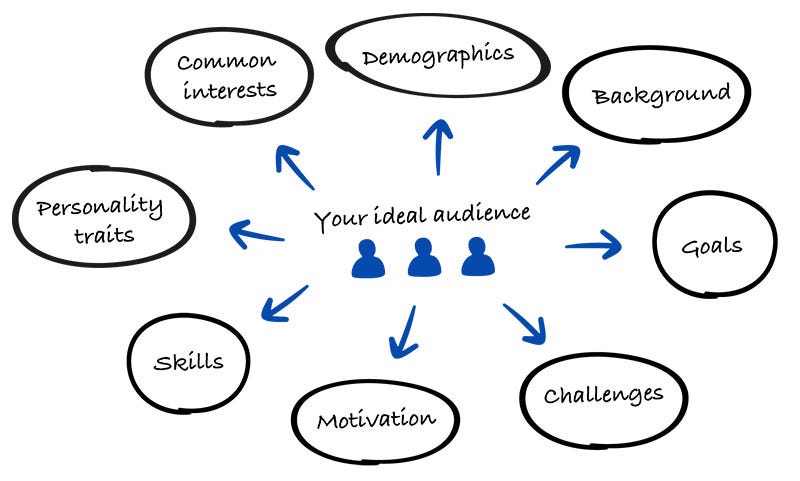
A personal might look like this:
Name - Senior Engineer, UK.
Demographics - 28+, 50k+, outside London.
Background - Senior level software engineer with a Computer Science degree.
Goals - Personal - promotion and pay rise. Professional - remove friction from delivery.
Challenges - Learning new skills.
Motivation - Improve their quality of life, start a family. Make their work life better.
Skills - Experienced Python developer.
Personality traits - Quiet, probably introverted.
Common interests - Python, TDD, DevOps.
Common complaints - Meetings, things that slow them or their team down.
What can I do - Share lessons from my past experiences.