


Join live webinar hosted by DX (Sponsored)
Setting targets for developer productivity metrics takes careful consideration: in some cases, setting the wrong goals can backfire by creating unintended consequences.
Teams might start focusing on optimizing the numbers instead of the system, and it can be difficult to figure out what kind of targets are realistic in the first place.

Join Abi Noda and Laura Tacho, DX CEO and CTO, for a discussion about how to properly set targets for productivity metrics, so you can continue to push for both improvement and accountability from your own teams.
You will learn:
How to think about potential pitfalls, like Goodhart’s Law and Campbell’s Law, and spot them in your own metrics
How to set goals at different levels: frontline team, group, and organization level, and what realistic targets can look like for your team
Real-world examples of good and bad approaches to setting goals and targets for productivity metrics
The live webinar will be on Mar 24, 8:00am PST / 4:00pm CET.
Let’s get back to this week’s thought!
Intro
Being active on LinkedIn has shown to be one of the best decisions I have made. As I mentioned in the previous article, I’ve been able to get SO many different opportunities because of it.
So, that’s why you shouldn’t neglect it and focus on improving it as much as you can.
It will pay dividends in the long run and especially in the current market, it’s really important that you stand out in a certain way.
Lucky for us, we have John Crickett today with us again for Part 2 of how to stop being invisible and be able to get opportunities on LinkedIn.
John is a seasoned engineering professional who has worked both as a senior IC (Staff+) and a senior manager (VP, Head of Software Development).
Fun fact! I met John via LinkedIn more than 2 years ago → it was when we both were just starting with our LinkedIn journeys and writing online.
We helped each other with advice and support and did many collaborations, including 4 of the articles together and many other online events.
Who would know that LinkedIn can help build such great partnerships and friendships!
Here are the articles we did together:
Become the engineer everyone wants to work with (paid article)
12 ways to become a CTO (paid article)
Become a better engineer by working on side projects (paid article)
From invisible to in-demand: LinkedIn for engineers and managers Part 1
And today’s article is the 5th one!
Steps 1 to 5
Make sure to also read the first part, where we define how to start with LinkedIn and how can you prepare your profile and your overall LinkedIn journey for success.
You can read the article here:

And now, we are diving deeper into writing content, the overall structure and how to engage with people.
John, over to you!
Step 6 - Share original content that resonates with your audience
The core of building an audience and personal brand on LinkedIn is writing.
You can write posts, comments, articles and newsletters. The first two are the most important.
In this section, we’ll focus on posts because they are the best tool for you to get your views, experience and expertise in front of your ideal audience.
What to write
The first step is to decide what to write about.
There are three broad approaches you can use to help you decide:
Use your niche, ideal audience profile and personas. Pick topics that will resonate with them.
After you’ve done identifying your ideal audience, you can also look at what content is resonating with your ideal audience to get inspiration. What are they liking and commenting on?
Leverage your expertise, experience and insights. Tell your stories and share the lessons you learned from them.
Then you have to start writing. This can seem daunting at first, particularly if you’re not used to writing content for public consumption.
What follows is a guide to help you get started producing content.
How to write
Rather than face a blank page, work through the following to help generate some ideas.
As you’re doing that, note down the ideas - they will give you a starting point for future writing.
There are three broad approaches you can use for your content. They are:
Sharing your expertise - write about what you know and what you did.
Learning in public - write about your journey and share what you learned on that journey.
Sharing and summarising other people’s expertise - write about what someone else (with expertise or experience) did.
Your content can also fall under the following two categories:
Educational - you’re teaching people.
Entertainment - you’re entertaining people.
Finally, you can also write content that is:
Actionable - specific advice that they can implement immediately to see a result.
Analytical - you’ve dug into some data and figured out what it is telling us.
An inspiring story - you’re telling a story that can inspire us.
An educational story - telling a story that educates us, we learn what someone did and what happened as a result.
Structuring your post
A great way to simplify the process of writing a post is to have a clear structure to work with. Fortunately, there is a simple structure that works for posts on LinkedIn.
Each post should consist of two core elements: the headline (also often referred to as the hook) and the body, followed by an optional call to action (CTA).
That looks like this:
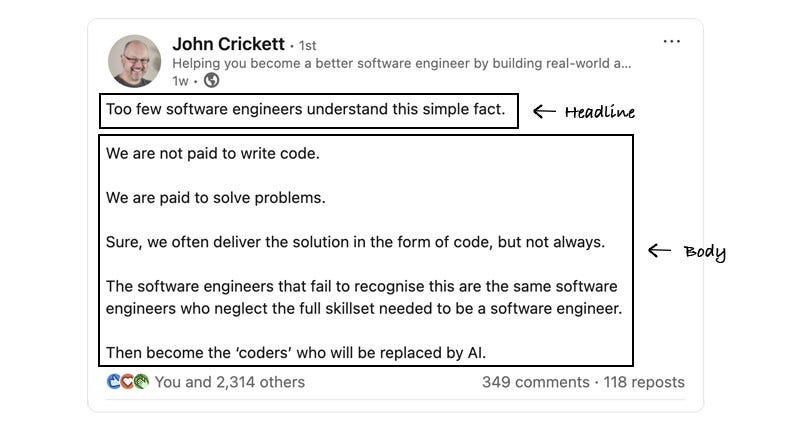
Headline - Why you should read this post right now!
The body is where we fulfill on the promise made in the headline by:
Explaining why the post matters.
Outlining the problem behind it.
And a solution to the problem.
Now, take this structure and write your own post!