This newsletter is sponsored by Unblocked.
[Webinar] How to stop babysitting your agents
Agents can generate code. Getting it right for your system, team conventions, and past decisions is the hard part. You end up wasting time and tokens in the correction loops.
More MCPs, rules, and bigger context windows give agents access to information, but not understanding. The teams pulling ahead have a context layer to give agents exactly what they need for the task at hand.
Join live on Sep 2 (FREE) to see:
Where teams get stuck on the AI maturity curve and why common fixes fall short
How a context layer solves for quality, efficiency, and cost
Live demo: the same coding task with and without a context layer
Thanks to Unblocked for sponsoring this newsletter. Let’s get back to today’s thought!
Intro
This is something that has been on my mind for quite a while now. It seems like everything these days revolves around “AI”, “AI tools”, “AI productivity”.
“You need to use this AI tool”
“You need to be using this AI workflow”
“Your engineers should be 2x, 5x, or even 10x more productive with AI”
And I get it. AI is changing how we build software, and I use AI tools myself every day as well.
But we’re focusing too much on AI tools alone and not enough on the environment in which the tools are being used. Because there’s something a LOT more important than AI tools, and that’s a great culture.
Throughout my 13+ year career in the engineering industry, I’ve seen both the negative effects of bad culture and the positive effects of a good one. I even felt it myself as an engineer and an engineering manager, when departments spent whole days blaming each other for problems.
So, I am a big believer that everything starts with a good culture, and I’ll tell you all about it in this article.
Let’s start!
"This is very easy to build now that we have AI, and we don't need as many people"
This is a sentence that breaks a good culture and makes people believe that their job is not important. Especially if it comes from an executive, e.g., a CEO, CPO, or even worse, a CTO.
The problem with it is that it totally decreases psychological safety, and everyone starts wondering whether they'll still be needed or not.
But here is an important thing that many people forget:
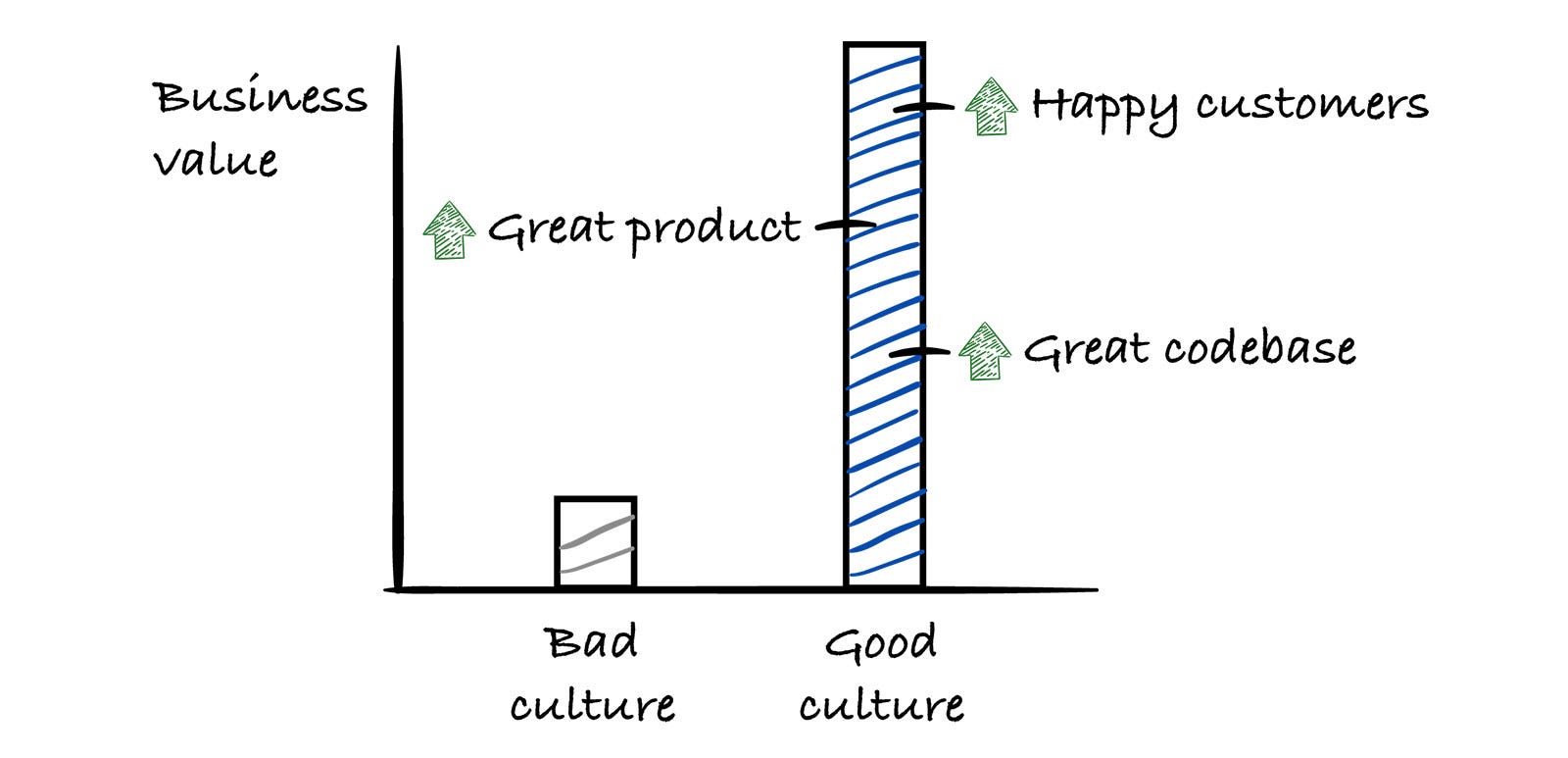
There is no better productivity hack than a great culture. No AI tools will provide bigger productivity gains.
I’ve unfortunately seen and heard this sentence quite a few times, either directly or from an engineer or engineering leader who has reported that to me.
I think things have gotten a bit better this year, but in 2025 and in early 2026, I heard this many times.
Let’s go more into why this is really problematic.
Without good culture, everything else won’t work well
Many executives believe that AI will just magically increase the productivity of everyone. But the reason that often doesn’t work is Conway’s law. It states:
Organizations which design systems (in the broad sense used here) are constrained to produce designs which are copies of the communication structures of these organizations.
I mention this law quite a lot in different articles, because it’s just so important. And the reason why it’s particularly relevant in this case is that the overall productivity and the “end product” mimic the overall culture of the organization.
If the culture is bad, the end product will be bad as well, because people just don’t work together well and they don’t communicate properly. But if the culture is good, then often the end product will be good as well.
So, you should always think about good culture as a prerequisite for everything else. And I like to make an analogy to what health is to us, humans. Without health, we can’t do anything else well.
And the same is true for organizations with bad culture, everything else won’t be good as well.
“Other companies are 10x more productive by using this AI tool”
Now, here comes the problem that many people fall into, especially CEOs and other executives. They see either a competitor or some other company reporting 10x higher productivity using a certain AI tool.
They start to panic, they start feeling FOMO (fear of missing out), and they start blaming people around them: “Why don’t we have that same amount of productivity as well?”
A lot of the CEOs are unaware of what kind of problems this may bring. Especially to the culture of the organization. When you start actively “blaming”, it shows to everyone that they are not doing their job well, and that you don’t trust them to make good decisions.
And this especially falls hard on engineers and engineering leaders, as they are often viewed as people who should be initiating AI adoption.
What many CEOs don’t realize is that a lot of the “reporting” of AI increasing productivity by 10x is more or less selling a certain AI product, or a certain partnership where they are promoting the other product.
So, many of the CEOs fall for the trick and make their company culture a lot worse.
My recommendation: Always take a look at what the incentives are behind people saying something, that says a lot about whether it’s true or not.
AI makes good culture even more valuable
Here is another really important point, and many people seem to forget it. As we mentioned, good culture is a prerequisite for everything else. But when it comes to AI, it amplifies everything you already have.
So, both AI and good culture go hand in hand really well together. AI makes bad communication even worse, it also makes bad architecture even worse as well.
But if you have a good culture and good architecture, people will be more productive because they will help each other, and AI will also have a better blueprint of what good looks like because of good architecture.
Always keep this in mind. Just starting to use AI for everything just makes things worse if you don’t have good processes, architecture, and people don’t work together as a team.
Everyone just goes in the wrong direction faster.
This is my recommendation for building a good culture
If you’re wondering whether you have a great culture inside your team or organization, here are some useful questions to answer:
Do people know what they are responsible for?
Can they make decisions without unnecessary approvals?
Do they feel safe challenging leadership?
Do teams trust each other?
Are priorities clear?
Can people disagree constructively?
Do we reward outcomes?
Do people understand why they are building something?
Do we learn from failures, or do we look for someone to blame?
If the answer to these is “Yes”, then you are on a good track to have a good culture. Additionally, here is my personal checklist that I look at when doing an assessment of a certain engineering culture:
Checklist for a great engineering organization
You can find my full checklist for assessing whether a certain engineering organization is great or not.
You can use the same checklist in your case as well. This checklist provides you with a guide on what you should focus on in order to create a great engineering organization where everyone can thrive.
It works for organizations with multiple teams or smaller organizations. You can also use this for a specific team that is part of the bigger organization as well.
Paid subscribers, you can get it here: 🎁 Products for paid subscribers.
Additionally, take a look at how I do a full engineering organization audit in this article:
Now, let’s go to a very important thing next. How to actually message AI adoption correctly, so that you keep a great culture and have everyone excited about using AI tools.
How to correctly message AI adoption
The best messaging I saw (and has worked well) is the following:
What great engineers and engineering leaders do is learn and utilize all different tools that help them do the work better. This hasn’t really changed.
AI is like any other tool that has come out over the years. Use it in your favor to help your team, organization, and the business. That’s what great engineers and engineering leaders do. And it hasn’t changed with AI.
Don’t ever mention something even close to “replacing” or something along the lines of “You are not important anymore, because we have AI”. Those are just going to completely diminish morale and break the entire culture.
When it comes to AI adoption, it only works bottom-up, it never works top-down, and the reason for that is that things are changing so fast, new AI tools are coming out every day, and there needs to be constant exchange of knowledge between everyone.
Always keep this in mind. Trying to “force” people will only result in bad outcomes.
Many people believe that AI adoption happens just by introducing a new tool, and people will just magically become 2-5x more productive. Well, it doesn’t work like that.
AI adoption is not a tooling problem, it’s a leadership problem.
And at the same time, if your goal is to just increase AI usage amongst everyone, you’re basically losing. The goal should always be business success and overall outcomes.
As we mentioned, AI is like any other tool, and we need to treat it that way.
Replacing engineers with AI is not the way to go
I wrote the article called: Companies should hire more engineers in the age of AI, back in July, 2025. And it’s now more true than ever.
I fully believe that the best companies hire more engineers, not fewer, and the reason is that with more people, you exponentially increase your productivity as well.
Of course, the prerequisite is that the company culture is on point. Without it, it won’t work.
Time to market (TTM) is a very important metric in the age of AI, and I strongly believe that the best companies in a specific industry are going to be the ones that are going to move the fastest, make adjustments based on market needs, and provide the best experience for the users.
This was true before the age of AI, and now it’s even more important as things are progressing faster than ever.
So, knowing this, why would you actually restrict yourself with less productivity and less talent?
It’s a huge competitive advantage to be more productive. And I believe being less productive (that you can be) is actually a huge liability, which would result in an overall decrease in market share percentage long-term, in my opinion.
If you believe that “replacing engineers with AI” is a good bet. You’re actually making your company a lot worse that way. That’s my opinion.
Last words
Let’s end this article with the following:
I DON’T think the biggest question for leaders should be: “How do we get everyone to use AI?” The biggest question is:
“How do we build an organization where great people can do their best work, and then use AI to multiply them?”
This is the real question that organizations should be asking and focusing on. Great culture is the biggest productivity hack.
Liked this article? Make sure to 💙 click the like button.
Feedback or addition? Make sure to 💬 comment.
Know someone that would find this helpful? Make sure to 🔁 share this post.
Whenever you are ready, here is how I can help you further
Interested in sponsoring this newsletter? Check the sponsorship options here.
Check out my book “The Multiplier Mindset” coming out later this year, here.
Take a look at the cool swag in the Engineering Leadership Store here.
Want to work with me? You can see all the options here.
Get in touch
You can find me on LinkedIn, X, YouTube, Bluesky, Instagram or Threads.
If you wish to make a request on particular topic you would like to read, you can send me an email to info@gregorojstersek.com.
This newsletter is funded by paid subscriptions from readers like yourself.
If you aren’t already, consider becoming a paid subscriber to receive the full experience!
You are more than welcome to find whatever interests you here and try it out in your particular case. Let me know how it went! Topics are normally about all things engineering related, leadership, management, developing scalable products, building teams etc.