


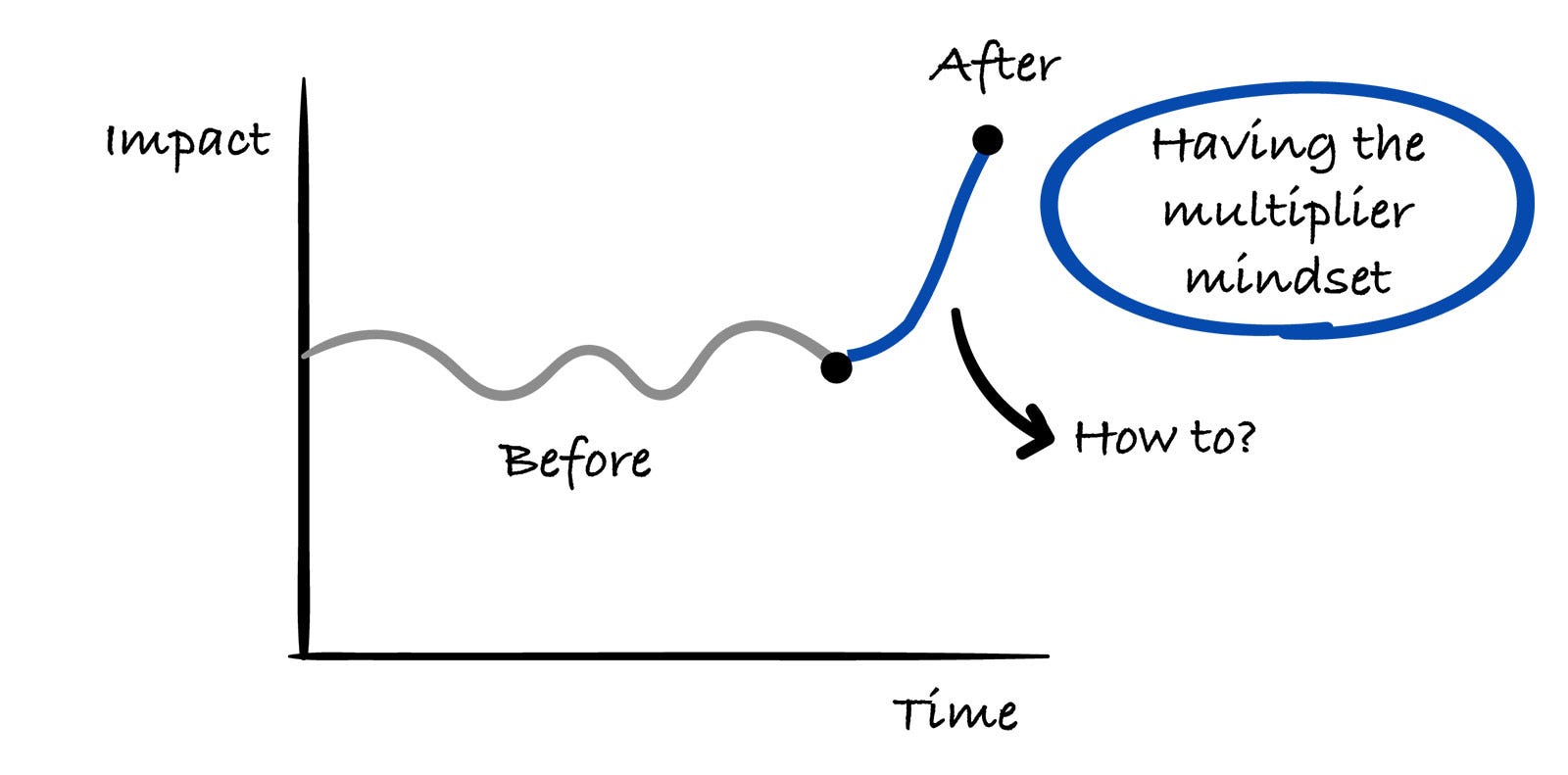
This newsletter is sponsored by Unblocked.
A Pile of MCP Connectors Is Not a Context Engine
Your team connected Slack, Jira and GitHub over MCP, and engineers still spend their time steering agents to the right answer.
This article looks at why: connectors fetch from one tool at a time, so every agent stitches the pieces together itself, trusts the first doc that looks right, and adds a search to your token bill each time.

Read what changes when a context engine sits on top of your connectors: the same coding task finished 83% faster at 48% lower cost.
Thanks to Unblocked for sponsoring this newsletter. Let’s get back to today’s thought!
Intro
My book The Multiplier Mindset published by O’Reilly has recently been released, and has also been a #1 Bestseller (or close to) on Amazon for the past weeks.

In the part 2 of the book, I feature 8 case studies of successful multipliers (tech leads, engineering managers, staff engineers, and architects), looking at:
How they multiply others
What makes them successful
How they use AI
Their advice to engineers and engineering leaders to thrive in the AI era
Today, I am sharing the case study of Patricia Juárez Muñoz, who was a Tech Lead at AWS at the time of our conversation, and she is also a fellow newsletter author writing the WonderLead in Tech newsletter. This case study is also included in the book.
Let’s start!
What Patricia Juárez Muñoz Does?
Patricia Juárez Muñoz leads the engineering of multiple internal model context protocols (MCPs) in the AWS Customer Experience organization. In a previous organization, she was a tech lead for AWS Resource Explorer, Tag Editor, and Resource Groups consoles and widgets.
Every one of those launches, she says, taught her something different about how to lead without having all the authority and how to move work forward through people, not around them.
She says her most challenging project was an MCP that autogenerated user interfaces (UIs) and user experiences (UXs), not for the tech itself, but for aligning people around AI they didn’t yet understand.
She proposed a new development workflow for cross-functional teams that increased the quality of the code generated. What she finds most meaningful about it is who uses it and why:
Product managers use it to turn their ideas into tangible interfaces they can share with UX designers before a single line of production code is written.
UX designers use it to compress the development cycle, reducing the back-and-forth with engineers. Engineers use it to communicate design ideas and intent. One product scaled what used to require three separate jobs to be done into a single cohesive workflow.
She owns the tool and is responsible for its integrations across teams, who used it through Amazon Q and later Kiro.
How Juárez Muñoz Succeeds In Her Role
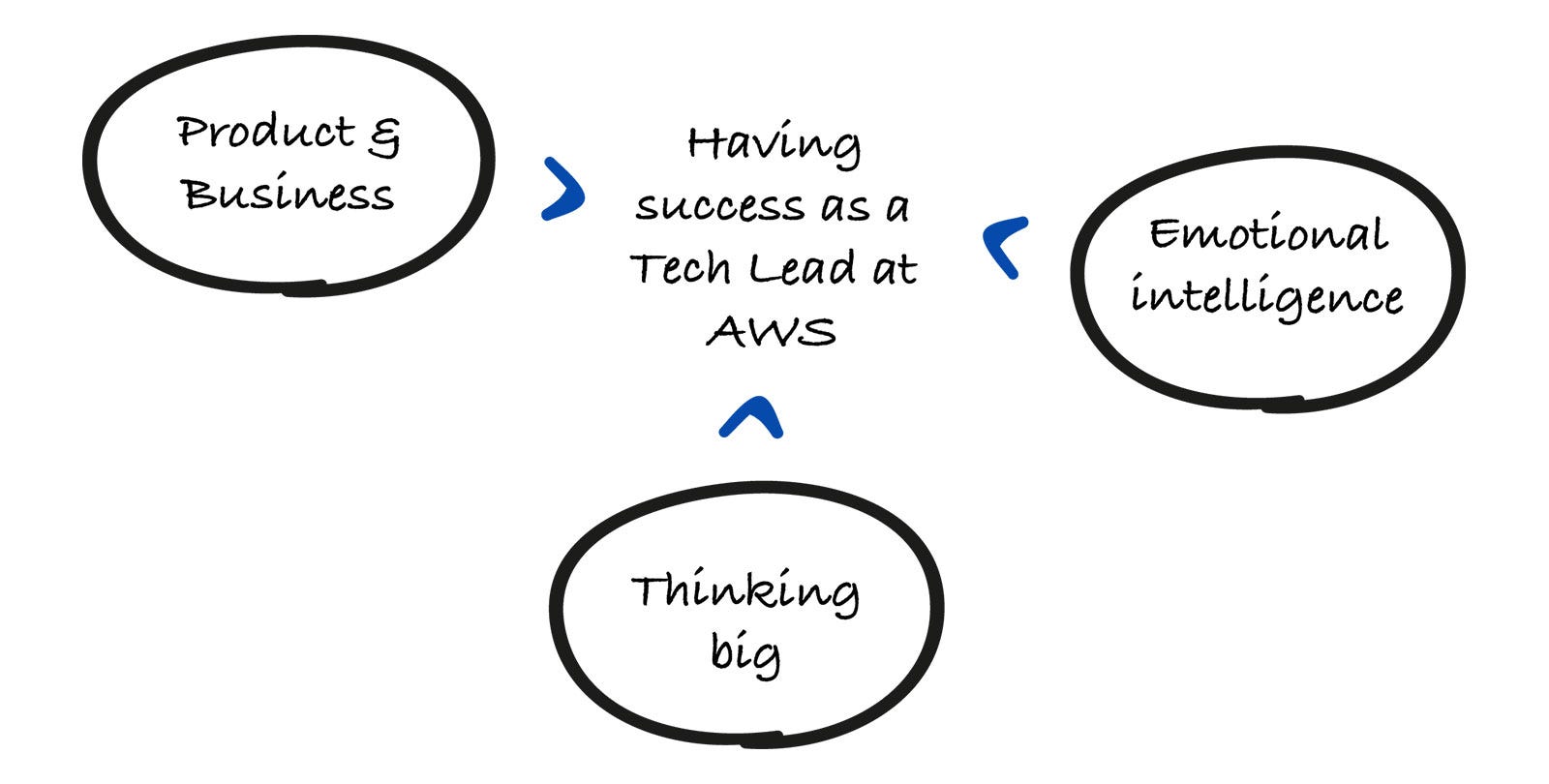
Juárez Muñoz shares three key factors in her success as a tech lead.
1. Having product and business understanding
This is the foundational factor:
Deep knowledge of our product, customers, and technology allows me to understand the system well enough to ask the right questions, identify where the risks are, and earn the respect of the people building it with me. That credibility is the foundation everything else rests on.
2. Having emotional intelligence
This is what makes it all work:
Emotional intelligence is the operational layer of leadership. Without it, I’ve seen technically brilliant people fail in leadership roles because they couldn’t read the room, couldn’t manage conflict, or couldn’t hold a team together during ambiguity.
3. Thinking big
And this is her secret weapon:
Thinking big. With it, I see further; I connect what we’re building to where the organization is going and what the customer needs. Then, I advocate for that direction even when it’s not the most popular path. This has allowed me to influence the vision at director levels within and outside my organization.
She adds the following:
These three don’t work in isolation. Knowledge without emotional intelligence (EI) becomes arrogance. Vision without EI becomes isolation. EI without action becomes empty warmth. The combination is what actually moves things forward.
How She Multiplies Others
Juárez Muñoz says she helps her team scale and win by actively creating space for others to grow and succeed.
Creating a space for growth and success

Here’s how she does it:
I intentionally choose not to be the person who solves the problem if I’m not strongly needed. Instead, I ask “Who on my team is ready to grow into this?” Then, I give feedback, coach, sponsor, and connect people to projects that stretch them.
That sponsorship is particularly important, since it makes her team members’ work visible to the people who make decisions about their careers.
Calling out problems and proposing solutions
Instead of working around gaps in processes, guidelines, products, and organizational clarity, Juárez Muñoz makes a point of naming them and proposing improvements:
At Amazon, we have a document-driven culture, so for any proposal, I create a document first. I also set mechanisms to reduce friction and scale, such as a shared roadmap with clear ownership and deadlines or a weekly summary that keeps cross-team work visible. These small changes bring higher alignment and trust.
Building alignment
She also takes an intentional approach to alignment across teams, using Working Backwards documents and tools, such as press releases and frequently asked questions (PRFAQs), Amazon’s five customer questions, and technical designs, to build shared understanding and surface disagreements.
When conflicts arise, she says, “I try to find the shared ground and define a ‘path to green,’ a path that will unblock us and our customers.” She also doesn’t hesitate to escalate when an issue carries implications that reach beyond her scope as a tech lead.
Furthermore, “When priorities change, I surface that change immediately, seek clarity on what it means for the scope because I may have blind spots, and say no or ask for more resources if the work has grown.”
Often, she says, “Projects slow down because of misaligned expectations, unclear ownership, and missed psychological safety.”
Making actions visible
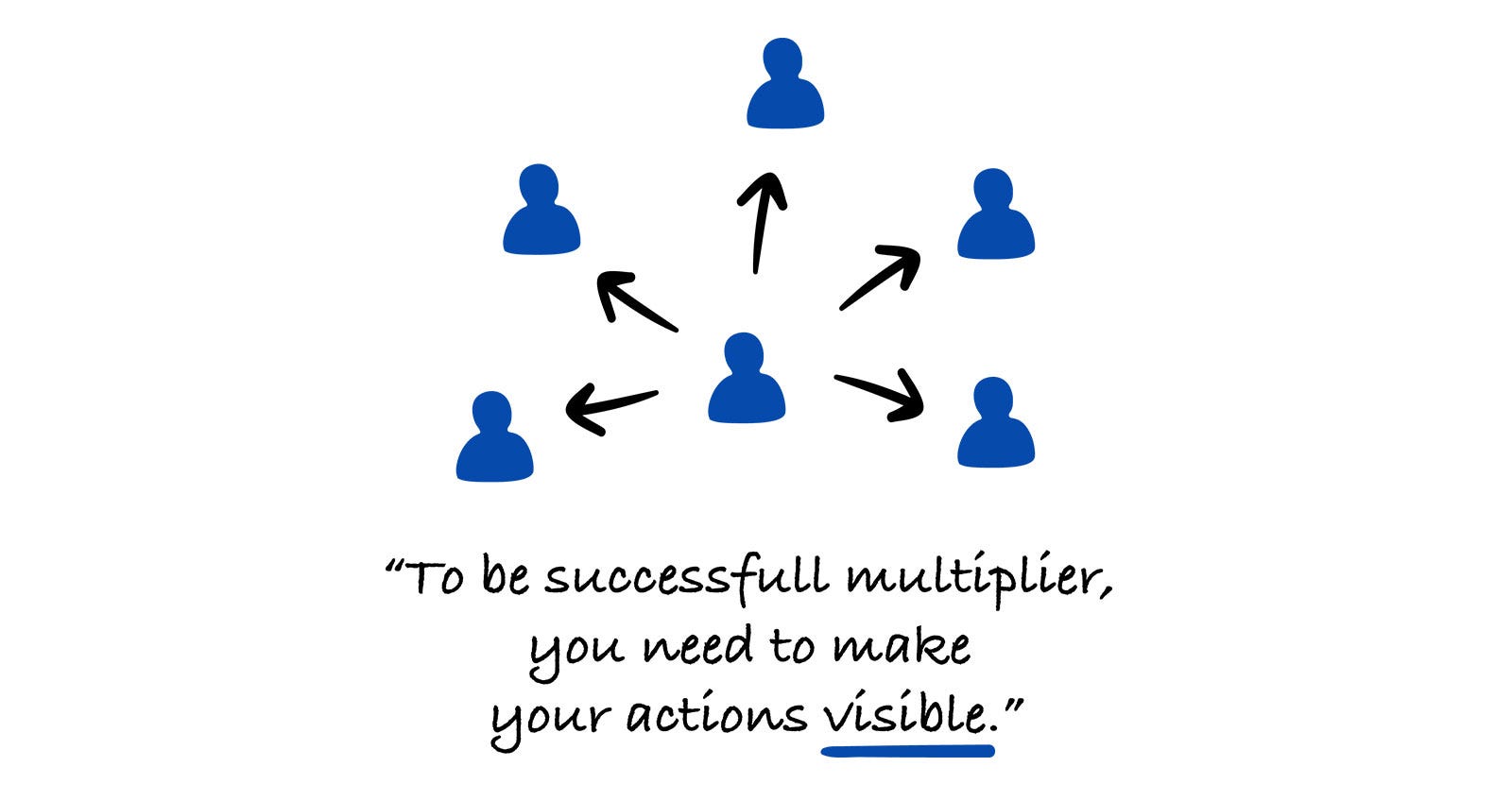
Most importantly, Juárez Muñoz adds, “multiplying with success requires you to make your actions visible,” particularly through sponsorship.
She also recommends tracking everything, surfacing your successes in your own performance reviews, and explicitly advocating for the people you’ve developed with your managers (direct and skip-level).
Being self-aware
Juárez Muñoz says self-awareness is another important skill, especially in terms of making sure women engineers get the credit they deserve:
Multiplying in invisibility is more common among women in tech. The expectation to support others is so deeply founded in women that when we do things well, sometimes our work gets missed by our managers or stakeholders.
The credit flows to those who ship visibly. To change this pattern, start with self-awareness, recognize your self-talk and bias, and remember the importance of visibility for ourselves and our teams.
How She Leverages AI
The foundation for doing good work with AI, Juárez Muñoz says, is “human trust first, and trust is built through consistency, not through one good meeting.”
She was an early AI adopter, and she leads her team by modeling transparency: “When something works well, I share it; when something fails, I share that too.”
Being flexible
The way Juárez Muñoz uses AI has evolved significantly over the past two years, and it varies by task. “The choice depends on what kind of problem it is, how the code is going to be maintained, and where the highest risk of failure lives.” Here are her recommendations:
For documents
She says, “I write a draft first and use AI to give it structure, challenge its content, and surface gaps. The main content is mine. AI makes it easier to read.”
For code
She says, “A year ago, I was running AI-assisted sprint planning and spec-driven development. Agents refined tasks, executed parallel work, and I was the first reviewer. It felt efficient.
But it was risky without guidelines or guardrails, and it was sometimes shifting the load to the reviewer.
Through trial and error, I learned where AI failed and where I was failing as author of the code when validating it.”
Juárez Muñoz has found that one principle holds in almost every AI use case: “The context and guidelines are essential for generating high-quality code.”
Sharing knowledge
Juárez Muñoz emphasizes the importance of sharing knowledge among and between teams:
The engineers who use AI most effectively aren’t the ones who trust it the most. They’re the ones who understand precisely how it works and where it fails and design their workflows around those failure modes.
In 2025, she started a regular AI learning series for engineers, PMs, and designers across multiple organizations in AWS’s Berlin office:
We started from scratch. Basic concepts, live demos, hands-on workshops. This year, we ran an AgentCore workshop and shared how different teams were generating and merging PRs automatically with AI. Attendance per session ranged from 15 to 60 people.
The thing I’m most proud of isn’t the attendance numbers. It’s the dynamic that emerged.
In those meetings, all of us are at the same level and role. All of us, managers and ICs, are humans learning AI, connecting, and sharing. There’s no performance tracking or politics in our meetings.
Everyone seeking to learn or share is welcome. We showcase what we learned, what we tried, what we found, and share resources across teams and organizations to scale. Learning in isolation slows us down.
Engineers resist when learning AI is a mandate, mostly because the return on investment is not clear. When you tell an engineer they have to adopt AI without giving them a safe space to experiment first, you’ve already lost.
What I suggested to my director instead was creating a bottom-up learning community, one where curiosity was the entry point, where mistakes were expected and discussed openly, and where people could share what was working.
Team members started volunteering to run sessions. Engineers who were starting became power users months later. Engineers who had been skeptical started experimenting. Each session sparked curiosity and creativity. The learning multiplied without anyone having to push for it.
She’s now working on defining guardrails across teams, researching how to reduce human and AI cognitive failure modes, and working with individuals and companies adopting AI.
Her Advice For Engineers and Engineering Leaders
Here’s Juárez Muñoz’s advice for engineering leaders:
Be human first. Be compassionate. If you are investing in AI, such as in tools, in adoption programs, or in automation, make sure the purpose is to support humans, not to replace them.
The ROI and employment satisfaction will be higher when people feel augmented by AI, rather than threatened by it. That emotional reality must be part of your business strategy.
And here’s her advice for engineers:
Experiment. Not just individually, but together. Run workshops together. Set AI–human team processes and define skills for your team around AI. Update your standards and skills as your team develops with AI.
Set up spaces to store documentation and API specs, then access them with RAG [retrieval-augmented generation] to reduce tokens spent. Share what you’re learning, the wins and the failures both.
The teams that thrive in this era won’t be the ones with the most advanced tools. They’ll be the ones that learn together, with psychological safety and curiosity leading their AI adoption journey.
Last words
Special thanks to Patricia for sharing all these insights with us!
Through WonderLead in Tech, she helps tech professionals, teams and companies with AI adoption strategy. As an Engineering Leadership reader, you get 15% off her 6-week AI Native Practitioner Programme with code ENGLEADERSHIP.
If you haven’t yet, make sure to check out the book The Multiplier Mindset, where you can find more case studies similar to this one.
Liked this article? Make sure to 💙 click the like button.
Feedback or addition? Make sure to 💬 comment.
Know someone that would find this helpful? Make sure to 🔁 share this post.
Whenever you are ready, here is how I can help you further
Interested in sponsoring this newsletter? Check the sponsorship options here.
Check out my book “The Multiplier Mindset” by O’Reilly, here.
Take a look at the cool swag in the Engineering Leadership Store here.
Want to work with me? You can see all the options here.
Get in touch
You can find me on LinkedIn, X, YouTube, Bluesky, Instagram or Threads.
If you wish to make a request on particular topic you would like to read, you can send me an email to info@gregorojstersek.com.
This newsletter is funded by paid subscriptions from readers like yourself.
If you aren’t already, consider becoming a paid subscriber to receive the full experience!
You are more than welcome to find whatever interests you here and try it out in your particular case. Let me know how it went! Topics are normally about all things engineering related, leadership, management, developing scalable products, building teams etc.
It was a pleasure to contribute my use case to your new book, Gregor.
I hope it helps lots of tech leads. Thanks for writing it and for inviting me to be part of it :).
I will publish it in my newsletter https://wonderlead.substack.com as guest post next week so my readers can find it.
On the RAG-over-API-specs tip: chunk OpenAPI files by operation and inline the $ref'd schemas into each chunk. Split naively, the agent retrieves the endpoint but not the request schema it points to, then fills the gap with plausible field names that only fail at runtime.