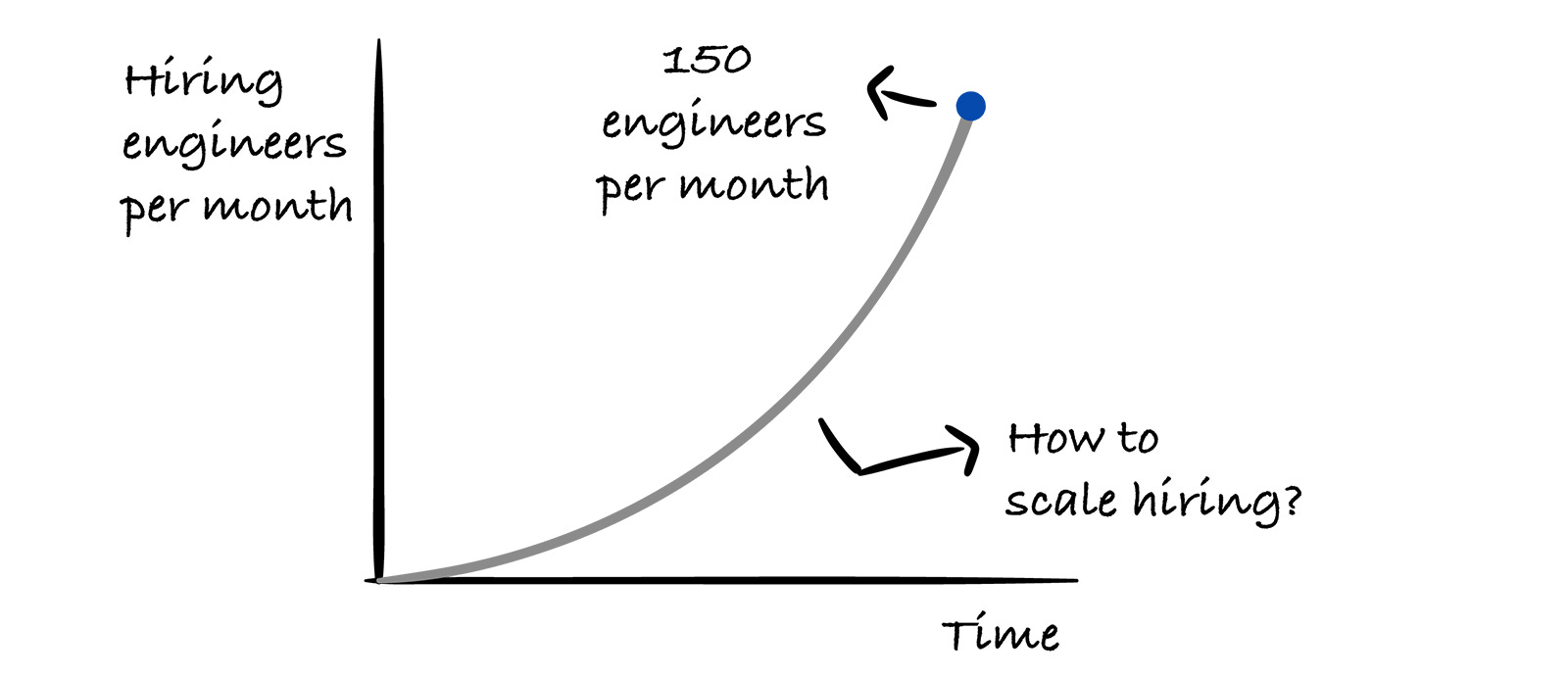
How Coinbase Scaled Their Hiring to 150 Engineers Per Month
Former VP of Engineering at Coinbase is sharing his insights on scaling hiring by 100x in the pandemic era!
This week’s newsletter is sponsored by PropelAuth.
Decoding Enterprise SSO
Enterprise customers come with Enterprise acronyms.
If your team is starting to hear questions like “Do you support Enterprise SSO? What about SCIM sync?” and you’re not quite sure how to answer… this blog post is for you.
Learn:
Why supporting Enterprise SSO is important.
What it means when someone talks about “IdPs”
The difference between SAML and SCIM
Thanks to PropelAuth for sponsoring this newsletter. Let’s get back to this week’s thought!
Intro
Scaling hiring is hard, and one of the biggest issues you have with it is that it’s impossible to keep the human element at the same level when you are hiring 1 engineer per month versus hiring 150 engineers per month.
That’s also one of the reasons why Big Tech has stuck with LeetCode-type interviews for quite some time now. Such interviews are objective, and they provide an even playing field for everyone being interviewed.
Even though I am not a fan of such interviews, as I believe that they are not a good representation of what the actual work engineers do daily, they do remove a lot of the human element and give less room for subjectivity.
To learn more about how to approach scaling at the largest scale, I’ve asked Luca Bonmassar, former VP of Engineering at Coinbase, to share his insights and experience scaling hiring at Coinbase.
Let’s introduce our guest author.
Introducing Luca Bonmassar
Luca Bonmassar is a CTO at Checkr, previously VP of Engineering at Coinbase and Director of Technology at Citadel. He has over 20 years of experience building software products across diverse industries, including Fintech, Crypto, Social Media, and AI/Machine Learning.
In his career, he also co-founded and sold 3 startups, and has managed + mentored thousands of engineers in large and complex organizations. He also holds multiple patents.
Today, he is sharing his insights on scaling hiring. Luca, over to you!
The Hiring Playbook at Coinbase Before the 100x Acceleration
When I started as a VP of Engineering at Coinbase in 2019, the company was based in San Francisco, and the vast majority of our hiring was SF-based. We had a small presence in London (around 12 people), and some remote employees (mostly as exceptions).
I joined when Crypto was coming out of the “crypto winter”, so we were hiring in the dozens. Hiring was very distributed back in the day:
sourcing,
interviewing,
making a decision,
offer,
onboarding
All were driven individually by each team.
Each team/hiring manager was working with a recruiter and sourcing partner, helping to bring in candidates. Interviewing, although standardized, was still very distributed → a candidate would mostly meet interviewers of the team they were interviewing for.
Hiring managers and recruiters would conduct “round-ups”, where they would meet all the interviewers, collect their feedback, and make a hiring decision.
The offer would be negotiated by the hiring manager and the candidate. Once hired, each team was responsible for onboarding, with some shared resources (video material/presentation) centralized on the general engineering topics.
Scaling Hiring by 100x
In 2020, crypto had a major acceleration as an industry during the pandemic, and Coinbase also started to grow at triple digits.
Every phase I mentioned above (sourcing, interviewing, hiring decision making, offer, and onboarding) became something to be scaled 100x.
We went for “economy of scale”, and decided to centralize each one of them, in order to go from artisan hiring to an assembly-line scale of hiring.
This is what we did in order to scale hiring
Standardized searches
Previously, for every new hire, it would be required to draft a “job spec”, with indication from the managers on skills, levels of expertise, job titles, etc. → All searches got standardized.
Now, you could only hire a frontend engineer, a backend engineer, a crypto engineer, an infra engineer, or an ML engineer (and a few others from the menu).
You could specify the seniority of what you are looking for as far as level. Title, comp expectations, experience, etc., is now all standardized. No more intake meetings to discuss the new search.
Sourcing goes nationwide
We moved to remote first during the pandemic, and with that, moved from hiring in SF only to hire nationwide (and later, in 10+ countries). This resulted in a massive increase in talent pool size.
Sourcing & interviewing becomes centralized
Candidates were now interviewing for standardized roles, without knowing which team they would land.
As a candidate, you won’t be screened by your future hiring manager or peers, but rather by any Coinbase engineer. This massively opened up the interviewer capacity.
From hiring manager round-ups to centralized hiring panels
Each day with a rotation, one Coinbase leader would host a hiring panel (with 5-6 senior managers), where all the interview packets feedbacks were reviewed.
The panel reviewed each hiring packet and decided which ones would move to offer and which ones would be rejected.
Each panel generally reviewed at least 10 packets every day, and we had up to 4-5 panels each day (led by a different senior leader). This gave us the ability to process 40-50 candidates at the pre-offer stage a day.
Team matching
The offers were standardized and non-negotiable (no back and forth with the candidate). Both base salary and equity were directly related to the level you would be hired in, no exceptions allowed.
Once the offer was received, you would be connected for 2-3 20-minute phone calls for team matching with prospective hiring managers. Candidates and hiring managers would express their preference, and we landed candidates based on both preferences.
Centralized onboarding
We ran a 2-week class of 100-150 engineers per class every month. During the class, you would get exposed to prepared content and live demos.
After the 2 weeks, you would land in your home team, where each team would continue with specialized onboarding for the domain you had to enter.
Lastly, staffing, staffing, staffing
We had to hire and scale up sourcers, recruiters, and recruiter coordinators to massively ramp up on this load.
This is How the Scoring of Candidates Looked Like
We had a leveling system, a rubric for interviews. Interviewers would rate the candidates on the questions answered, and had concrete examples of what below expectations would look like, what good would look like, and what great would look like.
The first screening was hit or miss. If you did not achieve a certain score, you would not pass to the next round. The round would generate a scorecard, with individual scores and feedback from each interviewer.
Panels would review scorecards and suggest whether the candidate leveling is correct, and whether to move to an offer or not.
To Get to That Scale, You Need to Develop a Mental Model of How Things Will Work
Hiring at scale is essentially like a sales funnel.
You need to organize your hiring/sales pipeline, modeling how many outreaches and leads you will need to generate, what the pass-through will be, starting with reaching out to candidates to get them excited about it.
From there, it’s important to model how many will pass your tech screening, how many will pass your cultural screening, etc.
In your model, you then need to have assumptions all around about how many sourcers and recruiters you will need to support this model.
You need to have assumptions on how many interviewers and hiring managers you will need, and how many interview panels you will need. However, all of this is just a model, riddled with assumptions left and right.
Next, you put your model to the test in the real world by observing what’s actually happening on the ground.
Are we able to generate the expected amount of leads?
Are we seeing deviations from the plan in Europe or Asia?
What you often discover is that reality doesn’t align with your model, and those gaps reveal your bottlenecks.
Maybe your outreach message isn’t resonating, so you’re not generating enough top-of-funnel interest. In that case, you may need to invest more in branding and refine your messaging.
Or you realize there are not enough interviewers in the right timezone, and you need to keep tweaking your process to eliminate these bottlenecks.
We were running a weekly meeting, where all these metrics would be analyzed and action items dispatched to keep tweaking and updating the model in order to eliminate all the bottlenecks.
Measuring Success of New Hires
Candidates would get evaluated in a check-in in their first month and after 90 days. Every employee is re-evaluated every quarter through a written performance check-in.
On top of that, employees would go through a performance review once a year, and a full calibration cycle where employees of the same level would be reviewed together to identify areas where managers could be too stringent or lax.
And that brings us to the next thing → how we maintained Coinbase’s culture and values while growing so quickly.
Maintaining Coinbase’s Culture and Values While Growing the Engineering Team so Quickly
We had a bar raiser interview program, similar to the Amazon interview process, where you specifically screen for certain traits, such as the ability to have clear communication, positive energy, the ability to respond to adversities, etc.
We repeatedly blogged and discussed publicly about Coinbase’s culture. We were clear from the start that Coinbase is not for the faint of heart, and we expect people to work very hard.
The company frequently made headlines for its cultural stance, from the “no politics at work” policy to its emphasis on “talent density.”
By being explicit and unapologetic about who we are, we created a powerful self-selection effect → people who weren’t aligned opted out before joining.
Although we were hiring at scale so quickly, leadership hiring was very selective, and we paid extra attention to bring in leaders who would be able to maintain and champion Coinbase’s values.
The Consequences of Scaling Hiring so Aggressively
It is certainly doable if you treat the problem as an engineering problem, you model it as a system, and you attack every sub-problem with data, analytics, and planning.
It also takes a large toll on everything. Not only do your hiring processes have to be rewritten and rebuilt every 6 months, but everything post-hire also needs to change.
While we talked here about how to scale hiring (and onboarding), performance management needs to be able to go from approximately 100 engineers to approximately 2500, and the same goes for promotions, roadmap planning, budgeting, etc.
Every process and lifecycle in the company needs to be quickly reconsidered every 6 months, because what worked last week might break under the new scale today.
Now, for the end, let me share what I would do differently if we were scaling hiring today.
This is What I Would Do Differently With Today’s Tools
Summarization of notes and note-taking is a massive improvement at this time.
Rather than everyone taking notes and shipping them through ATS, there’s an opportunity to automate the notetaking in every step, and the summarization to panels.
I would also change what is being assessed for engineers: in the era of AI, writing code has become secondary to reading code (written by a peer or an AI agent).
So I would spend many more cycles evaluating the ability of an engineer to read code.
My Key Takeaways on Scaling Hiring
Gregor here again. Here are my 5 key takeaways from Luca’s insights.
It’s important to centralize in order to scale
Coinbase moved from team-driven hiring to fully centralized sourcing, interviewing, decision-making, offers, and onboarding. It would be impossible to scale to that level if each team had a personalized process.
Standardization removes bottlenecks
This is another lesson here, and that is personalization and customization are impossible if you are hiring on a really large scale.
You need predefined roles, levels, compensation, and interview rubrics. You want to reduce subjectivity in order to dramatically increase speed.
Limit hiring for roles, don’t hire based on teams
This enables any qualified engineer or manager to interview the candidate, and not only the hiring manager of a certain team or an engineer who is a part of that specific team.
Treat hiring like a sales pipeline
Create a clear mental model, with conversion metrics, weekly reviews, and constantly look at the data and make improvements.
It’s important to have a clear culture in place in order to make scaling at that level possible
Predefined values and knowing what’s important for the organization → this makes it clear to people regarding what they can expect. And also, it already filters people who may not be a good fit, since they won’t apply to the roles in the first place.
Last words
Special thanks to Luca for sharing his insights on this very important topic! Make sure to follow him on LinkedIn, as he regularly shares interesting insights from his day-to-day experience there. His posts are always very thoughtful, analytical, and filled with personal experience.
Liked this article? Make sure to 💙 click the like button.
Feedback or addition? Make sure to 💬 comment.
Know someone that would find this helpful? Make sure to 🔁 share this post.
Whenever you are ready, here is how I can help you further
Join the Cohort course Senior Engineer to Lead: Grow and thrive in the role here.
Interested in sponsoring this newsletter? Check the sponsorship options here.
Take a look at the cool swag in the Engineering Leadership Store here.
Want to work with me? You can see all the options here.
Get in touch
You can find me on LinkedIn, X, YouTube, Bluesky, Instagram or Threads.
If you wish to make a request on particular topic you would like to read, you can send me an email to info@gregorojstersek.com.
This newsletter is funded by paid subscriptions from readers like yourself.
If you aren’t already, consider becoming a paid subscriber to receive the full experience!
You are more than welcome to find whatever interests you here and try it out in your particular case. Let me know how it went! Topics are normally about all things engineering related, leadership, management, developing scalable products, building teams etc.


Great read. As a hiring manager at Coinbase in 2021/2022, this is an accurate summary of the process. I wish notetaking AI was available back then, to help with consistency.
One of the bigger risks was the hire / no hire determination submitted in Greenhouse by individual interviewers. There was a reverse shadow process to calibrate interviewers when they started, but it wasn't an ongoing process.
When a company-level priority to 3x employee size in one year was introduced (called a Code Yellow), it made it difficult to maintain that consistently-high hiring bar.
Notetaking AI would have enabled more consistency & spot checking to ensure interview quality & alignment to the planned interview questions we were expected to ask. It would also give interviewers confidence they were within nominal ranges.
An internal AI audit process like the above is something I'd recommend all tech companies implement. It ensures consistency on interviewers and creates a better overall applicant experience.