How Engineering Managers Can Turn Team Growth Into Visible Impact
Step-by-step guide to tracking the signals of your team's growth and communicating them so your impact is visible.
This week’s newsletter is sponsored by Blitzy.
Blitzy is the first autonomous software development platform with infinite code context, enabling Fortune 500 companies to ship 5x faster from Figma design to production code.
It’s engineered specifically for enterprise-scale codebases due to its deep understanding of your codebase and design standards. This can clear years of tech debt, execute large-scale refactors, or deliver new features quickly.
Some of Blitzy’s core features:
Self-improving knowledge graph: Maps millions of lines of code and their dependencies to create a live understanding of your codebase.
Figma integration: Turns Figma designs into responsive, pixel-perfect frontend code that connects to your backend.
Agent orchestration: 3,000+ specialized agents plan, build, and validate production-ready code.
Result: 80% of the work delivered autonomously, 5× faster. If you are working on an enterprise-scale codebase, I’d definitely recommend checking them out!
Thanks to Blitzy for sponsoring this newsletter. Let’s get back to this week’s thought!
Intro
In your role as an engineering manager, your success does not only come from finished projects. A big part of your success comes from the growth of your people.
Especially in bigger companies, where there are promotion committees, an important metric of success for engineering managers is how well their people are doing. Are they growing and improving? Or are they stagnating?
And, as I like to say, the true lasting impact you can have as an engineering manager is the growth of your people.
Think about the mentors who shaped your career. Their impact wasn’t a task they did for you. It was a question that made you see a problem differently, or the confidence they gave you to take on something bigger.
To help you think about your team’s growth and communicate it in a meaningful way, Alex Ponomarev is our guest author today. He is sharing his insights from his 25-year career as an engineer and engineering leader with us.
Let’s introduce our guest author and get started.
Introducing Alex Ponomarev
Alex has over 25 years in the engineering industry, where he went through a full journey from engineer to leading and scaling engineering teams, working for companies like Cisco, Idea 11, and CrossClear.
Now, he is the founder of Volt, a software development company specializing in building internal operating systems.
He is also an author of the newsletter called Thriving In Engineering, where he regularly shares his experience. His goal is to help engineers and leaders with their career growth, improve confidence, and build meaningful, sustainable careers without burning out.
Today, he’s sharing his insights on the importance of growing your team as an engineering manager and also communicating your impact the right way.
Let’s start!
What if your most valuable contribution isn’t code, but careers?
Features fade, they get replaced, rewritten, or retired. But the growth of the people you manage is your lasting legacy. It’s what carries across projects, products, and even companies.
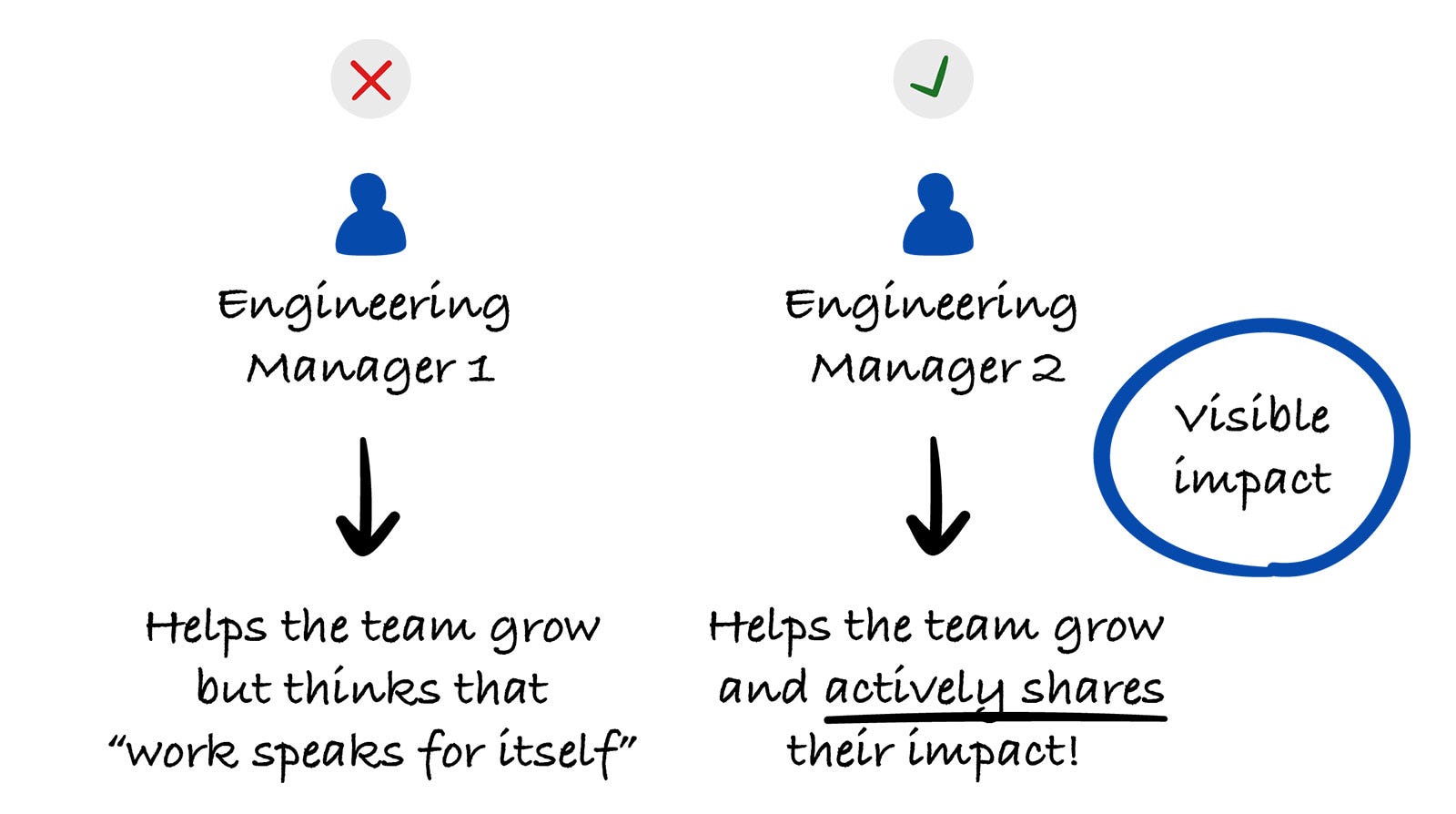
Many engineering managers (EMs) know this intuitively but don’t show it. And when you don’t show it, people assume your impact is just “keeping the team running”. That’s how you get overlooked for recognition, budget, and influence.
When your people grow:
Delivery improves everywhere
Decisions get made closer to the work
Escalations drop
And onboarding gets smoother
You don’t need a budget line for “retention initiatives”. People stay when the work is meaningful, the culture is healthy, the compensation is fair, and there’s a visible path forward.
Your job is to make those conditions real, then protect them.
That’s how I think about talent development. Together, your people gain more context every year. Their judgment sharpens, and their trust in each other deepens. In other words, your team becomes stronger.
This article will help you:
Track the signals of growth
Frame those signals in terms that resonate
Communicate them so your impact is visible
Because talent development is delivery, you just need to prove it.
A note on company size
If you’re running a small, close-knit team, you might think this only applies to big organizations that have layers of hierarchy and formal surveys and where leadership is very disconnected from the trenches.
An important thing to know is that the same principles apply to smaller teams as well, they just look different.
For example, we don’t run surveys because people have a direct connection and relationship with me as a manager, and they can come to me and say: “Hey, this is not working. This is how I feel, etc.”
In small teams, you don’t need engagement dashboards to spot growth signals. You see them directly in:
one-on-ones,
code reviews,
how people step up.
The feedback loops are shorter, but the compounding effect is the same.
Whether you’re in a large or small company, your job is to make growth visible. Not just to your people, but also to the stakeholders who decide where opportunities and resources go.
We’ll go through step-by-step on how you can do that next.
Step 1: Define what growth looks like on your team
I didn’t wake up one day and decide “careers over code.” It crept up on me. I looked around after a decade or so and realized the through-line wasn’t the products.
It was the relationships.
I’d worked with some people for 10 years. We’d moved across projects, roles, and companies. Features came and went, but the growth stayed. You probably feel this too.
Shipping clean releases is satisfying, but the deeper win is watching someone who needed handholding a year ago start coaching others.
Or when a team lead pulls you aside and says: “We can’t afford to lose her.” That moment says more about your management than any KPI snapshot.
So, make that impact explicit. Write down what “growth” means for your team.
Step 2: Assess healthy retention vs. concerning attrition
Not all attrition is equal. Some departures are healthy. Misalignment happens. Sometimes the right call is a clean, humane exit. But if good people keep leaving, you don’t have a “backfill problem.” You have a system problem.
Here’s how I interpret the signals:
Healthy attrition: Early-stage misfit acknowledged quickly. Clear reasoning. Respectful exit. The team learns and adjusts its hiring lens.
Concerning turnover: High performers leaving for culture or clarity reasons. Repeated backfills in the same role. A slow drip of “it’s fine” sentiment masking stalled growth.
I use retention as a health signal. Ask yourself: Are people staying and growing? If someone stays three years but never levels up: skills, autonomy, impact, retention alone is a false positive. In other words, retention matters when it comes with momentum.
Momentum means people’s scope, autonomy, and impact are expanding over time, not just that they’re still here.
Step 3: Track signals of growth
I like to think about growth as experience compounding. It’s like the XCOM games where seasoned units get more valuable with each mission. They’ve seen patterns, they make better calls under pressure, and they cover each other’s gaps. Teams work the same way.
You don’t need an elaborate dashboard. You need a few simple signals you can explain:
Time to independence
Measure how long it takes a new hire to go from “needs handholding” to “owns delivery.” If it used to take six months and now takes four, that’s real progress.
I track time to independence for every new hire, it tells me how well the team is compounding experience.
Performance review trajectory
Compare reviews over time. Are concerns repeating or being resolved? Are ratings and narratives trending up? More importantly, does the story show increased ownership?
Watch for stuck patterns such as: “Smart but needs prompts,” “solid but avoids ambiguity.” Your plan should target exactly that pattern.
One-on-one and feedback cadence
Keep a steady rhythm. Weekly or biweekly, depending on the person. Missed one-on-ones often show up later as surprise performance problems. And watch out for one-on-ones where you end up just talking about the weather, that’s usually on you if you didn’t do your prep well.
For each person, track goals for the next 6–8 weeks and the two specific behaviors they’re building.
Active development and coaching
We once hired an engineer who clashed with his team lead. Smart, opinionated, but different in style. Easy to write off as “not a fit”, but we made the adjustment:
Clearer expectations
Changed one-on-ones to async feedback
And we adjusted collaboration patterns without lowering standards
Within a couple of years, he was one of our strongest engineers. He shaped the team’s architecture, led initiatives, and raised the bar.
What changed wasn’t his raw ability. It was the environment, the feedback cadence, and the time to adapt.
The outcome was measurable: fewer escalations, smoother delivery on his projects, and a team that started using his patterns. That’s what real development looks like.
Promotions
In many companies, titles don’t mean much. If that’s the case for you, that’s okay. You can still measure growth in different ways.
Consider:
Scope: from single ticket to feature to project to multi-team initiative
Agency: from “asks what to do” to “proposes options” to “aligns stakeholders and executes”
Impact on others: from “needs reviews” to “gives high-quality reviews” to “raises standards team-wide”
Set expectations clearly in one-on-ones:
“Over the next quarter, let’s move you from owning features to owning a small project. You’ll define the plan, sequence the work, and handle review comments proactively.”
That’s measurable, and you’ll know if it happened.
Backfills avoided
Every avoided backfill represents time and money saved. If people are staying, growing, and creating stability, that’s measurable value.
Retention with momentum
As discussed in Step 2, track one, and three-year retention and add a note on how each person’s scope or autonomy has expanded.
Think of these as your growth KPIs. They’re conversation starters that make your impact visible.
Step 4: Frame growth in stakeholder language
As I’ve discussed before, engineers and stakeholders speak different languages.
Engineers care about learning and autonomy. Stakeholders care about stability, cost, and delivery capacity. If you don’t translate one into the other, your impact won’t land.
Take these examples:
The same outcome, told two ways. Framing your language to its appropriate audience is what makes your growth impact visible.
Step 5: Build visible proof
Metrics without context are just numbers. Context without metrics is just a story. You need both.
Don’t worry, you don’t need a PhD in HR analytics. You need a handful of simple signals you can explain. Make the invisible visible with lightweight artifacts:
Growth maps: One-pagers per person with three snapshots (scope, agency, impact), for example:
when they joined
6 months after joining
today
Team stability note:
No backfills in the last 12 months
Two internal promotions
Time-to-independence dropped from 5 months to 3.5 months
Before/after stories: “Sarah joined unsure about architecture decisions. After three months of guided reviews, she led the API redesign and mentored two mid-level engineers.”
Example of how you can structure before/after for a specific individual:
Honesty: If retention drops, don’t hide it. Explain the why and the fix you’re testing.
This is your evidence. You’re saying: “The right things are happening here.” And if they aren’t, you’re showing how you’ll make them happen. Keep it realistic and human, you’re showing the real results of your people’s work.
When the machine isn’t smooth
Sometimes this part is the hardest, when it feels like nothing’s clicking. You feel it in the churn. You see it in people who don’t grow, and you notice repeated mis-hires. But don’t gloss over it, call it out, fix it, and track the improvement.
Two engineers not progressing?
Pair them with seniors, re-scope their work, and set tight feedback loops for eight weeks. Re-measure autonomy at the end.
Repeated mis-hiring in one role?
Rewrite the scorecard, change the interview exercise, and add a culture-add conversation with the actual team, not a generic panel.
People leaving for motivational reasons?
Audit the work. Is it challenging? Is there a path? Are we saying “not now” to every initiative that would let someone stretch?
In other words, treat “people problems” like product problems: isolate, experiment, fix, repeat.
The short version: show the value of helping your people grow
As EMs, we often struggle to make our efforts visible. But growing your people is delivering results, and showing that growth is how you show your impact.
Here’s where to start:
Define what growth looks like: name the milestones that matter for your team
Separate healthy attrition from concerning turnover: retention only counts when it comes with momentum
Track simple signals: independence, trajectory, feedback cadence, scope, and stability
Translate growth into stakeholder language: capacity, cost, and delivery, not just learning and autonomy
Show your proof: with lightweight artifacts and honest stories that make the invisible visible
Do this, and you won’t just build stronger teams, you’ll build your reputation as the leader who makes growth happen.
Last words
Special thanks to Alex for sharing his insights with us. Make sure to check out his newsletter Thriving In Engineering, he regularly shares interesting articles there!
Liked this article? Make sure to 💙 click the like button.
Feedback or addition? Make sure to 💬 comment.
Know someone that would find this helpful? Make sure to 🔁 share this post.
Whenever you are ready, here is how I can help you further
Join the Cohort course Senior Engineer to Lead: Grow and thrive in the role here.
Interested in sponsoring this newsletter? Check the sponsorship options here.
Take a look at the cool swag in the Engineering Leadership Store here.
Want to work with me? You can see all the options here.
Get in touch
You can find me on LinkedIn, X, YouTube, Bluesky, Instagram or Threads.
If you wish to make a request on particular topic you would like to read, you can send me an email to info@gregorojstersek.com.
This newsletter is funded by paid subscriptions from readers like yourself.
If you aren’t already, consider becoming a paid subscriber to receive the full experience!
You are more than welcome to find whatever interests you here and try it out in your particular case. Let me know how it went! Topics are normally about all things engineering related, leadership, management, developing scalable products, building teams etc.


What an article! Just a goldmine of learning for other managers and leaders. I’ve been in leadership for many years now and continuously trying to improve. Lots of lessons for me here, especially around the performance management approaches through specific metrics.