

This week’s newsletter is sponsored by Unblocked.
[Webinar] Can you prove AI is working?
AI is in your engineering workflow. While the token spend shows it, the throughput doesn’t. The human is very much still in the loop, and that’s a context problem.

Join live on Aug 19 (FREE) to learn:
The 4 metrics to measure the gap where gains leak out before production.
The 8 stages of context maturity, the specific walls capping your metrics, and a free tool to pinpoint where your team is.
Why more MCPs and bigger context windows aren’t enough, and what it takes to get real value from your agents.
Thanks to Unblocked for sponsoring this newsletter. Let’s get back to this week’s thought!
Intro
AI has definitely changed what it means to be a great engineer. Some time ago, you could be considered a great engineer just by being good at a certain programming language and/or specific framework.
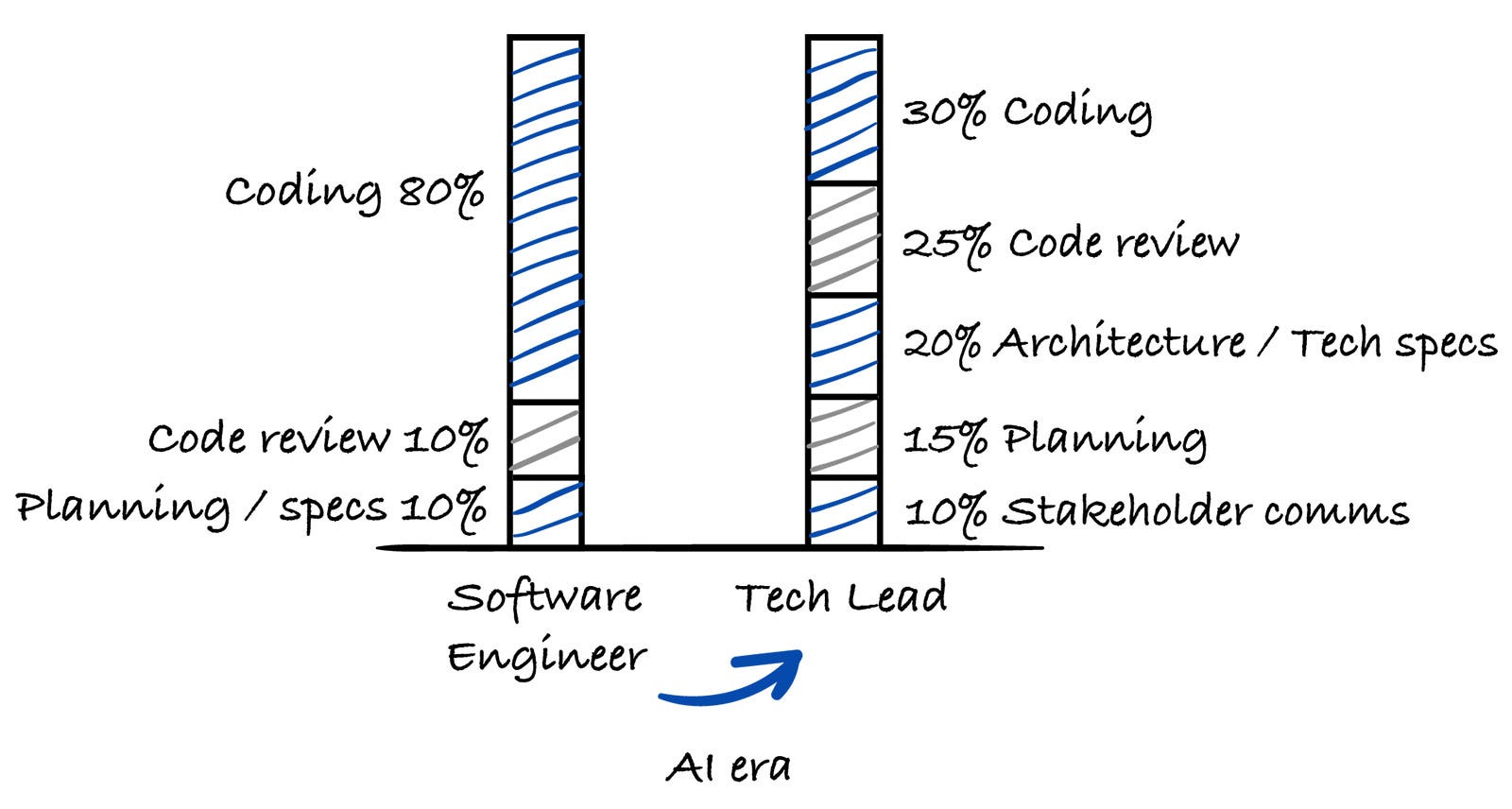
Today, a lot of the expected work of software engineers is actually more aligned with being a Tech Lead and a multiplier for others (making everyone around you better). You can read all about this specific shift in this article:

In today’s article, we’re focusing on how you can utilize AI to be more efficient and productive in your day-to-day work, while providing more impact and making everyone around you more effective.
This is an article for paid subscribers, and here is the full index:
- What is an engineering multiplier?
- How to be an effective engineering multiplier?
- There are 3 camps of engineers and engineering leaders when it comes to using AI
- Engineering multipliers use AI to help them be successful, but they don’t delegate their judgment
🔒 This is how you can utilize AI to be a multiplier
🔒 Learn faster using AI
🔒 Think through difficult problems
🔒 Write better code
🔒 Communicate more effectively
🔒 Find relevant information quickly
🔒 Coaching and leading your team
🔒 Make better decisions overall (especially data-driven)
🔒 Automate repetitive work
🔒 Last words
Let’s start!
My Upcoming Book “The Multiplier Mindset” Published by O’Reilly
This article is an adapted version of one of the chapters of my upcoming book called “The Multiplier Mindset”, published by O’Reilly. The book will be published later this year!

What is an engineering multiplier?
As tools for development got better, the desired skills for engineers have moved from just pure knowing programming languages and frameworks (expected) to problem-solving abilities and people skills.
It's less about the tasks, but how big an impact you can create. And engineers who can create the biggest impact have the multiplier mindset.
It's the mindset where you focus less on just your pure individual tasks, but you focus on how you can make things better for your whole team, organization, and, of course, the customers (users).
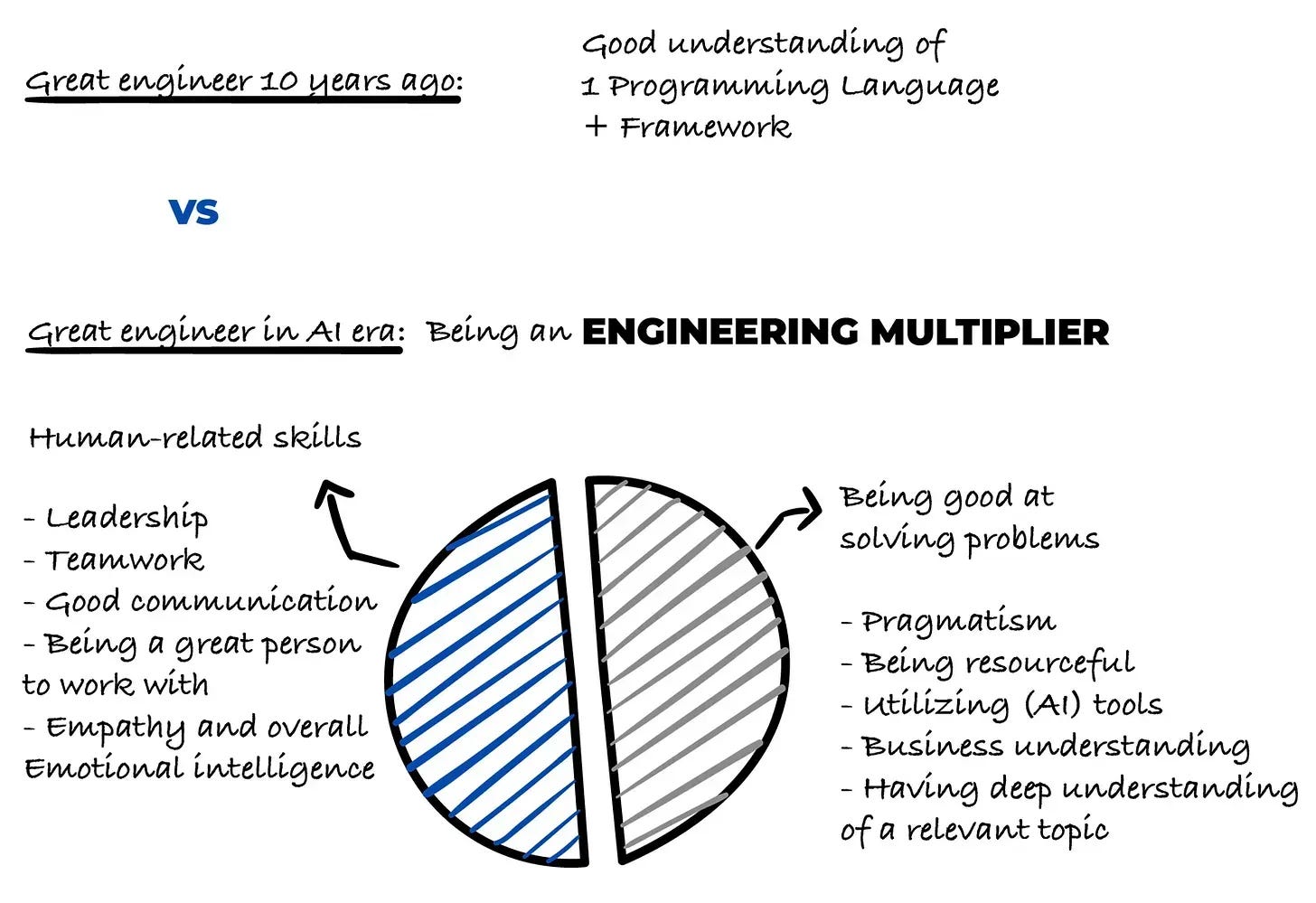
I like the term “Engineering Multiplier” because it’s a mix of “Engineering” and “Force Multiplier”, which fundamentally connects the two together.
Being an engineering multiplier means being someone who amplifies the productivity and effectiveness of the engineers around them, not just focusing on their own output, but elevating the entire team.
An engineering multiplier doesn’t just ask, “What can I build?”, they ask, “How can I make everyone around me more effective?”.
How to be an effective engineering multiplier?
As you can see from the picture above, the 2 main focus areas that are important in the AI era to become an engineering multiplier are:
Human-related skills and
Problem-solving abilities
And here is the visual of the most important areas:
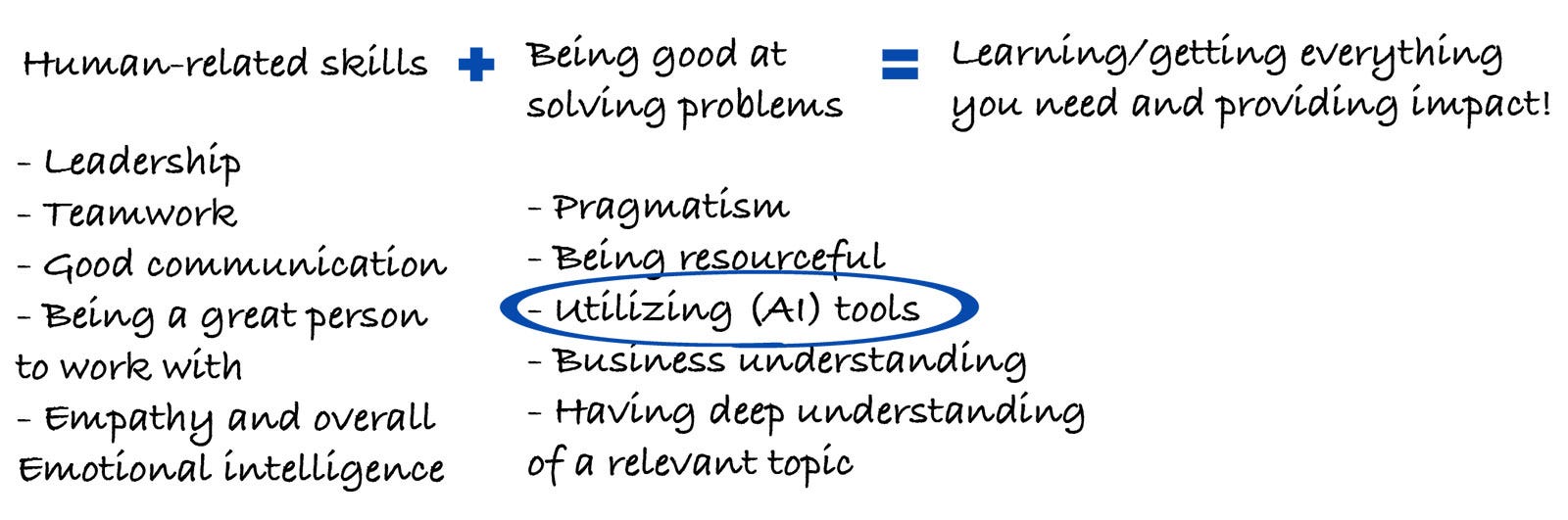
In this article, we’ll particularly focus on how to utilize AI to help you in all of these specific skills. Before we get into the details, it’s important to have the proper mindset for utilizing AI.
There are 3 camps of engineers and engineering leaders when it comes to using AI
The first camp → everyone who avoids using AI in their day-to-day work
Those are normally more experienced people who have been in the engineering industry for a while and have also seen a lot of shifts in the industry. They are more reluctant to change, and rather stick to what they know and what they are good at.
The problematic part is that the mindset of “It has worked well for me for 15 years, why would I change?” can be really harmful for learning new things and improving your craft.
The second camp → everyone who overuses AI in their day-to-day work
Those are normally less experienced engineers, either coming to the industry or they’ve been in the industry for a short while.
Such people normally have a good grasp of AI tools and what’s available out there, but they overly rely on them, resulting in the work being mediocre or, even worse, they don’t even check if the output from the AI tools is aligned with the standards.
Such work can be quite a problem for teams, as it puts a lot of work on reviewers to find out all the problems, which can end up taking a lot more time than it would take if they just do it right from the start.
The third camp → everyone who takes a balanced approach with curiosity
This is where you want to be. You don’t just blindly trust the “fancy new tool”, and at the same time, you are very curious to find out how you can improve your own and your team’s workflow with new tools.
You are keen on trying new things out, and at the same time you understand how important good engineering fundamentals and understanding of good engineering practices are.
You like to learn new things all the time, and you look at software development as one of the most fun things to do, because there’s always something new to learn.
Engineering multipliers use AI to help them be successful, but they don’t delegate their judgment
Using different tools that are available to make your day-to-day easier and more productive is what great engineers and engineering leaders do.
This hasn’t changed with AI, it has always been like that. We’ve always looked to automate aspects of our work. AI is a tool like any other, just the difference is that it’s a lot more ambiguous to use.
You get a tool that has so many capabilities, but no real manual on how to use it for your specific case. You need to figure out what works best for you and your work specifically.
At the same time, you shouldn’t just blindly trust these tools, you should verify and ensure they actually make you more productive.