

This newsletter is sponsored by Nango.
Connect your products & agents to 1,000+ APIs

Nango offers everything you need to connect your AI agent with external APIs:
Pre-configured integrations for 1,000+ APIs with 7,000+ tools: let your agents securely discover & call tools across 1,000+ APIs without clogging context.
Every integration type covered: auth, tool calls (MCP-ready), triggers, and syncs, with token refresh, rate limits, retries, and logs handled for you.
Extensible and enterprise-ready: customize any integration in code; supports SOC 2 Type II, HIPAA, RBAC, audit trails, BYOC, or self-hosting.
Open source with 11.7k+ GitHub stars, used in production by Smartsheet, Ramp, and ServiceNow. Simple pay-as-you-go pricing.
Thanks to Nango for sponsoring this newsletter. Let’s get back to today’s thought!
Intro
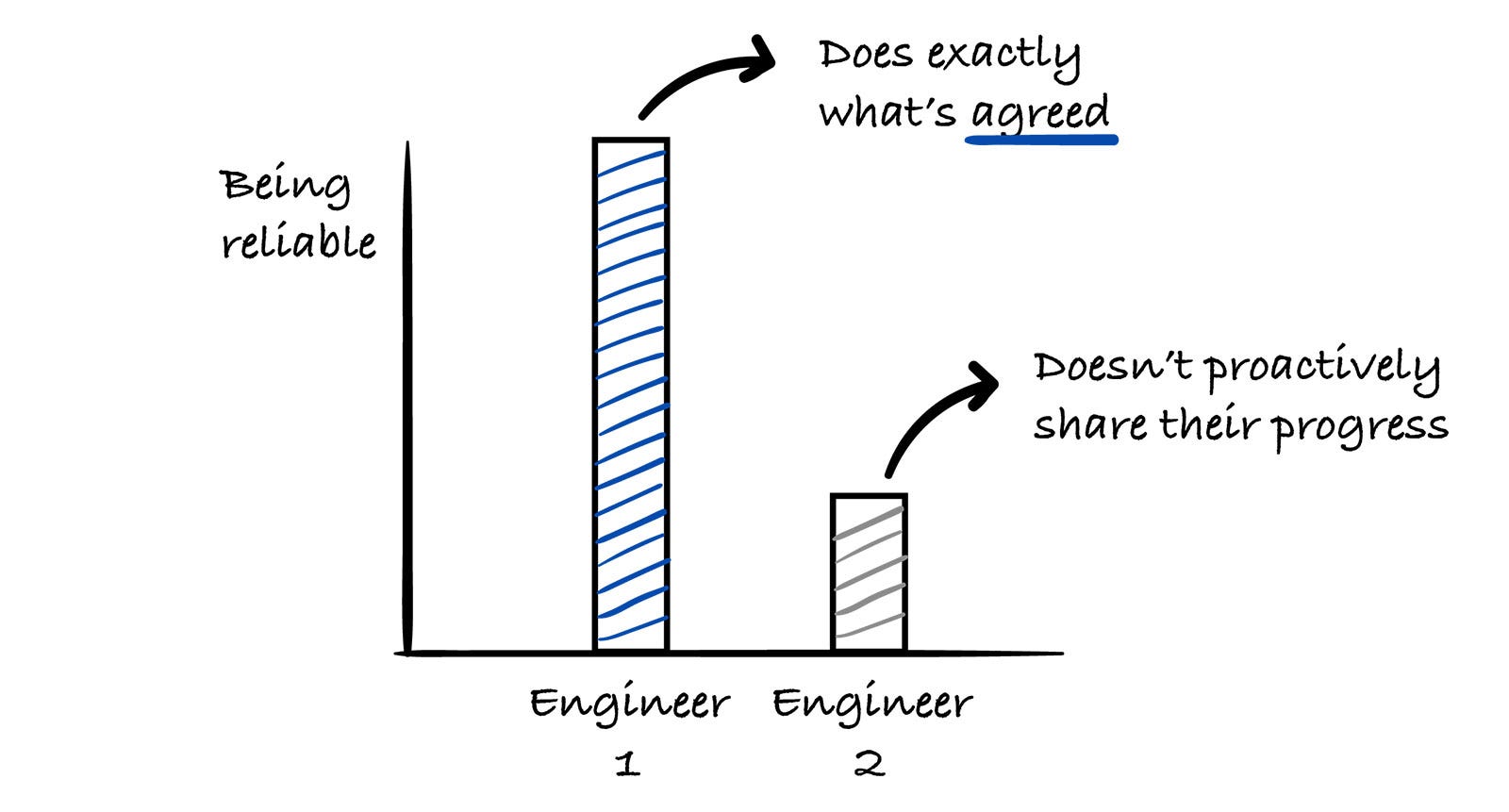
You may believe that people will see you as reliable if you do good work. But there’s a lot more to it, and you need to be intentional about how you showcase your reliability.
What seems reliable to you might not seem reliable to your manager or stakeholders, so try to see yourself from their perspective.
In this article, we’ll break down all of the things you should do to be seen as a reliable person who gets stuff done.
This is an article for paid subscribers, and here is the full index:
- Do exactly what you agree to do
- A lot of your success is determined by how well you communicate
- Provide estimates instead of making guesses
- Keep your manager in the loop
- Admit your mistakes
🔒 Get good at time management
🔒 Prioritize ruthlessly
🔒 Block out focus time
🔒 Have separate maker time and manager time
🔒 Use Pomodoro to avoid distractions
🔒 Improve communication to save time
🔒 Cancel pointless meetings
🔒 Say no more often
🔒 Take time off
🔒 Last words
Let’s start!
My upcoming book “The Multiplier Mindset” published by O’Reilly
This article is an adapted version of one of the chapters of my upcoming book called “The Multiplier Mindset”, published by O’Reilly. The book will be published in mid-to-late October this year.

Do exactly what you agree to do
During one of my very first freelance projects, I was working hard to build a website for a client. But my communication wasn’t really on point.
I wasn’t asking questions to find out what was really needed, and I wasn’t managing the client’s expectations the right way. I was just focused on building.
To my surprise, what I delivered wasn’t what the client expected. It went too far in a different direction, and the client immediately saw me as less reliable.
I was able to turn the project around by making appropriate adjustments, but my reputation was already damaged. The client didn’t send me any more work after that.
So I learned this lesson the hard way:
You can do the best work in the world, but if you don’t manage stakeholders’ expectations and deliver what they’re relying on you for, it won’t mean much.
After that, I started regularly updating my clients on my progress, asking the right questions, sending previews, and asking for confirmations before I started building.
Being reliable got me more projects than I could handle. I learned that continuous communication works much better than “big-bang” reveals. Clients don’t want to be surprised. This is true for full-time roles as well.
A lot of your success is determined by how well you communicate
Notice that a lot of what we mentioned above takes place before the work actually starts:
Doing great work starts with being careful and precise about what you agree to do (and when and how you agree to do it).
Additionally, look for ways to narrow the scope of the project or a task in order to deliver on time. It also helps to give two options and let the stakeholder of the project choose as well.
An example of a trade-off in order to finish the project on time:
“We found out that to finish X completely, we also need to do Y, which will take 3 to 5 additional days.
I’ve talked with the product manager and, as an alternative, we could adjust the scope of X and deliver without also doing Y.
I suggest we pursue the second option, but please let me know which option you would prefer.”
This clear communication shows that you care about finishing the project on time, have taken ownership, and are proactively searching for a solution.
Provide estimates instead of making guesses
If you’re not exactly sure how long something will take, share a confidence percentage and estimate a range.
I can’t tell you how many times I’ve made the mistake of saying things like “This will take five minutes,” or “This is very easy to do.”
In planning meetings, I used to say that something was very easy to develop and then spend the whole night working on it to prove that it wasn’t that hard.
After making many inaccurate estimates, I learned that it’s much better to not go straight to optimism. If you are not entirely sure, say so and attach a confidence number to it like this:
“With 70% confidence, I estimate that we can finish this within 2 to 3 weeks.”
This sets the expectation that you might be wrong, which in software development is realistic: a lot of things are uncertain and hard to predict.
It won’t be a problem if you’re wrong as long as you communicate as early as possible and don’t make claims you can’t deliver on.
Keep your manager in the loop
Your manager shouldn’t have to ask you for status updates. Be proactive and send the updates yourself. I recommend following this template:
We’re on track to deliver [functionality] by [date].
We have completed [recent achievement] and we’re now focused on [next steps].

Risks and roadblocks

[Brief issue summary and mitigation plan

[Brief issue summary and mitigation plan]

What’s next?

[Task or goal: ETA: date-date]

[Task or goal: ETA: date-date]

Support needed [if any]

[Specific ask or decision needed from your manager]

Let me know if you’d like more details!
You can send this update via Slack or email. The important thing is to keep it concise.
Admit your mistakes
If you make a mistake, admit it and learn from it, don’t try to sweep it under the rug. Take ownership and do everything that you can to learn from it and help others to learn from it, so no one else makes the same mistake.
Robert, a student in the course “Senior Engineer to Lead”, suggests sharing what you did that led to the mistake and what you’ll do to avoid the mistake in the future.
Then, share it with your manager and the team. This shows that you’ve taken action to learn from and avoid repeating the mistake and that you care about both quality and learning.