This newsletter is sponsored by Unblocked.
[Webinar] How to stop babysitting your agents
Agents can generate code. Getting it right for your system, team conventions, and past decisions is the hard part. You end up wasting time and tokens in the correction loops.
More MCPs, rules, and bigger context windows give agents access to information, but not understanding. The teams pulling ahead have a context layer to give agents exactly what they need for the task at hand.
Join live on Sep 23 (FREE) to see:
Where teams get stuck on the AI maturity curve and why common fixes fall short
How a context layer solves for quality, efficiency, and cost
Live demo: the same coding task with and without a context layer
If you want to maximize the value you get from AI agents, this one is worth your time.
Thanks to Unblocked for sponsoring this newsletter. Let’s get back to today’s thought!
Intro
A scenario that I have heard quite a few times (and it has happened to me as well):
A new engineer gets promoted and becomes a manager for the first time. That new engineer quite quickly discovers that the new role is less about engineering and a lot more about dealing with people.
It’s a hard shift, but crucial to understand, a lot of the work that you need to do as a manager is to know how to deal well with other managers, the leadership team, and also balance that well with your team as well.
That’s where understanding company politics is crucial.
In today’s article, we’re going through all about company politics, and I’ll share my advice for you to deal with it better. I’ve personally made a lot of mistakes and learned a lot about it over the course of 13+ years in the engineering industry.
Let’s start!
The more you grow in your career, the more you’re going to feel company politics
When I first grew from a Senior Engineer to leading a team of 5 engineers as a Team Lead, I got a first sense of what company politics actually looks like.
I was invited to a meeting where every team lead was presenting what new things they and their team had achieved (including my team and me), and then all of a sudden the executives on the call started shouting at each other and blaming each other for some mistakes.
I can’t remember the exact words, but it was something along these lines:
“Engineering is moving slowly”, “Product is not giving the right requirements”, “Sales is promising something that can’t be delivered”.
I had quite an optimistic view when I first became a Team Lead, and that was what I witnessed that day. I thought that maybe this was an exception, and it’s not what it actually looks like when you grow even further.
But I was definitely wrong. Especially when I later grew to become an Engineering Manager, leading 3 teams, I was exposed to company politics even more.
As an enthusiastic manager, I wanted to make things better across the whole company, even the areas outside of my control. What I quickly found out is that the best solution doesn’t always win.
There’s a lot more to it. I tried to make the process better, I tried to make the way we are handling certain meetings better, etc. But it has often ended up in a dead end. The responsible person for a certain area normally said they’d look into it, but nothing really changed.
In some cases, I was even reported to my manager for trying to “stick my nose into something that’s none of my business”.
So, yes, it’s not about having the best idea, and in some cases, if you want something, people will even do everything in their power to go against it.
What I quickly learned is that good relationships, your reputation, and credibility + being able to influence well, that’s what’s really important in order to manoeuvre company politics well.
Across this article, I’ll be sharing my advice on what I would personally do if I could turn back time, when I didn’t know anything about company politics.
Understand the politics without becoming part of the problem
If I could go back to the time when I first became an Engineering Manager, this would be my first piece of advice for myself. I can’t go back, but maybe some of you, reading this, are in a similar position.
It’s crucial to understand and find out how things work inside the organization you are in, who the person is who has the biggest influence (title doesn’t always provide the biggest influence by default), and who has good relationships with whom.
So, let’s break it down.
First, find out how people (who are your peers or higher) like to work
This is crucial because not every organization operates the same, and some people may be in a certain position for a while, and they have developed certain habits. The worst thing you can do is try to push your whole new process to them and assume they would just be magically happy with it.
Well, if you have a really good reputation and credibility (both internal and external), that might work, but if you don’t, there’s a good chance there’s going to be pushback, and your relationship with them will become worse.
So, especially if you need to collaborate and work with someone on a certain thing, it’s always better to find out what the process is that they are used to.
My recommendation is to talk with your manager, really understand how things work, and also ask for advice on how to approach a certain person. If you have a good relationship with other people inside the company who might know, you can also ask them.
Second, find out what I like to call the “influence diagram”
This is crucial because that’s how you’re going to better understand how decisions get made, and the influence diagram is not always the same as the reporting diagram.
You need to understand who has more influence inside the company and who has less.
That’s how you’re going know who you need to talk to if you want a certain change to happen. Even better, if you have a good relationship with them.
This is something that you normally “visualize” inside your head, but if you have a hard time doing that, you can also create an actual diagram where you connect the dots on who has a good relationship with who, and which person might have the highest or lowest credibility.
Third, start building good relationships
As I’ve mentioned above, from my experience, making changes and decisions across the whole company is not about having the best idea, but it’s all about relationships and your overall credibility and reputation.
If you make a suggestion to someone who is your peer about a certain change, they will ask themselves 2 questions:
How risky is it for me to say “Yes”?
What am I gaining or losing from this change?
And having a good relationship with them automatically de-risks that specific change for them, because they know you already. And even better if you have strong relationships across the whole organization, that specific suggestion sounds a lot less risky.
For building better relationships across the organization, take a read of this article:
Building good relationships is all about giving first and helping them succeed.
Fourth, focus on building your credibility and social proof
This is a prerequisite to everything that you do. If you have good credibility and good social proof, people will automatically be more willing to work with you, and you will have a much better time dealing with company politics.
You’ll be able to build good relationships a lot faster, and people will automatically see a certain new suggestion as “less risky” because of it.
Think of it as the “armor” that you put on yourself that helps you protect yourself from bad things happening to you, and gives you an advantage when you’re dealing with tricky situations.
That’s also one of the main reasons why I highly suggest that every engineering leader devote time to building both. I view it as a part of the job to do that.
Spending your time on building both is going to be a time well spent. What others say about you when you are not in the room matters a lot.
Things like writing online, public speaking, and having a good LinkedIn profile will automatically increase the perspective people have about you. And it’s very important that you leave a good one.
Fifth, try to not take part of unhealthy politics
This one is important because the fact is that you are going to be affected by the company politics, and the way you operate will influence you. But try to distinguish good and bad politics, and avoid the bad one as much as you can.
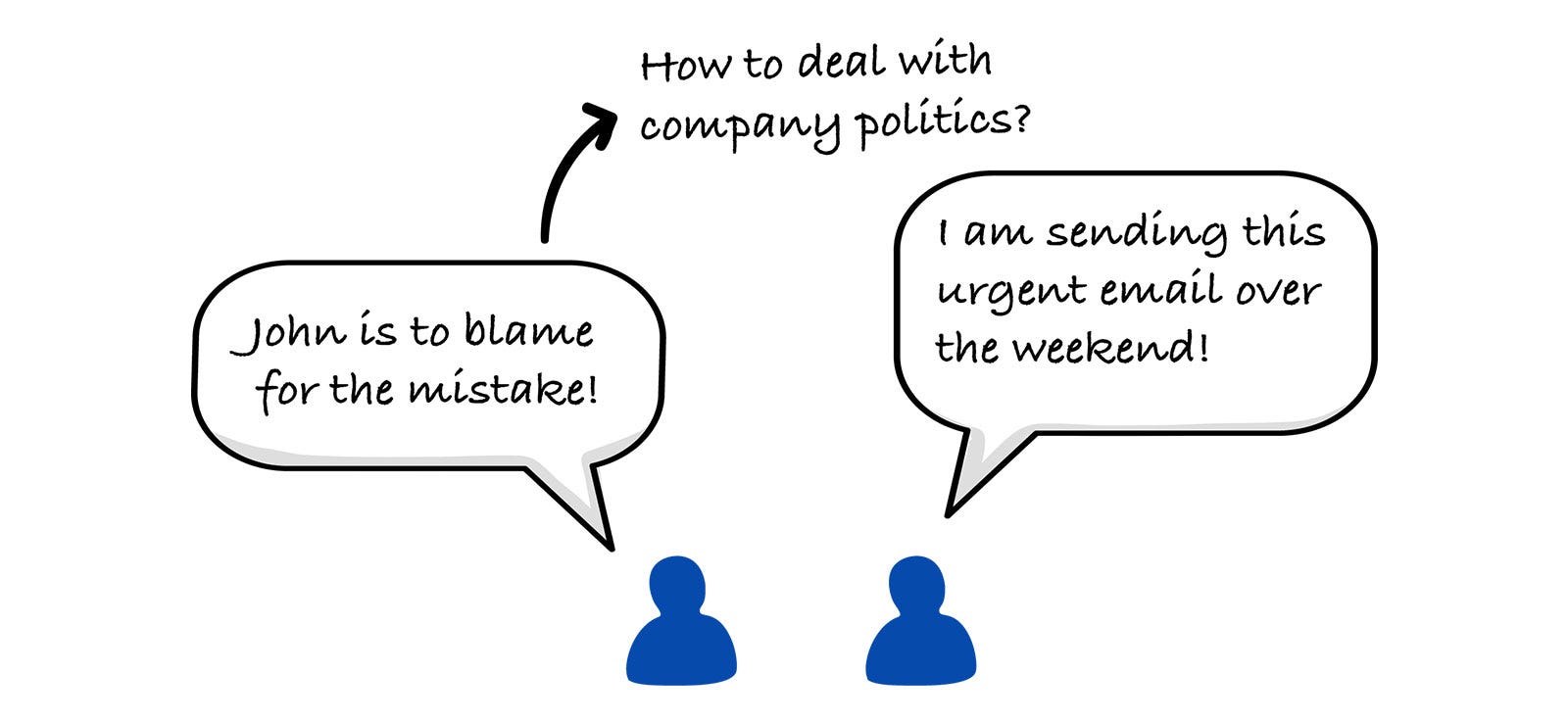
For example, if people are openly blaming others or saying bad things about certain people openly, don’t automatically fall into that as well.
Or, if a certain leader is sending out emails overnight and on weekends, or even holidays, and always sticking the “urgent” sign to every request, it’s a bad habit for you to try to do the same.
Another one is to be “always online”, because a certain leader is always online to show everyone how much they are working.
It’s really important not to fall into these bad habits, because “that’s just how everyone operates at a certain company”.
Not every company culture is worth keeping up with it
I’ve been a part of some good cultures and some really toxic ones as well, where company politics were very unhealthy, and looking back at them, I should’ve made the move to go elsewhere sooner.
But interestingly, I somehow hoped that things would get magically better. But in reality, they never do.
Company politics rarely change unless there is a drastic change in leadership, starting with the CEO (in some cases also investors who are a lot more hands-on).
So, always ask yourself this question: “Is this environment healthy for me to be a part of long-term or not?” This will give you a good answer, and if the answer is “No”, that’s the time to start looking elsewhere and see what options are out there for you.
But also keep in mind the following: Every company has pros and cons, and the grass is not always greener on the other side. So, moving to another company might not actually solve your problem.
Even if the interviews are great and the experience talking with different people has been good, you really see the actual culture when you join the company.
That’s also why my recommendation to you should be to have career and job optionality. I know it’s a lot harder these days, especially in the engineering industry, but with enough credibility and social proof, you can have that.
You just need to keep working on it every day. You got this!
Last words
Always keep in mind that “dealing with company politics” and being able to deal with it well is actually part of your job as an engineering leader, there’s just not any official requirement for you to do that.
I’d even say that a lot of your success in your role depends on how well you are able to deal with it, so treat it as an actual skill and focus on improving it.
It will pay dividends in the future, I promise.
Liked this article? Make sure to 💙 click the like button.
Feedback or addition? Make sure to 💬 comment.
Know someone that would find this helpful? Make sure to 🔁 share this post.
Whenever you are ready, here is how I can help you further
Interested in sponsoring this newsletter? Check the sponsorship options here.
Check out my book “The Multiplier Mindset” coming out later this year, here.
Take a look at the cool swag in the Engineering Leadership Store here.
Want to work with me? You can see all the options here.
Get in touch
You can find me on LinkedIn, X, YouTube, Bluesky, Instagram or Threads.
If you wish to make a request on particular topic you would like to read, you can send me an email to info@gregorojstersek.com.
This newsletter is funded by paid subscriptions from readers like yourself.
If you aren’t already, consider becoming a paid subscriber to receive the full experience!
You are more than welcome to find whatever interests you here and try it out in your particular case. Let me know how it went! Topics are normally about all things engineering related, leadership, management, developing scalable products, building teams etc.


Love the idea of the influence diagram! It sounds like something obvious and easily overlooked, when in reality drawing it will help to decide who to get on your side, and whose opinions weigh less in conversations