


MoEngage Inform (Sponsored)
This week’s newsletter is sponsored by MoEngage Inform. As tech leaders, we’re forever looking to optimize costs while increasing efficiency — but this shouldn’t impact the speed at which your devs ship.
MoEngage Inform is a single-API infrastructure for critical alerts that cuts costs by 60% and frees up dev bandwidth by 95%, so they can focus on P0 tasks instead.

Brands like JPMorganChase, Chuck E. Cheese, Panasonic, and SoundCloud trust MoEngage to:
Add & Manage New Channels within minutes
Debug in Real Time with centralized logs
Consolidate 100s of integrations into 1 API
Send millions of critical alerts in <3 seconds
And all of this Without Engineering Overhead, AT SCALE!
Take the mess out of your messaging infrastructure today.
Let’s get back to this week’s thought!
Intro
As engineers, we may believe that technical skills alone are what makes a big difference. But the more my experience grows in the engineering industry, the more I see that:
A lot of problems in tech are actually people problems.
I like to say that Engineering is one of the most collaborative fields out there and if you are not able to work well with others, it will be really hard for you to show your value.
People with high EQ are often great team players, great collaborators and overall great people to work with.
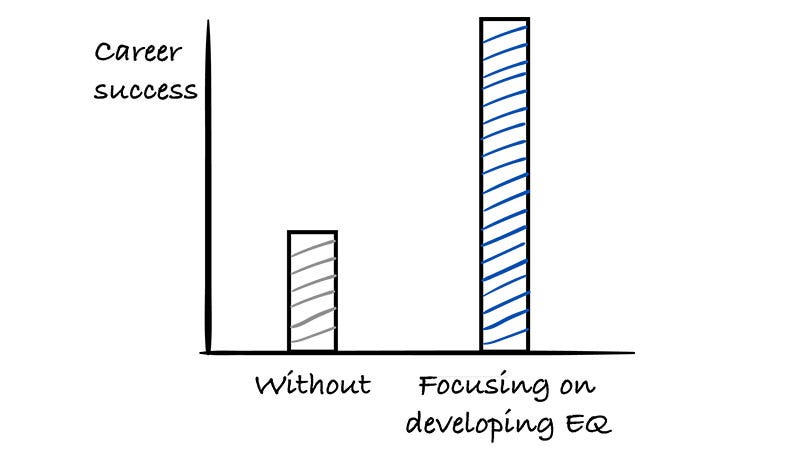
The good thing? You can develop and improve your EQ. And by doing that, you’ll be set up for success in our industry!
Lucky for us, we have Patricia Juarez Muñoz with us today as a guest author. She is sharing her insights based on her own opinion and experience on: why EQ is so important and how to develop it.
Patricia, over to you!
When in my career I got feedback about having a high IQ but low EQ, I got confused
I always believed that emotions had no place in the workplace.
Then, I listened to “Power of Vulnerability” by Brené Brown and read “Emotional Intelligence” by Daniel Goleman and found out that I was doing things wrong. Embracing our emotions is a powerful leadership tool. Suppressing them was stopping my growth and even risking my job at the staff level.
I wasn’t aware. Stopping my emotions was negatively impacting the team's well-being and the efficiency of our collaboration and communication.
Learning about Emotional Intelligence (EI) and how to embrace it allowed me to understand myself and connect better with others. It unblocked my path toward the person I wanted to be: a role model for my team, a leader who inspires.
And I believe I’m achieving my dream without climbing the professional ladder. As a Staff Engineer without formal authority, I’ve influenced executive leaders (L8s) and the vision across organizations through inspiration.
My learning: Being good at interacting with people is not just for managers. EI makes us more human and is the multiplier that transforms good engineers into exceptional technical leaders.
IQ vs EQ: Which one do I need as a Tech Lead?
IQ measures cognitive intelligence; the capacity for problem-solving, critical thinking, and logical reasoning of what is known.
EQ measures emotional intelligence (EI); the ability to understand and manage oneself and others' emotions, and use that awareness to guide our decisions.
Before: When a colleague asked me for help, I immediately jumped to solutions, and sometimes I offered myself to fix things. It felt good to help. Then, it got to a point where I became a bottleneck unintentionally. – I was showcasing a high intelligence quotient (IQ) but low emotional quotient (EQ).
Now: I listen, ask questions, and support my team to get through the challenges. – I showcase my emotional intelligence first. And it feels great too. I help my peers to grow and scale.
Then, if my team really needs my answers, I walk through my reasoning together with my peers, turning solutions into learning opportunities.
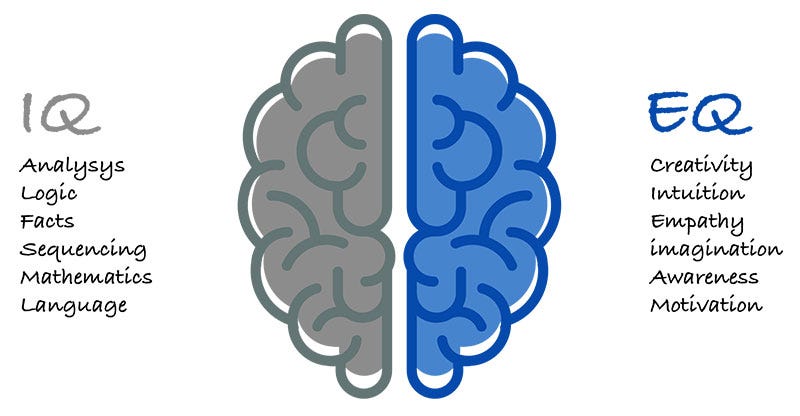
By combining EQ with IQ, we achieve greater success.
Both types of intelligence can influence our job performance, relationships, and overall well-being. It’s not that I didn’t have EQ, it was that my EQ/IQ were not balanced.
Understanding and developing both is your key to thrive!
Choose the EQ/IQ areas you need to improve by considering:
Self assessments results. E.g. for IQ Stanford-Binet Intelligence Scale, and for EQ MSCEIT and STEMs and ESCI.
AI impact in your daily jobs. E.g. Technical knowledge, memory and basic problem-solving is being automated.
Your current job requirements and future career aspirations. E.g. EQ becomes more valuable at higher leadership levels.
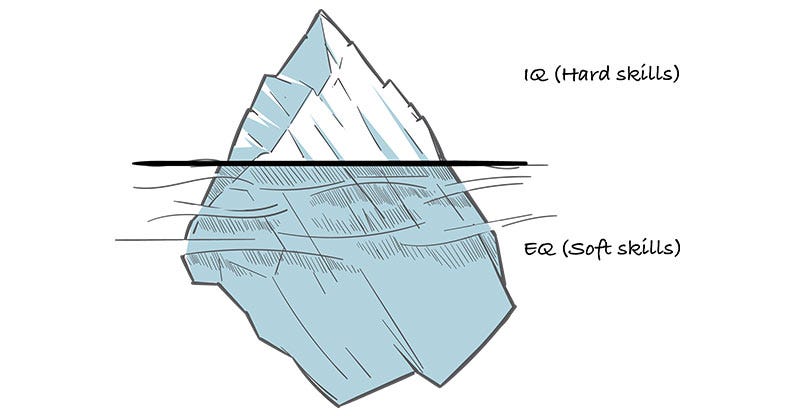
The Secret of Top Performing Teams: Emotional Intelligence
According to Daniel Goleman, emotional intelligence matters twice as much as IQ or technical expertise in determining performance. He says that it is almost 90 percent of what sets star leaders apart. Multiple studies support him, and 20% of companies measured EQ in 2014.
“Strong emotionally intelligent leaders tend to lead more successful teams.” - Joshua Freedman
“Companies with more self-aware employees, from IC to top-level executives, significantly outperform while only 10% of people are really self-aware.” - Korn/Ferry Instititude
In my personal experience: Emotional intelligence was a growth area that was recommended by my manager. After starting to apply it, the team’s and my performance increased.