


This newsletter is sponsored by Unblocked.
How much work can you hand to your coding agents?
It depends on what they know when they start. Maybe an engineer pastes the context in, or it lives in rules files. Maybe your agents fetch it through MCP connectors and still return outdated docs instead of last week’s Slack decision.

Find your team’s stage and what’s holding your agents back in five minutes.
Thanks to Unblocked for sponsoring this newsletter. Let’s get back to today’s thought!
Intro
When I first became an engineering manager, I wasn’t sure if my style of communication, delegation, and decision-making was the best possible way of leading the team.
I was more or less leading with my instincts, and hoping things would turn out fine.
What I’ve learned throughout the years is that a different situation requires a different style of leadership.
And that’s where your leadership range becomes crucial. You are able to optimize the way you lead based on the situation.
Luckily for us, we have both Cate and Jean with us as guest authors today. They’ll share all about how important leadership range is and how to develop it!
Let’s introduce our guest authors.
Introducing Cate Huston and Jean Hsu
Cate Huston is a fellow O’Reilly author of the book The Engineering Leader, fractional CTO at Twill, and engineering leadership coach. Previously in leadership roles at DuckDuckGo and Automattic, and an advisor at Glowforge.
Jean Hsu is a VP of Engineering at Circuit & Chisel. Previously in leadership roles at Pulse, Medium, and Range, and built out a leadership development company focused on engineers.

They are also running an 8-week async course for engineering managers called Engineering Manager Survival Guide. Their next cohort begins February 8, 2027.
Both bring a wealth of engineering leadership experience and insights, and I’m excited to have them share their knowledge with us as guest authors today.
Let’s start!
Why leadership range matters more than ever
Someone once gave Cate an incredible compliment: they said she was as good in peacetime as in wartime.
Cate is in software, not the military, so it’s an odd compliment to get, but an accurate one. She has range as a leader; she can operate in the good times as well as the bad times.
Leadership range is the ability to draw on different approaches depending on what a situation actually needs.
When the industry was cushier, maybe it seemed less necessary; you could find a situation matching your preferences, and stick with it.
But the industry is more chaotic than ever, and you may very well find yourself in situations that don’t fit your default leadership style. As a result? Leadership range is more important than ever.
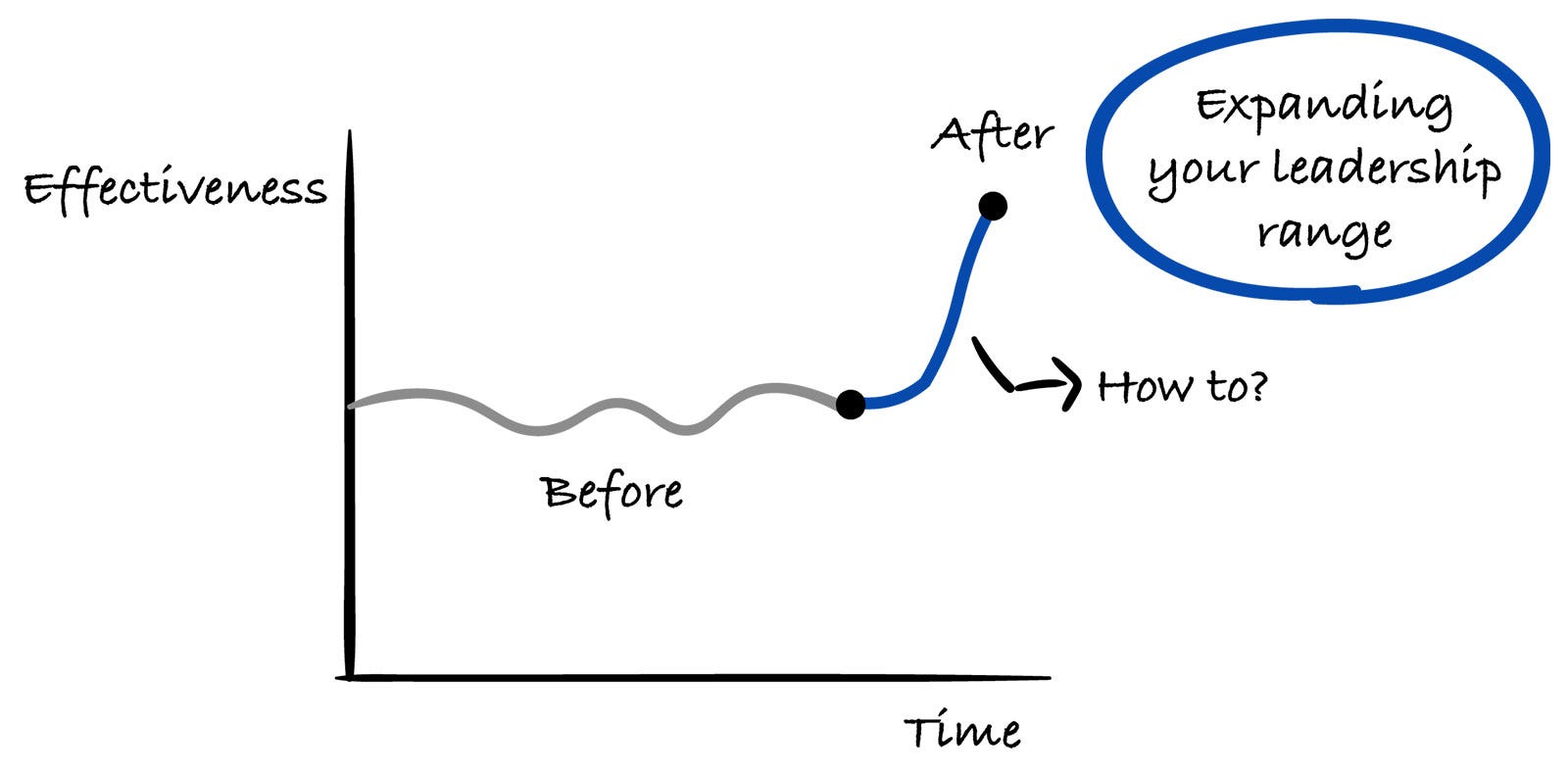
Expanding your leadership range is also what helps you bridge the gap between surviving and thriving as a leader.
So if you feel a bit more like you’re surviving than thriving right now, and if the upending of basically everything in tech is making you question the playbooks you used to rely on, this article is for you.

Build leadership range before you need it
When we are in survival mode, we narrow. We fall back on instinct, we cling to what is familiar and whatever worked before. That’s a response to threat, but it’s a limiting one when the threat is the challenge we signed up for.
In contrast, thriving is expansive. It means having options, and being able to read a situation and choose a response rather than reacting from habit or fear.
The paradox: the greater the challenge, the more you need a broad range, and the harder it is to build one in the moment. You have to build range when you are not activated, so you have more available to you when you are.
You can both recognize your strengths and think beyond them. Too often, people see their strengths as an immutable part of who they are, and they don’t think about expanding past them.
It can be threatening and can feel like becoming a kind of leader you decided you weren’t, or actively didn’t want to be.
Try and keep an open mind. Like so many tasks (perhaps backlog grooming or hunting down gnarly bugs), there are things you don’t have to like or enjoy; it does benefit you to be able to do them.
Recognize your default strengths
We all have habits, and our leadership habits are no exception. We are not different people at work than we are anywhere else.
Our leadership range reflects who we are, what we value, how we want to be seen. These defaults are often our strengths, and have served us well in getting us to where we are.
But remember the old adage: when you only have a hammer, everything looks like a nail. Defaults stop serving you when they are the only tool you have, or when you reach for them automatically regardless of what the situation needs.
Early in your career, you improve by fixing what you’re obviously bad at. Later, the ways you get in your own way are usually the flip side of things you’re great at, what we call your controlling weaknesses.
Marcus Buckingham and Donald Clifton’s Now, Discover Your Strengths makes the case for building on your strengths and managing around most of your weaknesses; a controlling weakness is the exception.
If, as a manager, you can’t have a hard conversation, that one gap will rapidly govern everything else. It doesn’t have to become your most-used tool. It does have to be available when you need it.
It is often difficult for people to see their strengths clearly. We tend to over- or undervalue our strengths.
Cate undervalued strategy for years, belatedly realizing that she’d been doing other people’s strategy for them, without credit. She started writing things down instead, which made it clearer whose work it was.
Jean undervalued reliability, the plain ability to do what you say you’ll do, or tell someone early if it won’t get done. It seems like the obvious baseline to her, so she discounted it as a strength, until she kept seeing people who just don’t have it.

Name your saboteurs
In coaching, we call the ways we get in our own way our saboteurs. The Positive Intelligence program used factor analysis to reduce them to ten that most people carry some mix of, and it has a free quiz.
What we like about the framing is how neutral it is. It’s not “I am hyper-vigilant,” but “there’s a hyper-vigilant part of me.” The saboteurs are allowed to be in the car, but none of them should be driving.
Cate’s saboteurs are all the hypers:
hyper-achiever,
hyper-rational,
hyper-vigilant.
This will shock no one who knows her. When she first took it she scored high on most of them, and over time they’ve come down. They’re not going away, but they’re no longer driving her decision-making.
Jean’s saboteurs were:
pleaser,
avoider, and
restless.
Her default is to go with the flow and avoid conflict, a short-term optimizer, which is a problem exactly when you need to set long-term structure and boundaries.
The hyper-achiever is worth singling out because it’s everywhere in tech. This saboteur’s core message is that your only value is your achievement, and it is genuinely terrifying to operate from a sense of your own potential instead of beating yourself up.
You might think that if you weren’t beating yourself up, you’d just lie down and sleep for a month. Turns out that’s not true. It can be hard to believe, but the more we work from self-kindness rather than self-criticism, the easier it is to land at a sustainable output that’s actually higher.
Naming your saboteurs matters because they’re what stops you from reaching for a different more effective style when necessary.
You don’t have to defeat your saboteurs to lead well, but you do have to be aware of them so that they’re not calling the shots. They can provide input, but you’re the one driving.
Learn the 6 styles
Daniel Goleman’s research identified six leadership styles (HBR, 2000). Whilst it’s useful to have the categories, the most useful insight is that effective leaders don’t have just one style, they have range.
The research found that leaders who could draw on four or more styles, and switch as conditions required, created the best climate and the strongest results.
The ones who’d mastered only one or two, or reached for the wrong one, did worse, despite how hard they were working.
Coercive “do what I say”
Immediate compliance. Right for a genuine crisis or someone going off the rails. Almost everywhere else it kills initiative.
Authoritative “come with me”
Sets the goal, leaves the means to the team. Strong when a team is adrift; weak when they know more than you.
Affiliative “people first”
Builds harmony, heals rifts. Alone, it lets poor performance slide.
Democratic “what do you think?”
Builds buy-in and ideas. Wrong, it’s endless meetings and no decision.
Pacesetting “do as I do, now”
High standards, modelled. Great with an expert, motivated team; elsewhere it overwhelms and creates dependency on you.
Coaching “try this”
Develops people over time. Not a substitute for clear feedback when performance is the problem.
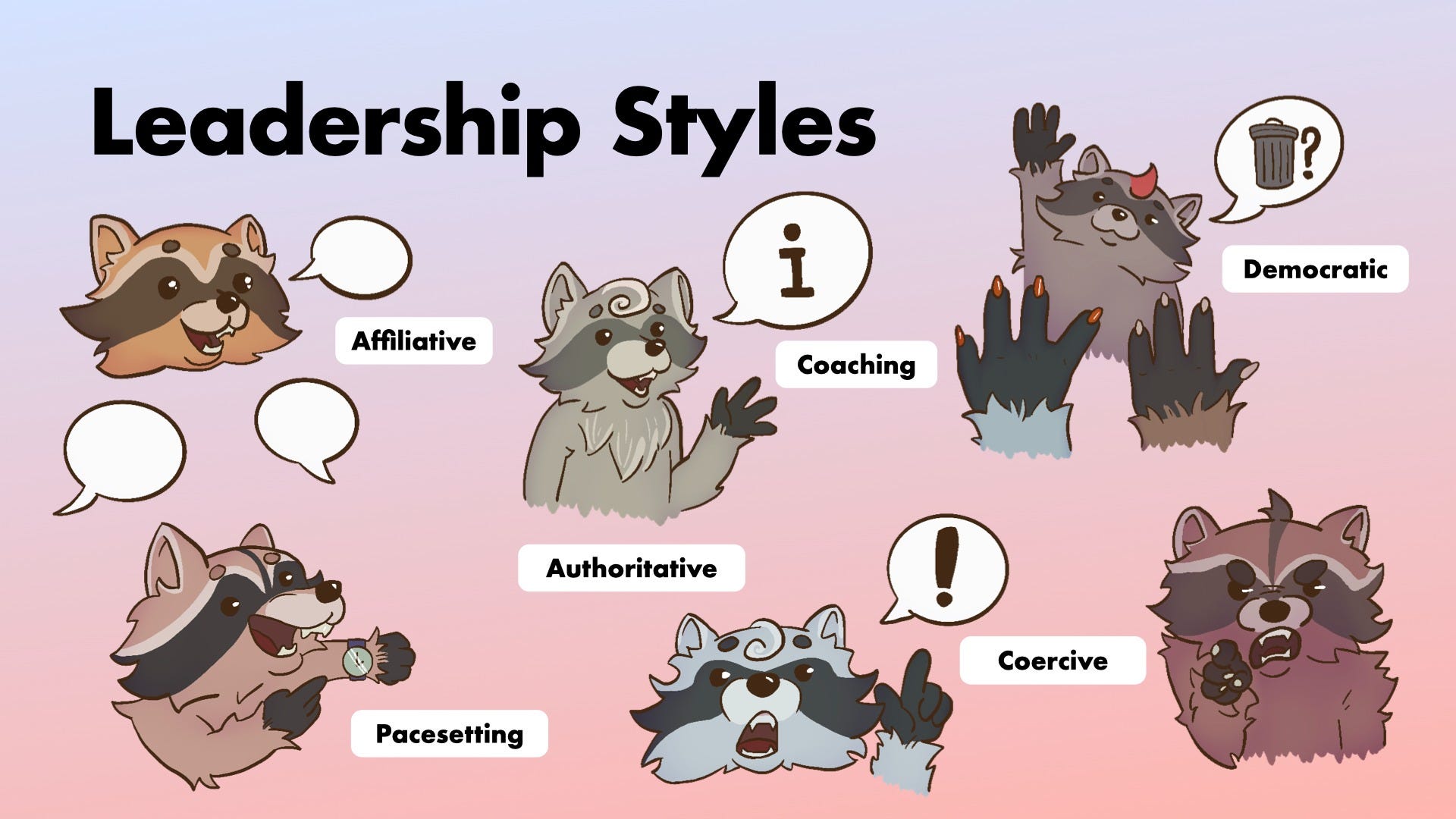
The style you think you’re using isn’t always the one others experience. You can see yourself as authoritative, setting a vision and granting autonomy, while your team experiences you as coercive because you’re also dictating the how.
Self-perception can be unreliable here; power dynamics create distortion, and people aren’t always willing to speak up unless you ask them to (and sometimes even then).
Notice the style you over-rely on
Most managers overuse one or two styles and never visit the rest. We both over-rely on coaching, so much so that we both went and got coach training.
Coaching is powerful when it works. When it doesn’t, when someone genuinely doesn’t want to change, the longer you spend coaching them the more time you’ve wasted.
Jean learned this concretely. She moved into engineering management at Medium, where it was initially a very coaching-shaped role, a matrix org where you managed people across teams you weren’t actually working on.
Coaching was literally the only tool she had, and in that context, there’s no option to say “let me go fix that for you.”
It worked beautifully for motivated, autonomous high performers, but when there were performance issues and unmet expectations, it was so slow and troublesome to root-cause problems. A more direct, authoritative approach would have been far more effective.
Pacesetting can catch you the same way, and it can be harder to see.
The demand for “hands-on leaders” is often a demand for someone who’ll set the pace, and most of the writing on this style warns against it.
What surprised us is how easily it shows up even outside a manager-report relationship.
When Cate left her day job and suddenly had creative energy and abundant time, she set the pace for Jean for weeks, including a stretch when Jean had a stomach bug.
It was effective at first in achieving quick progress, but soon felt unsustainable for Jean’s available bandwidth, and she became somewhat disengaged.
In remote work especially, a leader who always reaches for a pacesetting style can miss contextual cues of what their team can really handle.
Identify the styles you avoid
We need to look at the styles we avoid, and why. This can be hard and can feel in conflict with your values, at least at first, but that is not necessarily the case.
Cate avoided the coercive style for a long time, but finally had a breakthrough by thinking about it as a backbone.
She once asked someone whether she seemed like a pushover, and they very gently said, “there have been situations where you’ve really taken the high road.” Which is a very kind way to say yes.
Now she thinks of coercive as boundaries: being flexible, but only up to a point. A high performer and a low performer can experience Cate as two different people, even though she’s not, it’s just that she’s operating from trust with one and from the backbone with the other.
Jean similarly finds coercive and authoritative styles difficult, even when they’d plainly be more effective.
What changed things for her is realizing that the coaching style builds the trust that lets her use the other styles. If she walked into an org 100% coercive, that would be a huge turn-off and she wouldn’t be able to be an effective leader.
But if people have seen her operate at high trust, then once in a blue moon saying “I need everyone to push hard this week” lands completely differently.
For her, her strength of coaching is what makes the harder styles work when she needs to reach for them.
Start here
If you want to build range, our suggestions:
Start with your values
They explain what energizes and drains you, and your failure modes are usually the flip side of what you value most. Name your top five, and for each, notice how it shows up at your best vs your worst.
Find your strengths, then look at their shadow
16 Personalities is free and enough to start; Clifton Strengths goes deeper. For each strength, ask what its overuse costs you, and which strengths you take for granted because they come easily.
For your top few saboteurs, ask what each is trying to protect you from. That question will tell you when they serve you, and when they don’t.
Map yourself onto Goleman’s six
Which two do you overuse? Which do you avoid because they’re uncomfortable rather than wrong? What feedback have you heard repeatedly across your career, and what does it say about your default?
Match your style to the timeframe you’re optimizing for
In an incident you want the fastest resolution, so telling people what to do makes sense, but if you’re building a team over months, that same move strips autonomy and learning. Ask what timeframe you’re on before you pick a tool.
Pick one thing for the next two weeks
If you default to the softer styles, add some democratic and use authoritative to make sure decisions actually get made. If you fall on the harder side, coercive or pacesetting, try democratic or coaching, which still keep the focus on the work rather than the emotions and can feel more reachable than jumping straight to affiliative.
Keep practicing
You’ll still find yourself in survival mode at times. Your defaults will reassert themselves, and that’s normal. But when you catch yourself defaulting to one style regardless of context, you can notice it and pause.
When you find that you’re avoiding an approach because it’s uncomfortable rather than wrong for the situation, you can try it anyway.
Range isn’t something you achieve once. It’s a practice, and new styles feel awkward at first, like speaking a language you’re still learning.
That awkwardness means you’re expanding. Be proud of yourself for trying.
This type of leadership work lives on the longest timeframe, far beyond your current job. The team changes, the title changes, the crisis changes.
What you keep is a wider set of ways to respond, and the judgment to match your approach to what the moment in front of you actually needs.
This article draws from Module 4 of the Engineering Manager Survival Guide, our 8-week async course for engineering managers. Our next cohort begins February 8, 2027.
Illustrations by Joe Groove.
Last words
Special thanks to Cate and Jean for sharing these insights with us!
Make sure to follow them on LinkedIn and also check out their course, The EM Survival Guide, where they focus on helping everyone become great engineering managers and thrive in their roles.
Liked this article? Make sure to 💙 click the like button.
Feedback or addition? Make sure to 💬 comment.
Know someone that would find this helpful? Make sure to 🔁 share this post.
Whenever you are ready, here is how I can help you further
Interested in sponsoring this newsletter? Check the sponsorship options here.
Check out my book “The Multiplier Mindset” by O’Reilly, here.
Take a look at the cool swag in the Engineering Leadership Store here.
Want to work with me? You can see all the options here.
Get in touch
You can find me on LinkedIn, X, YouTube, Bluesky, Instagram or Threads.
If you wish to make a request on particular topic you would like to read, you can send me an email to info@gregorojstersek.com.
This newsletter is funded by paid subscriptions from readers like yourself.
If you aren’t already, consider becoming a paid subscriber to receive the full experience!
You are more than welcome to find whatever interests you here and try it out in your particular case. Let me know how it went! Topics are normally about all things engineering related, leadership, management, developing scalable products, building teams etc.