


This week’s newsletter is sponsored by Steady.
It’s time to quit doing work about work
55% of your engineering team’s time is spent doing busywork—chasing status updates, hunting for information and managing the mechanics of work.
All that work about work pulls devs out of flow, threatening focus, productivity and velocity.

Get the guide to Continuous Coordination and learn:
The proven system that gives teams time back
How to increase autonomy and accountability
Advanced techniques for reducing coordination overhead
Thanks to Steady for sponsoring this newsletter. Let’s get back to this week’s thought!
Intro
Behavioral interviews play a significant part in the interview process. And in my opinion, the importance of behavioral interviews is just going to keep increasing as time goes on.
The reason?
The reason is that we are in the age of AI, where focus is a lot more on your soft skills, overall communication, and problem-solving. A lot less on your pure coding abilities.
Therefore, what problems you have solved (stories), what impact you had, and your overall skill to present your results and learnings in a compelling way → that’s going to be more and more important.
To help us be well prepared for behavioral interviews, especially for Big Tech roles, I had the pleasure of talking with Austen McDonald. In this article, I am sharing our full conversation and an in-depth overview of it.
Let’s introduce our guest author.
Introducing Austen McDonald
Austen McDonald is a former Senior Engineering Manager and Hiring Committee Chair at Meta, where he did over 1,000 interviews and trained 100s of interviewers, setting interview structures and picking questions.

Grab a copy of his best-selling book Mastering Behavioral Interviews, to get a complete prep system and learn how to land the roles that really matter.
My Full Conversation With Austen
You can watch/listen to the video below for the full conversation, or you can keep reading for the in-depth overview of our conversation.
Let’s start!
Behavioral Interview is Where Your Level Gets Determined
When I chaired Meta’s iOS + Android hiring committees and reviewed packets for staff-level engineers, I went directly to read the behavioral interview feedback.
System Design is also critical, of course, but I wanted to see immediately whether the candidate was solving staff-level problems and had the depth of experience and insight to be successful leading Meta’s highly autonomous engineering teams.
No staff-level scope there, no staff-level offer.
Let’s face it, there are only so many ways to invert a binary tree, and that’s not what senior engineers are for anyway.

We have AI for that now, and the scope of what’s required for senior engineers is only widening as we rely more on automated implementation.
Ownership, communication, the ability to handle ambiguity, conflict resolution skills, and leadership are what’s needed on teams. These are all assessed in the behavioral interview.
If you’re a senior/staff/principal+ engineer preparing for big tech interviews, the behavioral round isn’t something to squeeze in between LeetCode sessions. You need to actually prepare for it. It’s where your level gets determined.
Why Senior Engineers Underprepare for Behavioral Interviews
Most senior engineers underprepare for behavioral interviews:
Their career has changed
A senior candidate might not have interviewed in a while, and during that time their scope has grown. They might be stuck in a more junior engineer mindset where behavioral interviews are more of a disqualifier than a critical part of the leveling process.
Interviewers’ expectations have changed
As AI does more implementation work, more and more will be expected of our soft skills.
Senior engineers have a lot of stories, and they are long
A senior engineer has more projects to talk about, so more emphasis needs to be placed on careful story selection. Also, senior engineers tend to have long projects that are then difficult to discuss. It takes effort to organize them and extract the most useful bits for interviewers.
There are often multiple behavioral rounds
For Principal+ roles and managers, there are often multiple behavioral rounds: general culture fit, managing people, working with cross-functional partners, technical project retrospective, etc.
Every company’s process is different, but behavioral interviews provide the majority of the signal for these roles. For a principal role at a FAANG, compensation could be $1M+, so You Better Eat Your Wheaties before that interview.
The Real Way to Prepare: Decode-Select-Deliver
Most engineers approach behavioral prep like they approach coding prep. They find a list of “Top 50 Behavioral Interview Questions” or whatever and start rehearsing answers.
This is logical but wrong.
Behavioral interviews are about you and your actual experiences. You can’t practice your way through “Tell me about a time...” questions the same way you practice algorithms.
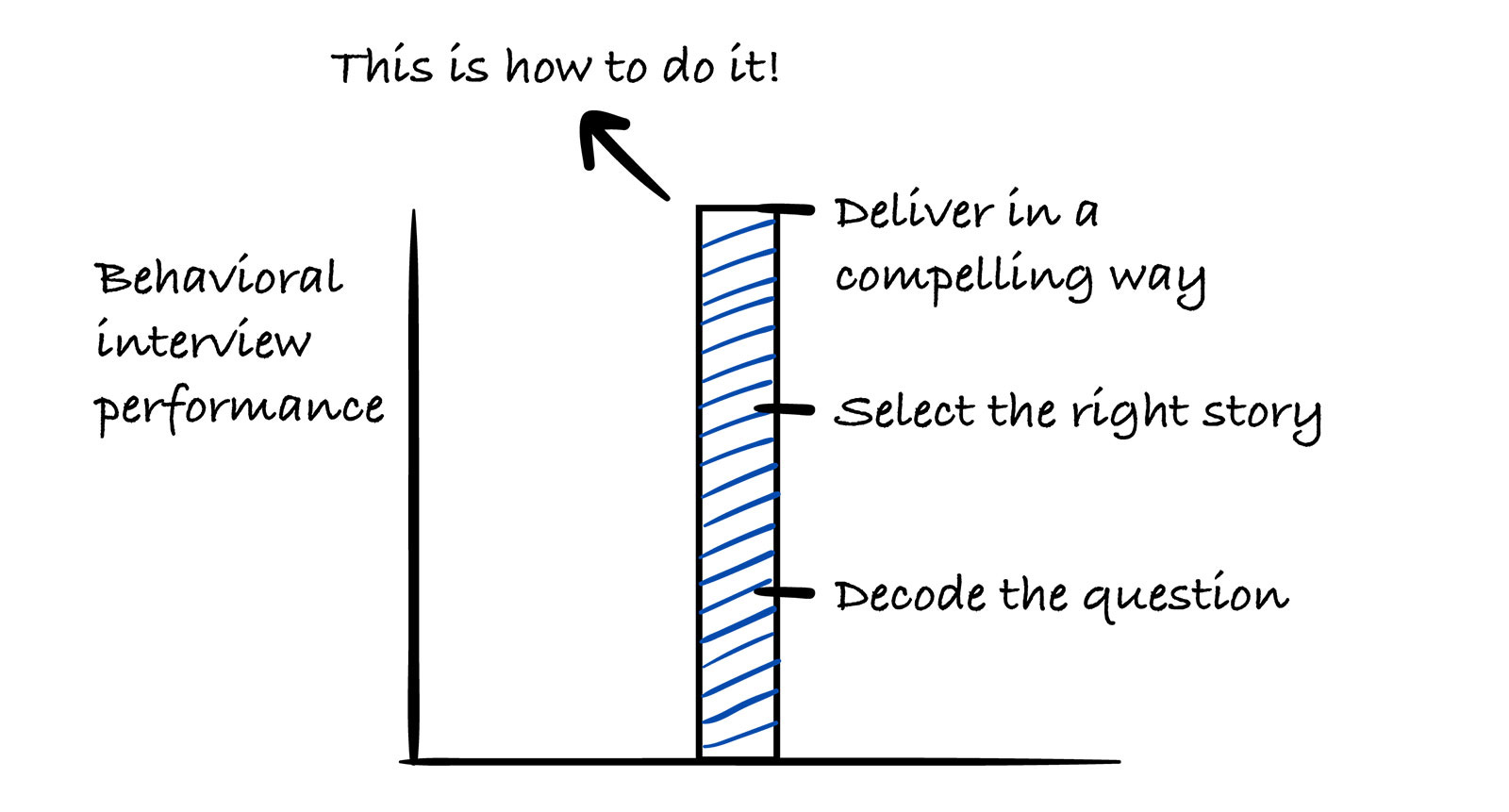
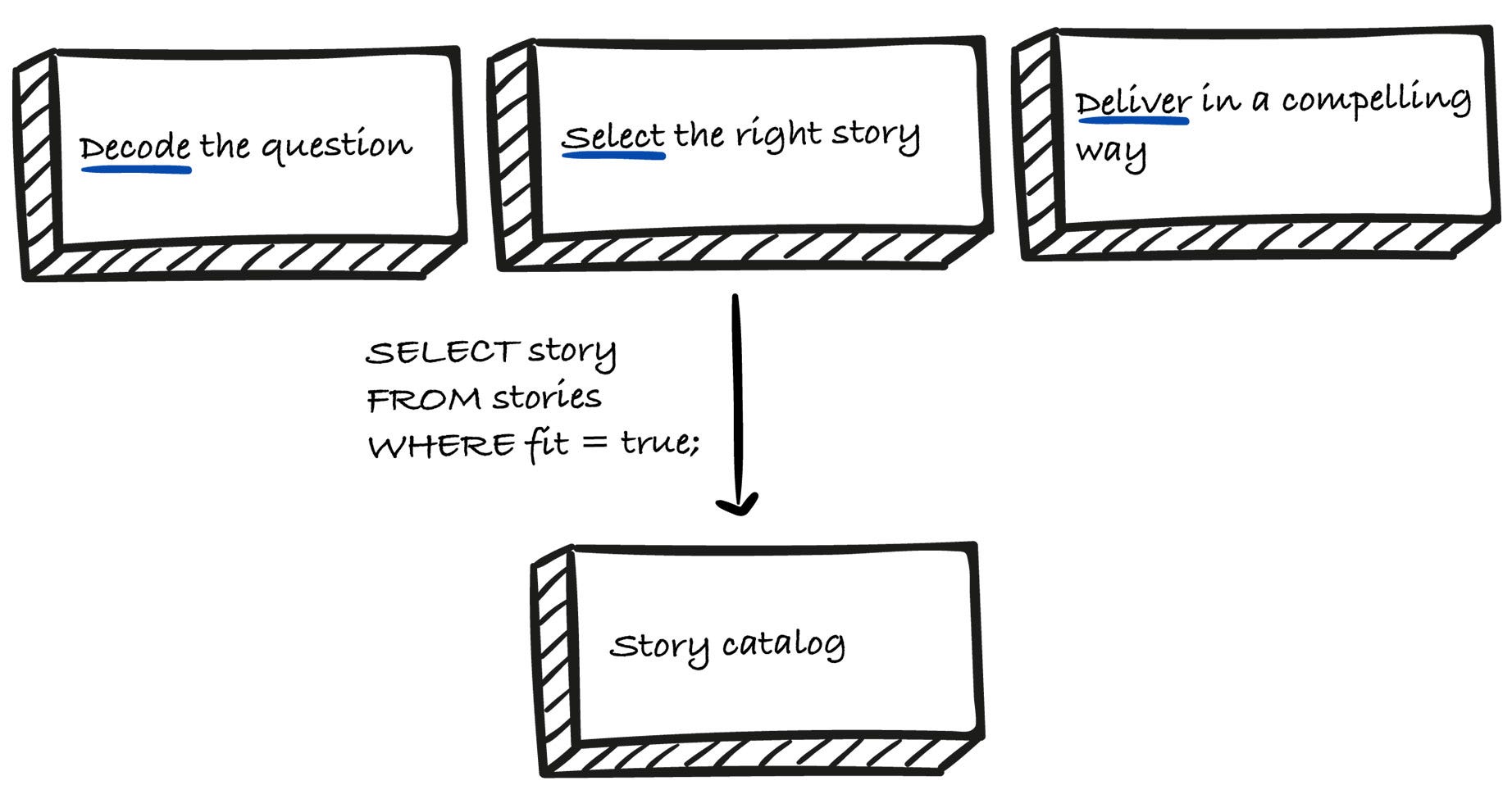
Instead, you need to be able to do three things in the interview:
Decode the question to understand what signal the interviewer is looking for. When someone asks “tell me about a time you had a conflict with your manager,” they’re not specifically interested in manager conflicts. They want to understand how you handle challenges with people in positions of authority.
Select the right story from your past that demonstrates the strongest signal. Often this means choosing the story with the largest scope, even if it doesn’t exactly match the literal question asked.
Deliver that story in a way that’s engaging and highlights your repeatable behaviors.
To do these three things well, you need a story catalog ready to go.
Building Your Story Catalog (Perfect Timing for Performance Reviews)
If you’re reading this in early 2026, you’re probably in the middle of writing your annual or semi-annual performance review. This is the perfect time to build your story catalog, even if you’re not actively interviewing.
Your story catalog should include 3-4 core stories that represent your high-water marks. These are the stories you’d tell a hiring manager if you only had a few minutes to demonstrate your capabilities.
For a staff engineer interview, these might be:
A multi-year initiative you drove that involved coordinating across multiple teams
A significant technical refactor with substantial business impact
A situation where you resolved conflicts between teams with competing priorities
A project where you handled significant ambiguity and made critical architectural decisions
One of my core stories from my time at Meta was how I transformed the iOS and Android recruiting pipelines to assess skills closer to the job, standardizing the coding and system design portions, enabling us to hit our hiring goals while helping to resolve some negative sentiment in the job market about Meta.
It shows strong evidence of ownership, communication, conflict resolution, data-driven decision making, and leadership.
Be sure to tag these core stories with what signal areas they demonstrate.
Beyond your core stories, you need additional stories covering any signal areas your core stories don’t touch on: scope, ownership, communication, growth, ambiguity, perseverance, conflict resolution, and leadership. Go through each signal area and identify at least one story that demonstrates your capabilities there.
To help those writing performance reviews, pay attention to the projects where you:
Took initiative beyond your assigned work
Solved a problem that seemed impossible
Changed someone’s mind with data
Made a mistake and learned from it
Helped someone else grow
Those are your behavioral interview stories for when you need them.
Structuring Stories with CARL
Once you’ve identified your stories, you need to structure them effectively. Most people know STAR (Situation-Task-Action-Result), but I prefer CARL:

Context: The background of what was happening and why it mattered
Actions: The specific steps you took (plural, not singular)
Results: What changed and the impact you made
Learnings: What you learned or would do differently
The key difference is that CARL combines Situation and Task into Context, eliminating the mental energy wasted trying to separate them and it adds Learnings, which gives you a platform to demonstrate the depth of wisdom that separates senior engineers from less experienced ones.
When I interview someone who ends their story with a reflection like “This taught me to front-load alignment work before diving into implementation, which saved us three weeks on my next project,” I know I’m talking to someone who extracts transferable lessons from their experiences.
The Actions section deserves special attention. Interviewers are forecasters.
They’re looking at your past behaviors and predicting whether you’ll be successful in their organization. The more specific repeatable behaviors you can share, the more signal they get.
Don’t just say “I improved our deployment process.” Tell me:
You analyzed deployment failures from the last two quarters
You designed three different solutions and evaluated them against specific criteria
You wrote a proposal and shared it with the team
You got input from the platform team who would be affected
You implemented the changes incrementally
You measured the impact and shared results with stakeholders
Those are all repeatable behaviors. If you did them at your previous company, you’ll do them at the next one.
The Four Criteria for Selecting Stories
When an interviewer asks a question and you have multiple stories that could work from your Story Catalog, how do you choose?
Prioritize in this order:
1. Scope (most important)
Choose the project with the largest scope. This could mean:
Breadth and variety of actions you took across the software development lifecycle
Timescale (months vs. years)
Technical and organizational complexity
Business impact
2. Relevance
The story should naturally demonstrate the signal areas requested. But scope matters more than exact matching. If you’re asked about a conflict with your manager but your biggest conflict was actually with a product partner, tell the product partner story.
You still demonstrate conflict resolution with someone in a position of influence, but you showcase more of your repeatable behaviors. Time is short in interviews, so use your time to get out the largest scope stories.
3. Uniqueness
If you’ve already told a story in the interview, try to cover new ground with your next one. But don’t sacrifice scope or relevance for variety.
4. Recency
More recent stories carry more weight because they represent your current capabilities. But for senior candidates, a standout story from two years ago often beats a mediocre story from last month.
For more on story selection, including how to handle edge cases and different question types, check out the Select chapter in Mastering Behavioral Interviews.