


Intro
As much as we love our great engineering industry, it also has some downsides. These things are very common in our industry perfectionism, procrastination and feeling like an impostor.
All of such things can cause immense stress and can lead to burnout. But what to do to prevent such things from getting to us?
I have asked Richard Donovan, a Software Developer with over 22 years of experience, a mindset coach and also a personal trainer to share his insights on this important topic!
FYI: This is our second collab with Richard. If you are interested in reading our first collab, you can read it here: The importance of well-being in the engineering industry (paid article). You can read more about why well-being is so important in our industry.
Let’s get straight to Richard’s insights next!
Main reasons burning out is common in our industry
There are many reasons why burning out in the software engineering industry is so common. The factors are wide-ranging. They are driven by the organisations, the leadership, and the engineers themselves…
The Organisations
Many organisations offer a culture that is more likely to promote burnout than prevent it. Some of the worst offending insist on:
Working long hours and excessive workloads.
A blame culture when things go wrong.
Encroaching on personal time.
The Leadership
Unfortunately, leadership in our industry is often lacking, perhaps due to the focus on tech over people. It can result in:
Failure to provide feedback and recognition
A lack of guidance and support
Micromanagement
The Engineers
As engineers, we can sometimes contribute to our own downfall with things like:
Perfectionism
Difficulty Saying No
Not asking for support
We can quite quickly burnout if we are not careful
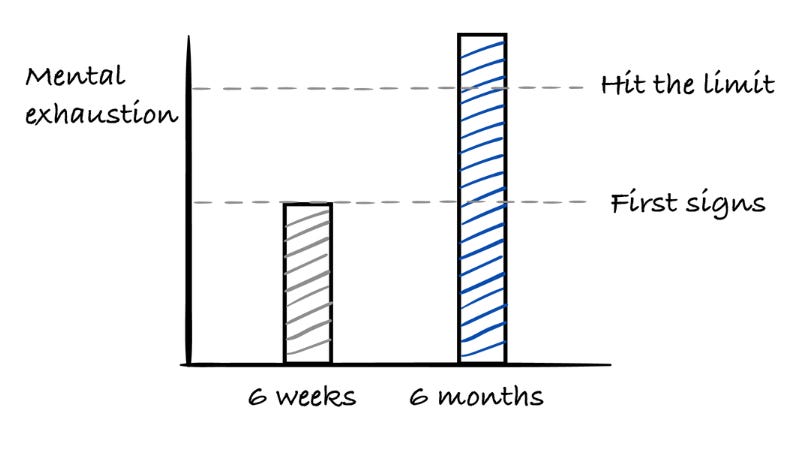
In my own experience with burnout, it was about 6 months before I recognised what was going on, but looking back, it was probably only 6 weeks for the signs to start showing.
I’d started a new job and felt imposter syndrome in a big way. I felt like everyone was better than me, and I needed to catch up.
I felt huge expectations from my boss. I started getting in early, leaving late, and continuing to work when I got home.
I leaned on exercise as an escape and ended up overdoing that, too. I dreaded going to work and started dreaming about things constantly going wrong.
One day, I found myself lying on the sofa physically and mentally exhausted, unable to muster the energy to vacuum the apartment.
Being naturally energetic, this was when I realised there was definitely something wrong. It’s difficult to put a timeframe on burnout as it’s very circumstantial and individualistic.
Many don’t see burnout approaching and find themselves deep in a hole when they finally realise it. It can take a significant amount of time to recover.
That is a big problem and that is why it’s so important to learn to recognise the signs as early as possible.
Recognising burnout can be tricky, especially if you’ve never experienced it before
The signs and symptoms could be caused by a million different things, as such, any one of them in isolation is not necessarily an indication of burnout.
However, it's super important to be aware of the signs and symptoms, and if you start to see an accumulation of them, it’s time to take action.
Some common signs that you could be facing burnout include:
Chronic fatigue and difficulty sleeping
Becoming overly negative and cynical
Feeling overwhelmed, anxious and depressed
Feeling a lack of motivation and a sense of detachment
There are some common behavioural signs, too:
Heavily procrastinating
Taking more sick days than usual
Withdrawing from social interactions
Turning to unhelpful substances to help you cope (alcohol, drugs, etc.)