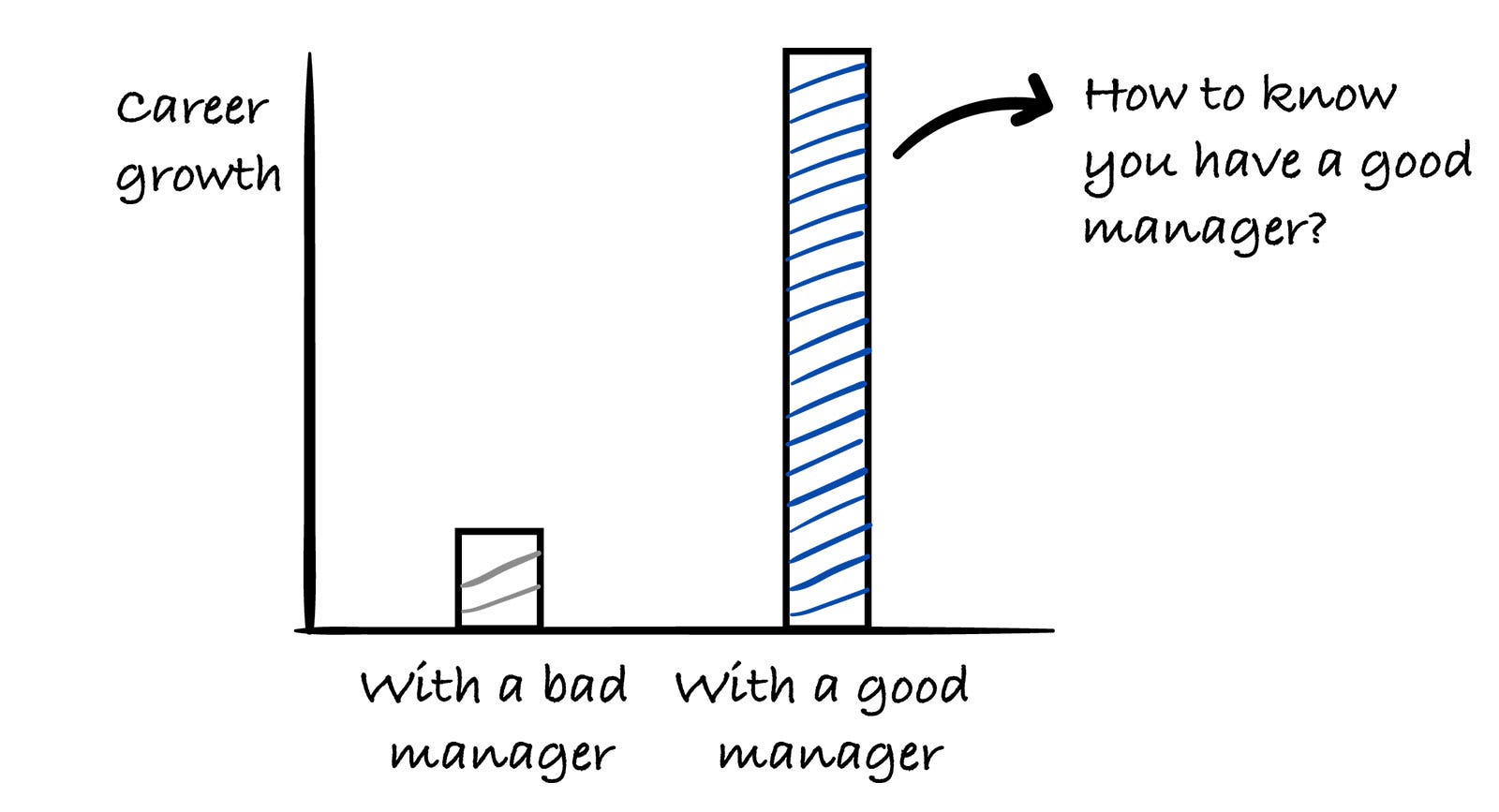
How to Tell if Your Manager is Actually Good?
The 3 signs that reveal whether your manager is helping you thrive or holding you back.
This newsletter is sponsored by Atono.
AI is definitely making engineers ship faster than ever. But AI-generated specs keep coming back with questions. And the problem is the missing product context, understanding in detail, how the product should actually work.
In this recorded webinar from Product School’s AI Builder Week, Doug, CPO at Atono, shows how important giving AI real product context is.
In the webinar, you’ll learn:
Why your AI keeps guessing and how product context fixes it
How to ground AI in your actual product decisions and architecture
When your spec is actually ready to hand off to engineering
Thanks to Atono for sponsoring this newsletter. Let’s get back to today’s thought!
Intro
I like to say that good managers are hard to find, and once you have them, they should be appreciated. The reason is that managers have a big impact on you and can be the reason you are having a great time at work or not.
And I also like to say that: “Engineering is a lot more about people than just tech” (I also wear a T-shirt with that sign as well!). Conway’s law is very real, as it states:
The structure of a system is determined by the communication patterns of the people who design it.
We can translate this to the following: The greater the communication + culture of the organization, the better the end product is going to be.
Therefore, good managers play an extremely important role in the success of any engineering organization. But how do you actually determine whether you have a good manager or not?
Luckily, Ryan Murphy will share with us today his insights from his experience both as an engineer and engineering leader.
Let’s introduce our guest author and get started!
Introducing Ryan Murphy
Ryan Murphy has about 20 years of experience, both as an engineer and engineering leader, most recently leaving Yelp after 5 years as an Engineering Manager to be a founder of EM Accelerator (use code GREGOR for 25% off).
I know Ryan for quite some time now, and we chat on different occasions, he’s also a planned tech reviewier for my upcoming book The Multiplier Mindset. Therefore, I am happy to share his insights in today’s article.
Over to you, Ryan!
When your manager tells you, “You are a resource”
When I was a mid-level engineer, I got my first big job outside of my small hometown. My new job was working for a stockbroker in London.
Something I had dreamt of since I started coding at age 11, building my own games website so I could bypass the school internet filters and play games in computer lessons.
On my first day in that job, my manager took me into a meeting room for the usual “Hey, how are you? Welcome” induction. At the end of that meeting, he said to me, “Remember, you are a resource here”.
Thinking back, his body language and tone were as if he was trying to make a power move over an early-20s mid-level engineer who was just here because he loved to code.
I didn’t notice anything weird at that time, I didn’t immediately flag that as a red flag. I just shook my head and said, “Absolutely”. I was naive, because it was my first big job in a company that actually had any structure, any semblance of formal management, so I had no idea how this really went in the real world.
For me, as far as I knew, this was completely expected behavior from a manager. I was extremely vulnerable, and that was taken advantage of by someone who was looking to assert their dominance and make sure I knew they were the person higher up in the food chain.
We expect people to manage others’ careers but don’t train them
This manager, I later found out, was a newly promoted manager. This is the same manager who told me in a 1:1 that I had the green light for some external training course, and then later rescinded that, saying the exact words: “My promise is worth the paper it’s written on”.
Thinking back now, and typing that, that’s crazy. Absolutely bonkers. My guess is that as you are reading this, at least some of you are reminiscing about your own horror stories. Nearly everyone has stories of awful managers who shaped how they think and behave in today’s workplace.
We are putting people into positions where, let’s face it, they have a significant impact on people’s careers and lives (no matter how much you preach about work/life boundaries, if you are having a tough time at work, this does bleed into your personal life), and we are not training them?
It’s a significant bottleneck in our team topologies, and we need to stamp it out.
How many managers have you ever met that had training outside of HR mandated internal training? Which is effectively just there to make sure managers act in formal situations according to the HR playbook.
This isn’t just me being emotional or sprouting opinion, according to a study from the Chartered Management Institute (CMI) in partnership with YouGov, 82% of workers in the UK entering management positions have not had any formal management and leadership training.
If you are joining a team that has a new manager, there is an 82% chance that this person, who holds significant sway over your well-being and career during your time with them, is untrained.
When I write it out like that, I find it impossible to come up with a reasonable defense.
It’s the team that suffers
The new managers eventually learn. Given enough time and enough hard-fought moments to learn from, they learn that this role is about being an enabler.
The role is all about delivering business value, about letting go of what made you a good IC, about understanding that a happy team has a much higher chance of being a high-performing team, and, in interesting contrast, perhaps that making the tough decisions and failing early on initiatives and/or people is actually in the best interest of the team.
And also understanding that psychological safety isn’t just a fluffy word thrown about for points and so much more.
All that time, the people who are really bearing the brunt of the “on-the-job” learning is the team of engineers:
Whose careers stall because the manager doesn’t know how to advocate for them.
Who get left in limbo because the manager doesn’t know how to coach them on stakeholder communication.
Who are stuck without leadership opportunities because their manager can’t let go of the critical path.
Who don’t feel safe to speak up because wellbeing is seen as a secondary citizen.
Who are stuck with the kind of manager who assumes that this role means they are an engineering leader now.
Who are building bad habits and creating silos because their manager doesn’t know how to have difficult conversations.
These are just some purposefully obtuse examples to get a point across.
What are the signs your manager is actually good?
There are managers, even when trained, who are not good, who just can’t let go of that autocratic nature and give the excuse, “My standards are just so high, and people can’t handle that”.
There are managers, even when untrained, who are inspiring, who just seem to be really good at learning what good looks like, both when wearing their leadership hat and management hat.
In the paper titled The Value of Bosses, published in the Journal of Labor Economics, Lazear, Shaw, and Stanton measured that replacing a boss in the bottom 10% of quality with a boss in the top 10% of quality raises the team’s total output by more than adding a whole new worker to a team of 9 people.
An increase in output is greater than an 11% increase in headcount.
There are signs you can look out for to see which side of the fence your manager, or you, sit on. I’ll be sharing the top 3 examples that I believe define a good manager the most.
1. Treats you like an adult
Everyone has worked in a culture where it seems like you need permission to go to the toilet.
I once worked for an agency where we got a 30-minute lunch break, and I was once 6 minutes over the lunch break one day, and the lead developer was told to watch my timekeeping (I was 20 minutes early that day, and stayed an hour past when I was contracted).
I also worked for a company where a junior engineer asked to come in 2 hours late (he pointed out he would stay late) so he could attend a doctor’s appointment. The boss said no, and that he needed to do it outside of work time or take a day’s holiday.
When the junior went on to explain that it was to take his Mum to a breast cancer screening, the boss stood his ground. I left that company within 3 months.
That same boss said to me on my last day, “I think in hindsight you will see you are making a mistake”. The ego was unbelievable.
A boss who doesn’t treat you like an adult is a problem that is shared by many, and I can prove that by showing you my most viral post ever.
In 4 years of creating content, I have not had a post that resonated like this. ~80k likes, >4k reshares, and nearly 30 million impressions made it clear to me that I wasn’t alone here.
This is a universal problem, and it’s why it has to go at the top of the list on how to tell if your manager is actually good.
Do they understand that to achieve our best work, we need to work to outcomes, not hours at desk?
Do they understand that if having 2 hours away from your desk one day every now and then to attend a cancer screening with your Mum is such a productivity issue that’s actually a them problem, not a you problem?
Do they understand that people make mistakes and that we should always, as managers, assume good intentions rather than be suspicious?
2. They are not the atmosphere
Have you ever been in a team where the manager completely defines the mood? If they wake up in a bad mood, then your day is ruined. If they mismanage their priorities, then suddenly it’s your problem and sometimes made to be your fault.
If they are in a great mood one day, then that’s how they feel they always come to work, because their consciousness is biased to the moments they present themselves best.
This is another way to tell if your manager is actually good.
Don’t get me wrong, we all have emotions, and I am actually a strong believer that some of the best leaders are highly emotional. My argument isn’t against managers having emotions. It’s when that leads them to negatively affect others’ careers.
In this scenario, these managers one week turn up fully to your 1:1, and the next week, just when you need the help the most, they cancel the 1:1, or they are checking their Slack constantly in your meeting with them.
There is little chance of consistency. Constantly blaming the “nature of this work and the modern world” rather than taking ownership and looking to put systems in place to make sure people get an unbiased and fair representation of them every time they need them.
To illustrate this, when I worked in France, I had someone on the leadership team who would define the mood of the whole office. On good days, everyone got pastries and lunch, good talks, and future thinking workshops.
On bad days, when they were hungover, everyone just sat in complete silence, shut up, and tried not to be seen, as it was known that people could be fired on the spot on those days if it was severe enough.
3. They don’t just give feedback
One of the hardest parts of being a manager is having difficult conversations and giving feedback.
Every single new manager that has ever existed has tried to look for an excuse, any excuse, to delay some difficult conversations, and thought to themselves: “Let’s give it another 2 weeks and see”.
With enough practice, and enough lessons, you get better at it, and understand that, when you give feedback the right way, it’s actually an act of kindness more.
A common trap I see is that a lot of managers leave the conversation at the feedback and eventually the measurement of improvement. The conversation might go:
“I noticed in your weekly update to the senior leadership team that you gave too much unnecessary detail, and the feedback I have got is that it’s hard to tell at a glance the status of the project and any actions the recipients needed to take”.
A few more words might be exchanged, some guidelines perhaps, best practices shared over 5 minutes, and left there. The missing part of the conversation is:
“...I’m sorry for not sitting down with you earlier to go through this, let me book some time on our calendars whilst we are both in the room before the next update is due so we can have a live coaching session on how we might communicate to different stakeholders. We can have as many sessions over the coming weeks as you like.”
Notice the difference between the first one of just giving the feedback, and the second addition of a manager who actually wants to help them succeed and goes out of their way to try and make that happen.
I could go into more detail on feedback, such as the importance of giving it early, the SBI technique, etc., but the point I wanted to make here is that a way to tell if your manager is actually good is if they don’t just look to pass the buck and think that’s the job done, but actively help you grow.
They give feedback but also take that as an opportunity to coach. They take an active stake in your improvement.
Final thoughts
I knew the stats for untrained new managers were high, but when I was researching for this article and read that 82% of new managers are untrained and that a good manager can have more of an impact than just adding more headcount, it did surprise me.
Training for managers doesn’t automatically mean they will be a good manager. I know several untrained managers who I firmly believe are better natural leaders than I will ever be.
We must still be looking to give everyone a baseline of what is expected, and the raw materials to do the job so the team doesn’t bear the brunt of their “on-the-job” learning.
I think we can move past the norm I see in tech that the most training new managers ever get is internal training, which, let’s face it, is just HR’s way of making sure managers are accountable for ensuring certain formalities play out the way HR wants them to.
Last words
Special thanks to Ryan for sharing these insights with us! Make sure to check him out on LinkedIn, and check out EM Accelerator for more insights on engineering management.
Liked this article? Make sure to 💙 click the like button.
Feedback or addition? Make sure to 💬 comment.
Know someone that would find this helpful? Make sure to 🔁 share this post.
Whenever you are ready, here is how I can help you further
Interested in sponsoring this newsletter? Check the sponsorship options here.
Check out my book “The Multiplier Mindset” coming out later this year, here.
Take a look at the cool swag in the Engineering Leadership Store here.
Want to work with me? You can see all the options here.
Get in touch
You can find me on LinkedIn, X, YouTube, Bluesky, Instagram or Threads.
If you wish to make a request on particular topic you would like to read, you can send me an email to info@gregorojstersek.com.
This newsletter is funded by paid subscriptions from readers like yourself.
If you aren’t already, consider becoming a paid subscriber to receive the full experience!
You are more than welcome to find whatever interests you here and try it out in your particular case. Let me know how it went! Topics are normally about all things engineering related, leadership, management, developing scalable products, building teams etc.