This newsletter is sponsored by Unblocked.
[Webinar] How to stop babysitting your agents
Agents can generate code. Getting it right for your system, team conventions, and past decisions is the hard part. You end up wasting time and tokens in the correction loops.
More MCPs, rules, and bigger context windows give agents access to information, but not understanding. The teams pulling ahead have a context layer to give agents exactly what they need for the task at hand.
Join live on Sep 2 (FREE) to see:
Where teams get stuck on the AI maturity curve and why common fixes fall short
How a context layer solves for quality, efficiency, and cost
Live demo: the same coding task with and without a context layer
If you want to maximize the value you get from AI agents, this one is worth your time.
Thanks to Unblocked for sponsoring this newsletter. Let’s get back to today’s thought!
Intro
For a long time, moving up in engineering meant becoming less hands-on. You would spend less time building and more time leading, delegating, and enabling others. That is changing.
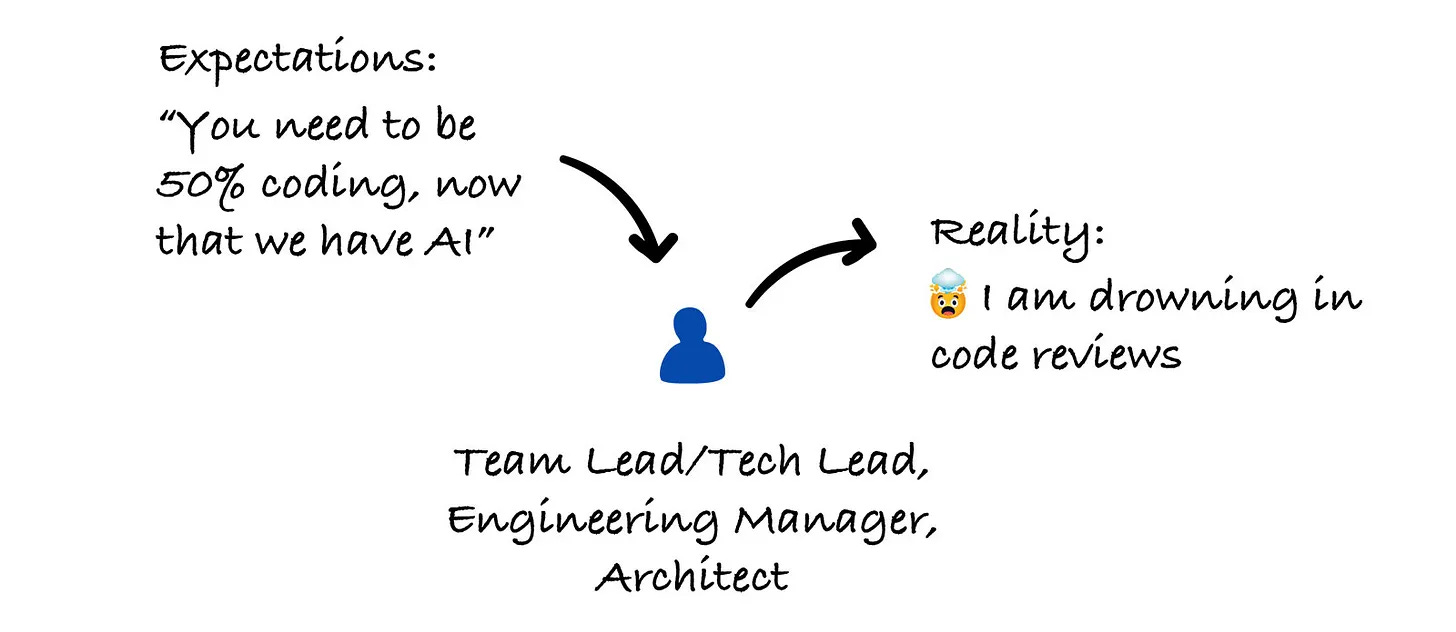
Engineering Managers, Tech Leads, Team Leads, and Architects are increasingly expected to be “player-coaches”. To be great leaders while also staying deeply involved in the technical work. It sounds great on paper. But here’s the problem:
We are adding more expectations to roles that were already difficult to do well.
AI was supposed to make the “player” part easier. In many ways, it’s doing the opposite, and in this article, I’ll share all about why that’s the case, and at the end, I’ll share my advice for both the leaders and player-coaches.
Let’s start!
What does being a “player-coach” actually mean?
We’ll start with this very important question because it’s crucial that we know and understand what it actually means and what the main responsibilities are.
A player-coach is someone who operates in 2 modes:
They are a coach
They set direction, develop their people, give feedback, ensure everyone understands the goals, remove blockers for others, coordinate with other teams, while making sure that the team is also efficient.
They are also a player
This might mean they are writing/generating code, reviewing/creating technical specifications, resolving production issues, building MVPs/prototypes, etc. Everything that a senior engineer would do.
The main associated roles of player-coaches are: Engineering Manager, Architect, Team Lead, Tech Lead.
Now, the main question you might have is: This sounds like 2 different jobs? How do you actually manage doing 2 jobs at the same time?
How do you actually do the work of a player-coach?
This has been an endless problem to figure out, especially for people who found themselves being in such position for the first time. The first-time tech leads, team leads, EMs, or architects.
You have a limited amount of time every day, you have a limited amount of mental energy every day, and you need to decide where to put your focus. There are endless things to do, but it’s crucial that you know what to work on and what not.
So, not only do you need to have both good people skills and tech skills, you need to be extremely good at managing your time and priorities.
And the biggest problem that I also had as a first-time lead was saying “no” to things that are not important, and trying to help everyone at the same time.
I found myself in so many different situations that “needed my help”, so that it became totally unmanageable. And it was either stop doing it or you’re going to burn out.
Learn how to manage your time in this article:
AI makes the player-coach role harder, not easier
The roles have been hard enough already, now, with AI, the role is harder than ever.
You might think that the “player” part is now easier, because you can just use AI to “do it for you”. In some cases, that is true, like creating a PR based on a clearly defined task is a lot easier.
But the problem is that there are 3x more PRs being created today than in 2024. And teams that use AI coding agents to develop their software create 6x more PRs than traditional teams.

And as we know, AI-assisted engineering is the standard way of developing software these days, so most teams are using AI coding agents, and if they are not already, they definitely should.
So, the reason why this is problematic is that the “player-coaches” are the ones who are most of the time responsible for the success of a certain project. And as I wrote in one of the past articles, code review is the new bottleneck for engineering teams.
With the speed of coding increasing, what happens is that a lot of reviewing falls onto these player-coaches to ensure that everything is on point.
And as you know, reviewing has always been a really draining part of software development, it’s much more satisfying when you are building than when you are reviewing other people’s code. That’s especially true for me.
So, based on my conversation with many engineering leaders across the industry, a lot of the work these days is actually reviewing other people’s code.
And what can be really problematic is when certain engineers don’t review their code correctly, and they just blindly submit “AI-generated slop”.
And that surprisingly happens quite often, especially with more junior engineers, where that engineer opens a PR full of AI-generated slop, and then it’s on the reviewers to find all the issues with it.
The unrealistic expectations of player-coaches
And then the real problematic part is that the “AI-generated slop” is actually incentivised across many companies these days, and a lot of leaders don’t actually understand that more code is not better.
We see people bragging that they are generating 50k lines of code per day, or even 100k, and many people think that this is “cool”. But here is the reality:
Less code and better code is much better, because less code means fewer problems and less maintenance we need to do.
With code that’s not needed, we are just creating future problems that we don’t need.
So, what happens is the following:
Engineers are incentivized to create more
Everyone is incentivized to create (you may have heard of a new important skill for non-tech people to “ship to production”)
Company leaders don’t understand the bottleneck comes on to reviewing and ensuring the software is built with the right standards
Company leaders think that you can do the “player role” with ease now that AI is here to do all the work and magic
This creates a ton of more work for these player-coaches, with no extra credit for them, because of the lack of understanding of what’s really important.
I’ll be sharing my advice for both company leaders and player-coaches next.
My advice for leaders who are managing player-coaches
Whether you are a Director, VP, CTO, or CEO, make sure not to fall into the story that “AI can just magically do everything for you”. It definitely helps in certain areas, but then creates a bottleneck in another area.
It’s your responsibility to figure out where that bottleneck is and provide the necessary support to the people who need it.
And that specific area is good judgment, which is a crucial skill that player-coaches must have in order to do well in their roles.
My advice is to really listen to the people who are at the root of these bottlenecks. The worst thing you can do is to just blindly “dismiss” it and keep on incentivising people to create more by using AI.
The people who are really important for the success of projects are going to be burning out because of the lack of understanding of how important their work is.
And at the same time, make sure to give credit where credit is due. Not just to people who “create more”, but to people who do the “glue work”, put so much effort into reviewing PRs, and proactively communicating with everyone to ensure that the project is still on track.
I know such work is often less visible, and that person must make that work visible. My advice is to keep your eyes on the lookout for people who are doing such work and ensure that they get the well-deserved credit.
My advice for player-coaches
Now, here comes the hard part, you are doing a lot of extra work, while people don’t really understand that your work is a lot harder, not easier.
The problematic part is that you can’t say that it’s the “leadership’s fault”, well in reality it is, because they might not understand how important your work is. But if you put the blame on others, there are no actionable things for YOU to do. And that’s the wrong mindset to have.
The best mindset to have is: “What can I do in order to ensure that people understand how important my work is?”.
The first thing is credibility and trust. You need to build both, because without them, your word doesn’t have weight, especially with the leadership.
The second thing is to actually have conversations with people about your work, and ensure that you communicate your impact correctly. You can “assume” that people know that already, but more often than not, they don’t.
Your manager sees about 40% of the work you do on a daily basis, it’s your responsibility to communicate the rest to them.
I wrote extensively about both how to build credibility and trust, and how to actively communicate your impact in these 2 articles:
I highly recommend you give them a read, they will help you a LOT with ensuring that you are viewed as a highly credible professional, and that everyone understands the impact of your work.
Last words
The “player-coach” role has never been easy, and with increasing expectations, it’s becoming even harder.
Let’s end the article with the following:
AI makes it easier to create more, but someone still needs to review, prioritize, make good decisions, and ensure everything fits together. And a lot of that responsibility falls on player-coaches.
If you are in such a role, remember, you can’t do everything. The key is knowing where your involvement creates the biggest impact, and saying “no” to everything else.
That’s what being a great player-coach is really about. You got this.
Liked this article? Make sure to 💙 click the like button.
Feedback or addition? Make sure to 💬 comment.
Know someone that would find this helpful? Make sure to 🔁 share this post.
Whenever you are ready, here is how I can help you further
Interested in sponsoring this newsletter? Check the sponsorship options here.
Check out my book “The Multiplier Mindset” coming out later this year, here.
Take a look at the cool swag in the Engineering Leadership Store here.
Want to work with me? You can see all the options here.
Get in touch
You can find me on LinkedIn, X, YouTube, Bluesky, Instagram or Threads.
If you wish to make a request on particular topic you would like to read, you can send me an email to info@gregorojstersek.com.
This newsletter is funded by paid subscriptions from readers like yourself.
If you aren’t already, consider becoming a paid subscriber to receive the full experience!
You are more than welcome to find whatever interests you here and try it out in your particular case. Let me know how it went! Topics are normally about all things engineering related, leadership, management, developing scalable products, building teams etc.


I would argue it has always been hard.
These days, it's expected more often, which means more folks are trying to "figure it out" and realizing that it is a real challenge.