Why Engineers Must Become Multipliers in the AI-Era
Being a great engineer means a totally different thing today than it did 10 years ago. This is why!
Intro
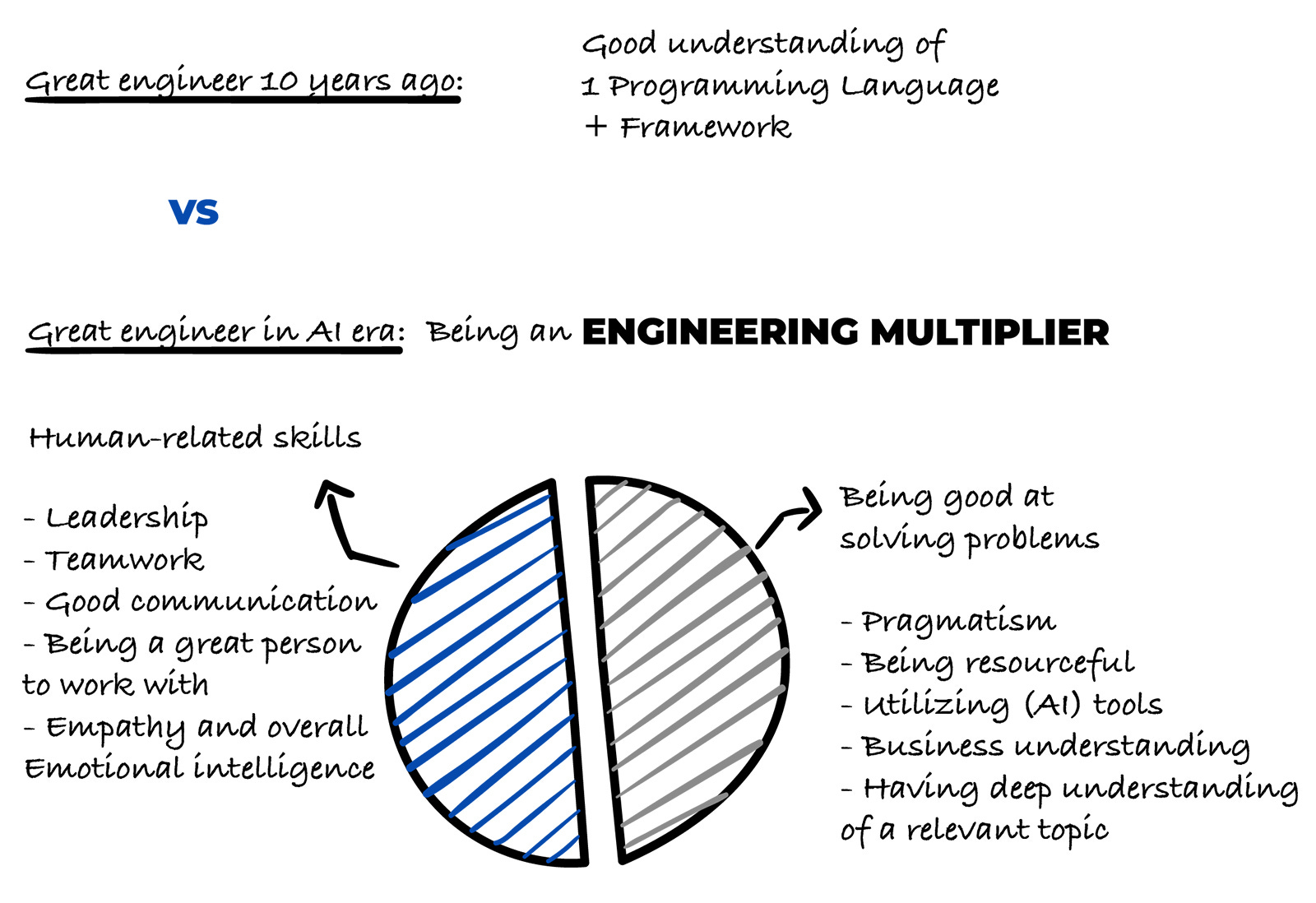
If you compare skills that make you a good engineer now versus 10 years ago, those skills are quite different.
10 years ago: You could get a job as an engineer, just by knowing HTML, CSS, JS, and one of the JS frameworks.
Now: As tools for development have gotten better, the desired skills for engineers have moved from just pure knowing programming languages and frameworks (expected) to problem-solving abilities and people skills.
It’s less about the tasks, but how big an impact you can create. And engineers who can create the biggest impact have the multiplier mindset.
It’s the mindset where you focus less on just your pure individual tasks, but you focus on how you can make things better for your whole team, organization, and, of course, the customers (users).
Let’s start by defining the difference between building Software today and in the past.
Visual/Audio Version of the Article
You can watch/listen to the video below, or you can keep reading for the complete overview and insights of today’s topic!
The Way we Build Software These Days Has Fundamentally Changed
The tools are much better, and it’s much more accessible to build Software. We can see a lot of people, even with non-technical backgrounds, doing vibe coding to build Software.
Vibe coding certainly has use cases, and I see it as a good option for quick prototypes and internal tools (non-critical and mostly presentational).
But it has issues when security, maintainability, and scalability are important → which most of the consumer-facing Software prioritizes.
And when you work in teams (2 or more engineers working on the same project together), it becomes really hard to maintain the project if you just commit AI-generated code, without having guidelines and styleguides for the project.
That’s where AI-Assisted Engineering comes into play, and it’s the best way to build Software these days, in my opinion.
AI-assisted Engineering fundamentally means that you use AI to help you, but you still keep good engineering fundamentals as a first priority.
You use AI to speed up your workflow, while you need a good understanding of engineering to ensure the things that you build are the RIGHT things, and also that they are built the RIGHT way.
Also, it is important to mention: engineers are less expected to just work based on pure requirements and clearly defined tasks these days. But the expectation is more and more for engineers to find the most impactful things to work on proactively and put their efforts into building them.
This is why.
Engineers are Already Owning the What, Why, and When in Startups
As a Fractional CTO and Advisor, I get to speak with many company leaders across the industry.
What I am hearing regularly is that increasingly, engineers are expected to take on not only the how, but also the what, why, and when.
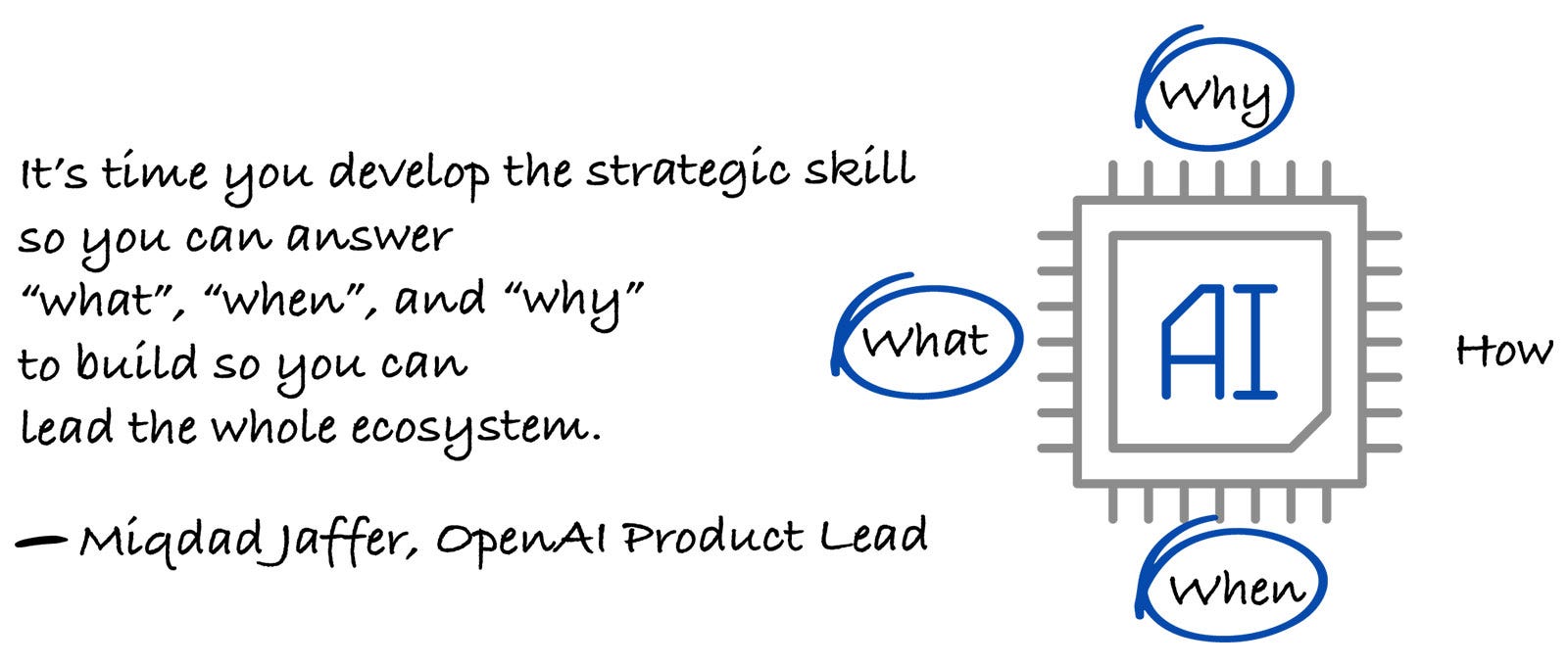
And that’s particularly the case in startups and smaller to mid-size companies.
A good example is Lovable → one of the fastest growing startups in EU. If you check their careers page. They don’t hire for Product Manager roles; instead, their engineers are taking on the PM hat as well. And each is leading their own projects.
Which basically means that every engineer acts as a Tech Lead, which is fundamentally an engineering multiplier.
And that is the trend I see happening more and more across the industry. The Product Engineer role is going to become an increasing trend across companies.
That’s why the multiplier mindset is crucial. Let’s define what that actually means.
What Does it Mean to be an Engineering Multiplier?
I like the term “Engineering Multiplier” because it’s a mix of “Engineering” and “Force Multiplier”, which fundamentally connects the two together.
Being an engineering multiplier means being someone who amplifies the productivity and effectiveness of the engineers around them, not just focusing on their own output, but elevating the entire team.
An engineering multiplier doesn’t just ask, “What can I build?”, they ask, “How can I make everyone around me more effective?”.
And this is how it looks in practice:
Improving team efficiency
You remove friction, simplify processes, and help others work better and faster. This could mean improving processes, writing better documentation, or helping your teammates so they can solve problems more efficiently.
Sharing knowledge
Instead of keeping knowledge only to yourself, you spread it. You write guides and help others understand things you know better. You focus on creating a culture of continuous learning and helping each other.
Raising the quality bar
You lead by example through quality code, system design, and good testing practices. Your influence encourages others to adopt higher standards and take pride in their work.
Enabling better decisions
You help the team make smarter technical and product choices by bringing clarity to discussions, anticipating trade-offs, and connecting the dots between engineering and business goals.
Mentoring and empowering others
You understand that relationships are one of the most important parts of your work. You invest in people. A true multiplier helps others grow into confident, capable engineers who can, in turn, multiply the impact of others.
Now, let me share why every company is looking to hire engineering multipliers, even if their job ad is not fully showcasing that.
When You See the Long List of Requirements on a Job Ad This is what it Actually Means
You’ve probably seen this meme before:
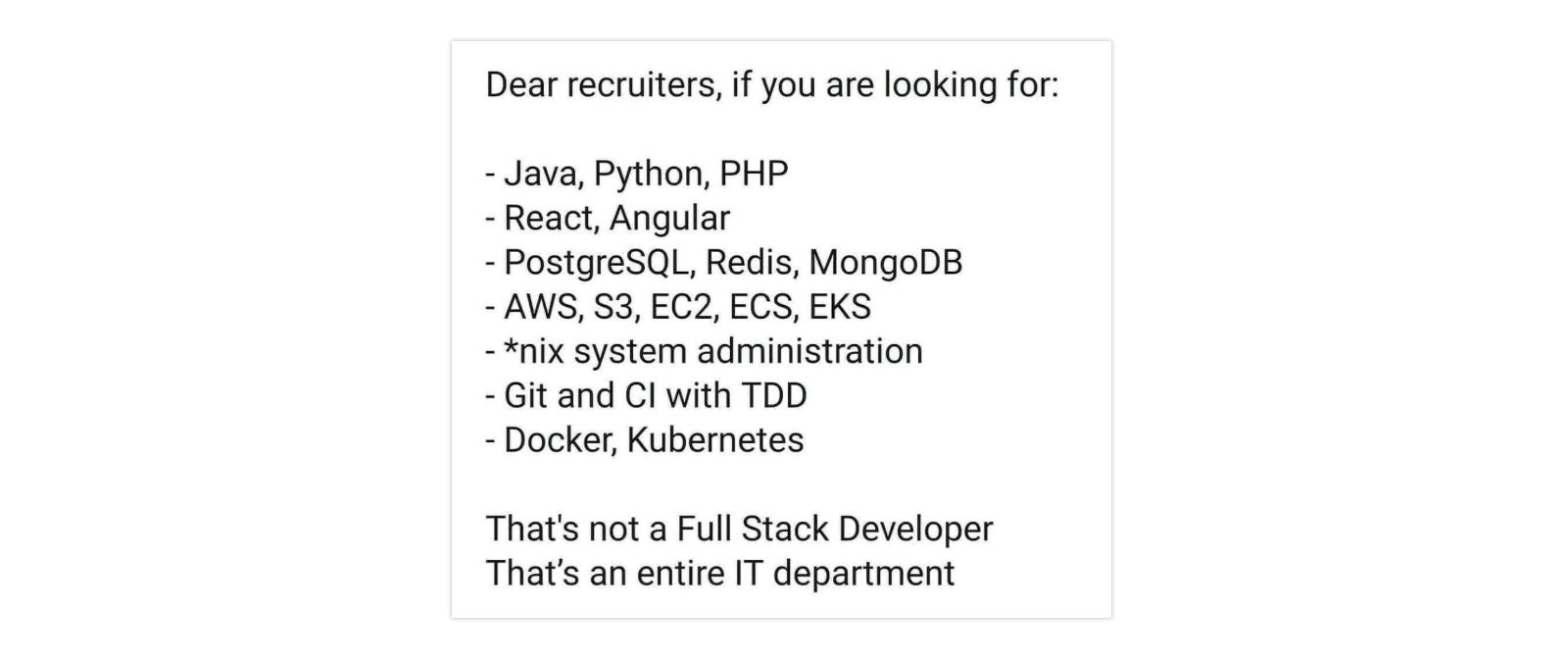
It’s becoming quite common for many companies to have increased the requirements for certain roles these days. But they do that in a completely wrong way.
It’s impossible for any individual to be an expert in all of these technologies, and, unfortunately, a lot of the companies don’t understand that.
But here is the twist. They don’t actually need a person who is an expert in all of the tech mentioned.
What they are actually looking for is an engineering multiplier. Someone who can learn a new tech if needed and is going to have good people skills + good problem-solving abilities to make an impact.
So, ultimately, my advice to companies is to get better at defining what they are looking for, but also, if you are an engineer, applying to roles → always keep in mind that you don’t need to be an expert in all of the technologies mentioned in the job ad.
Instead, you should develop as many skills as possible for you to create impact with your actions within the environment and the challenges that you face. And those are the exact skills that good engineering multipliers possess.
This is What it Looks Like in Practice
What engineering multipliers do and do well is:
They know how to leverage their own existing knowledge, resources, and people around them when they need to learn something new.
A great example is the following:
If you are an expert in Python, you can apply your knowledge + AI to be productive in Java and PHP.
If you know React well → you can learn Angular if needed by being resourceful.
You worked with PostgreSQL and Redis already, you can also learn MongoDB quickly if needed → of course, you’re not going to be an expert, but you can find experts in that topic and consult with them when needed.
You know AWS + S3, and then you can leverage people around you when needed to learn more detailed topics on AWS.
You worked with Windows system administration, so you know the core concepts and can apply some of the learning to Unix sys administration.
And similar to Docker and Kubernetes. If you know Docker, you can definitely learn Kubernetes more easily.
You use your good people skills and problem-solving abilities to get the desired knowledge in order to provide impact and finish the project successfully.
Your main goal is to develop your toolbelt with useful skills that will help you learning or get everything you need to provide impact. That’s where pure human-related skills and good problem-solving abilities shine.
That’s what companies REALLY look for. And we can compare it to this analogy.
If You Hire a Contractor to Build You a House, You Care That the House Will Be Built Well and on Time
When you hire a contractor to build a house, you’re not obsessing over:
How many hours they work per day,
How many nails they hammer, or
How often they talk about “optimizing their hammering technique”
You care about the result:
The house is well-built,
It’s delivered on time, and
The process is smooth and efficient.
And an engineering multiplier is like being that exceptional contractor → you focus on enabling great results and impact, not just on pure output.
You build systems, tools, and processes that help everyone deliver “houses” (products, features, services) faster and better.
You anticipate dependencies and risks, ensuring projects stay on track.
You learn everything you need by being resourceful.
You raise the bar for quality, so what’s built is strong, maintainable, and scalable.
You collaborate and coordinate well with others, ensuring that each of the other people’s expertise is going to play a vital role in a project → just like a contractor managing skilled specialists (plumbers, electricians, architects).
Now, let’s go to one of the trends that is pointing the expectations exactly in this direction.
The Trend of Flattening the Orgs Points Exactly in This Direction
A lot of companies these days are looking to “flatten” the orgs, and that’s where the middle-management roles are being impacted. Of course, every company has different motivators for doing that, but ultimately, this is true for most companies:
By increasing the pure number of reports per manager → engineers are expected to take on additional responsibilities.
And those are the exact responsibilities that we talked about above. Some companies express them with pure “knowing more programming languages and frameworks”.
But ultimately, everyone is looking for engineering multipliers. Engineers who provide impact without the need to be “managed”. People who proactively look to find impactful things and make everyone around them better.
Last words
The AI era isn’t eliminating the need for great engineers → it’s redefining what great means.
Engineers who thrive aren’t the ones who simply know the most frameworks, memorize the most syntax, or chase every new tool. The ones who thrive are those who can create impact far beyond their individual output.
That’s the engineering multiplier.
A multiplier doesn’t just code. They clarify, prioritize, elevate, connect, and amplify.
They are force multipliers for their teams, their products, and the organization.
And as AI takes over more of the repetitive, mechanical, “do exactly this” tasks, the value of these multiplier qualities skyrockets.
The world doesn’t need more engineers who just follow tickets → it needs engineers:
who take ownership of the what, why, and when,
who make others around them better and
who create leverage.
So if you want to stay relevant and thrive in this new era, don’t just focus on learning the next tool or framework. Focus on building the mindset, habits, and people skills that turn you into someone who multiplies the impact of everyone around you.
Because the future of engineering isn’t about being the best coder. It’s about being the best multiplier.
Liked this article? Make sure to 💙 click the like button.
Feedback or addition? Make sure to 💬 comment.
Know someone that would find this helpful? Make sure to 🔁 share this post.
Whenever you are ready, here is how I can help you further
Join the Cohort course Senior Engineer to Lead: Grow and thrive in the role here.
Interested in sponsoring this newsletter? Check the sponsorship options here.
Take a look at the cool swag in the Engineering Leadership Store here.
Want to work with me? You can see all the options here.
Get in touch
You can find me on LinkedIn, X, YouTube, Bluesky, Instagram or Threads.
If you wish to make a request on particular topic you would like to read, you can send me an email to info@gregorojstersek.com.
This newsletter is funded by paid subscriptions from readers like yourself.
If you aren’t already, consider becoming a paid subscriber to receive the full experience!
You are more than welcome to find whatever interests you here and try it out in your particular case. Let me know how it went! Topics are normally about all things engineering related, leadership, management, developing scalable products, building teams etc.


I really like the idea that engineers are moving more towards product managers / owners. I think AI is really going to split software engineering into two factions: one that is super technical and will be needed when AI coding tools can't get the job done right (deep technical knowledge) and those who understand the code AI is producing it, but do so at a much faster rate because AI is able to increase their ability to produce code (more in line with tech / team leads).
> Engineers are Already Owning the What, Why, and When in Startups
The thing is that they own these things only if there is a space to own it. But the space for such culture is built only by those who know it much better than any engineer in a team, by those who is in charge of it and can build the proper system with intentions (Product Lead/Founder).
I've struggled a lot in situations where I was really trying to own this, be a multiplier, lead the team in this way but the environment wasn't designed properly because even the Product Lead hasn't figured out anything and hasn't found answers to "why," "what," "when."
But when such culture exists, that's an insane opportunity to build a team of multipliers.