Engineering Leadership

Engineering Leadership

Companies Should Allow AI Usage in Tech Interviews

AI-assisted engineering is already the standard, and technical interviews should reflect how modern software is actually built.

Gregor Ojstersek's avatar
Gregor Ojstersek
May 07, 2026
∙ Paid

Engineering Leadership LIVE Event in San Francisco

Together with my friends from Augment Code, we are hosting a live event in San Francisco on May 26th!

Engineering leaders are holding excitement and dread about AI at the same time. The job description is changing faster than anyone can rewrite it.

Engineering Leadership LIVE is an evening for that conversation.

Three speakers, a room full of peers, networking, and snacks after. I’ll be sharing more about the speakers in future newsletters!

It’s a free-to-join event, but there is a limited number of spots available, so make sure to register for the event below while the spots are still available.

Secure your spot at the event

Looking forward to seeing you there! Let’s get back to this week’s thought.


Intro

Many companies these days are removing AI completely from tech interviews, not allowing the use of any of the AI tools to solve a coding task.

But that’s wrong.

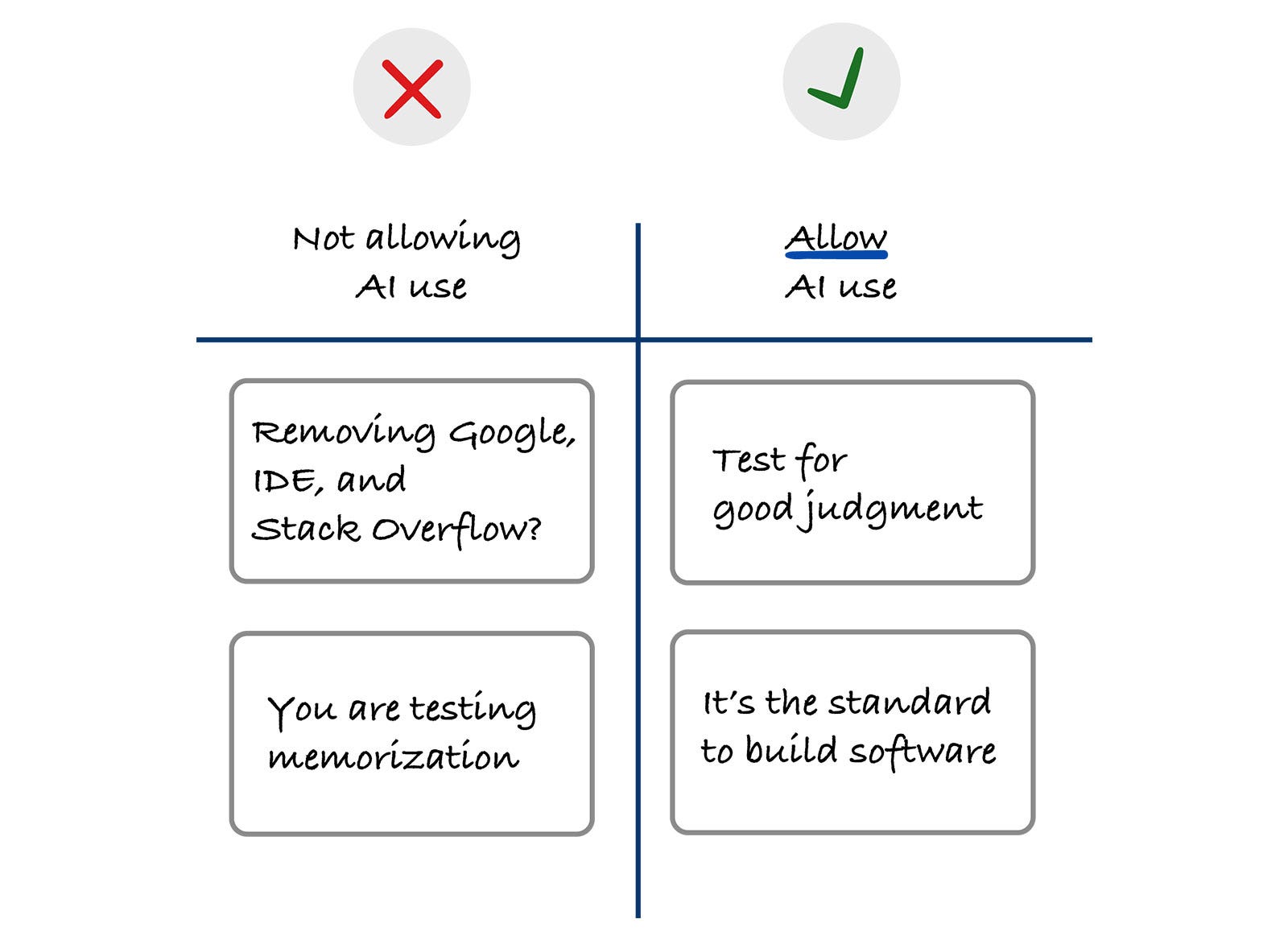
Not allowing the use of AI is like removing a tool that engineers use daily. Similar to Google, Stack Overflow, or using an IDE. Are you going to remove that as well, and just check how well a candidate memorizes specific functions of a programming language?

Modern engineering is: having good judgment + using AI to move faster. Judgment is the important skill you should be checking.

So, why remove something that engineers use and are expected to use every day?

Especially, it doesn’t make sense when a company is even pushing for more AI adoption.

In today’s article, I am sharing in detail about which parts of the hiring process I recommend allowing the use of AI and which not.

I am also sharing 3 concrete options on how to structure a tech interview, so you allow the use of AI, and get all the info that you need to do a proper assessment of the candidate.

This is an article for paid subscribers, and here is the full index:

- AI-assisted engineering is the best way to build software these days
- Leetcode-style of a tech interview has been a standard for years
- I’d be surprised if, by the end of 2026, companies still use such a type of interview
🔒 This is my recommendation for a tech interview in 2026
🔒 This is how to structure a tech interview
🔒 Option 1
🔒 Option 2
🔒 Option 3
🔒 Putting it all together, the full process for hiring a new engineer
🔒 Last words

Let’s start!

AI-assisted engineering is the best way to build software these days

It has become a standard for the way we build. Most of the engineers these days are using AI in at least some part of the development process, which may be generating code, researching, or something else.

Learn how 15 engineers and engineering leaders use AI in their day-to-day work in this article:

How to Do AI-Assisted Engineering

How to Do AI-Assisted Engineering

Gregor Ojstersek
·
Mar 22
Read full story

To quote from the recent survey conducted by JetBrains:

The biggest question is not whether developers use AI at work. The answer to that is already obvious: They do. In January 2026, 90% of developers regularly used at least one AI tool at work for coding and development tasks, a clear sign of high AI usage in software development.

We are currently in May, which means that the % of engineers using at least one AI tool has just increased.

So, if using AI as part of the development process is a standard these days, why would companies want to remove AI from the assessment of new candidates?

The goal with the tech interview should be to get as close as possible to the actual work that an engineer is doing on a daily basis, right? That’s how you can assess whether it’s a fit or not.

Well, that’s been a problem for years now as well, even before AI became so popular. Let’s get to that next.

Leetcode-style of a tech interview has been a standard for years

LeetCode (the platform) was founded in 2015, and quite quickly after that, it became the go-to style for tech interviews in many companies. It has become a standard for “objectively” assessing the technical skills of a certain candidate.

Well, I was never a fan of it, and I’ll tell you why.

When I was a Software Engineer, preparing for interviews, I solved 200+ leetcode style type challenges, and while solving them, I kept looking for specific patterns that could be reused across different challenges.

I made sure to create templates, which I could reuse for any problem that I’d be asked to solve in an interview. So, doing that, I was well prepared for interviews, and I also nailed the interview and got the job.

Well, that felt good, that I was able to “grind” leetcode challenges for weeks, and I got the job, but then none of it really helped me in my day-to-day work.

The work that I was doing was completely different than what I had been grinding for weeks.

So, basically, with the leetcode-style type of interview, you don’t really assess the actual skills that a specific engineer needs to be able to do the job well. You assess whether the person has been practicing such types of challenges or not.

I’d be surprised if, by the end of 2026, companies still use such a type of interview

Especially these days, with AI, you can solve any of the leetcode-style challenges in a matter of seconds.

And if the standard in our industry is AI-assisted engineering, then it really makes no sense to “check the tech skills” with problems, which can be easily solved with a prompt.

I’ve talked to many engineers and engineering leaders about this, and many share a similar sentiment, so I’ll be really surprised if, by the end of 2026, we’ll still see such interviews done by any of the companies.

As mentioned, a leetcode-style interview just checks whether the person has been practising solving such problems or not. But these problems are not even close to what an engineer does on a daily basis.

Now, let me share what my recommendation is.

This is my recommendation for a tech interview in 2026

This post is for paid subscribers

Already a paid subscriber? Sign in
© 2026 Gregor Ojstersek · Privacy ∙ Terms ∙ Collection notice
Start your SubstackGet the app
Substack is the home for great culture