

This newsletter is sponsored by DX.
Live webinar: Introducing the CAFE(S) framework for improving AI agent effectiveness
As AI agents become more capable, context quality is increasingly the limiting factor in their performance.
Join leading researchers on September 24 for an early look at CAFE(S), a new framework for evaluating whether AI agents have the context they need to do their jobs well.

The webinar will cover:
A practical framework to evaluate the five core dimensions of AI agent context quality.
A shared vocabulary to diagnose context failures before they become production issues.
Actionable guidance for engineering teams to improve context hygiene and scale AI workflows safely.
Thanks to DX for sponsoring this newsletter. Let’s get back to today’s thought!
Intro
In one of the previous articles, titled The “Player-Coach” Role is Becoming Increasingly Harder, we talked all about how the role is actually getting harder than it was before.
And the problematic part is that many people don’t understand that and don’t give the deserved credit.
Today, we’re diving deeper into how to actually do the coach part the right way!
This is an article for paid subscribers, and here is the full index:
- Great engineering leaders create leaders
- The difference between coaching and mentoring
- Make the mindset shift from telling to coaching
- Having a coaching mindset is all about asking great questions
🔒 Practical frameworks
🔒 The Solutions Focus model
🔒 The CLEAR model
🔒 Use the core skills for being a great coach and mentor
🔒 How to practice?
🔒 Great leaders multiply others
🔒 Last words
Let’s start!
My upcoming book “The Multiplier Mindset” published by O’Reilly
This article is an adapted version of one of the chapters of my upcoming book called “The Multiplier Mindset”, published by O’Reilly. The book will be published later this year.

Great engineering leaders create leaders
I view all the “player-coaches” as engineering leaders, and one of the most important things a great engineering leader does is create leaders.
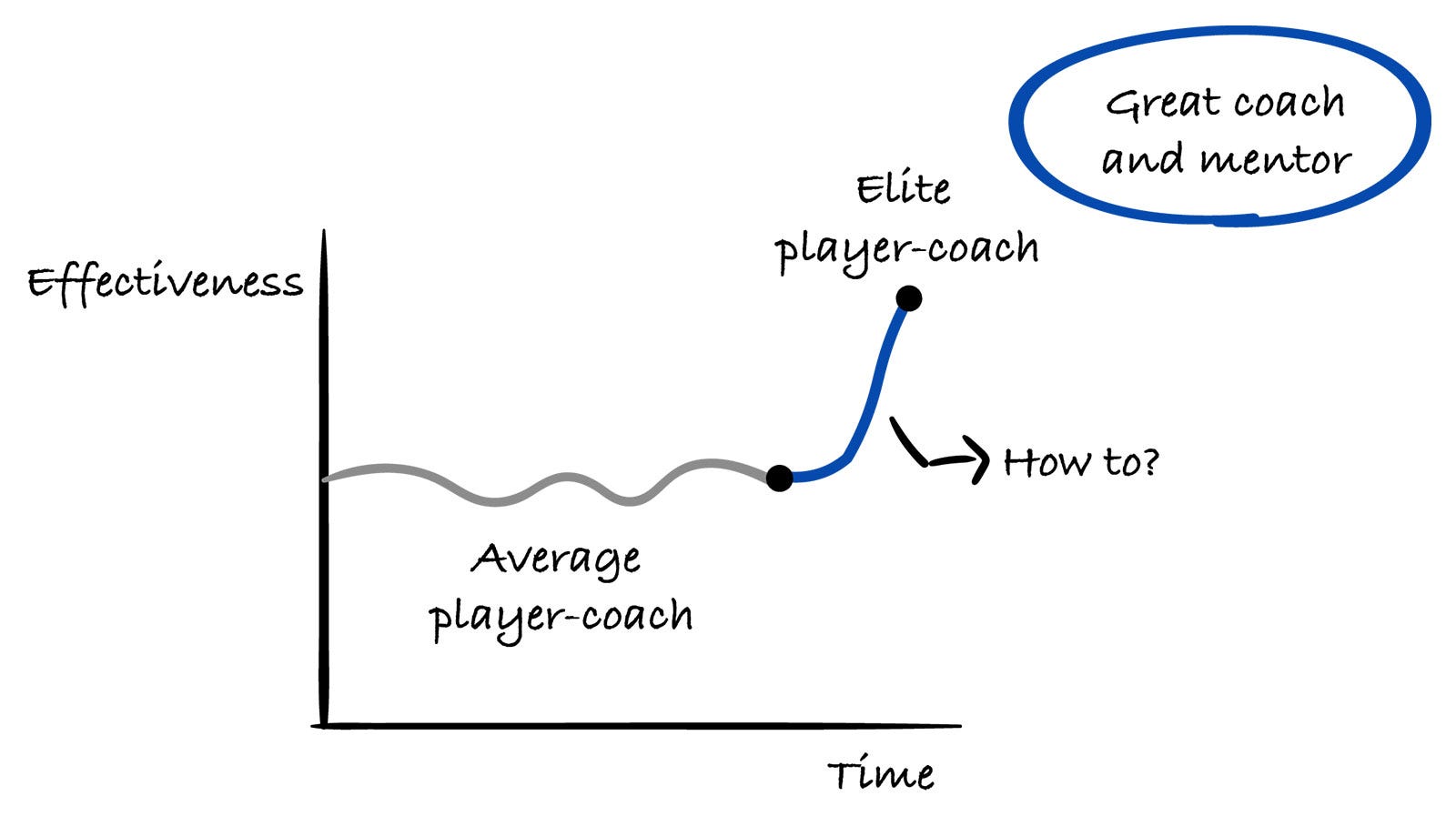
And to do that, you need to become a great coach and mentor who elevates everyone around you and helps others grow.
You’ve probably had one or more managers in the past who you didn’t see as great managers, and the exact reason for that is that they weren’t leaders. They weren’t making everyone around them better through coaching and mentoring.
To have a great career as an engineering leader, you need to know and understand how to do coaching and mentoring the right way. Let’s go into more details next.
The difference between coaching and mentoring
It’s crucial to understand the difference between coaching and mentoring, so let’s cover that first.
Coaching
Coaching is normally short-term oriented with a specific goal, such as helping someone solve a specific problem or get better at doing something. The focus should be on asking the right questions and guiding the person to finding their own answers.
Mentoring
Mentoring is normally longer-term and about building a good working relationship by sharing your own experiences, offering advice, and being a good role model.
It’s really important to know when to wear the coaching hat and when to wear the mentoring hat. Great leaders know this and are good at both.
Make the mindset shift from telling to coaching

As engineers, it’s in our nature to share what we know and go straight to finding solutions. I like to say that we are “born problem-solvers”.
But to be a great coach and mentor, you need to move from “telling” to coaching. It’s a hard mental shift to make, but it’s crucial.
If you just give people answers to their questions, they won’t get any better at finding answers themselves. And they’ll expect you to just give them more answers in future.
That’s what happens when you have the “telling” mindset.
But instead of just “giving them a fish,” you want to teach them “how to fish”. That’s what you’ll do if you have a “coaching” mindset, which is a lot more powerful because it lets you guide others to finding the solutions to their problems themselves.
Having a coaching mindset is all about asking great questions
Here are some of the questions that I personally like to ask, whenever I’m coaching:
“What have you already tried?”
“What would you say is the main problem here?”
“What are some different ways you could approach this? And what are the pros and cons of each?”
“What resources or what particular person might help you find the answer?”
This may seem A LOT slower at first, but, in the long run that’s going to make a big difference.
You will boost their confidence, critical thinking and independence, which they need to become resourceful so they can solve new problems by themselves.
As a leader, your job is not to be the smartest person in the room, it is to build a team full of smart and capable people.