

This newsletter is sponsored by Archera.
De-risk your multi-cloud spend with Archera

Archera is an automated cloud cost management solution designed to maximize savings across AWS, Azure, and GCP, without forcing you to predict your architecture three years out. If your stack shifts and usage drops, they’ll cover whatever goes unused.
Refactor without fear: Secure aggressive RI, SP, and CUD discount rates with native risk protection. You aren’t trapped paying for abandoned instance types or old nodes.
Skip the “percent savings” Tax: Most vendors take a 25% cut of your savings. Archera uses a $0 platform fee model with transparent, flat coverage premiums.
Live in your native cloud: Executes commitments directly inside your existing AWS, Azure, or GCP organization so you keep total ownership of your billing and setup.
Get started now with $0 platform fees:
Thanks to Archera for sponsoring this newsletter. Let’s get back to today’s thought!
Intro
The more you grow in your career as an engineer, the more important skills, outside of pure tech become.
Engineers who create the biggest impact are not only technically capable of building great things, but are also trusted to make things happen, make good decisions, and also be a multiplier, to make others around them better.
A big part of that comes down to being proactive.
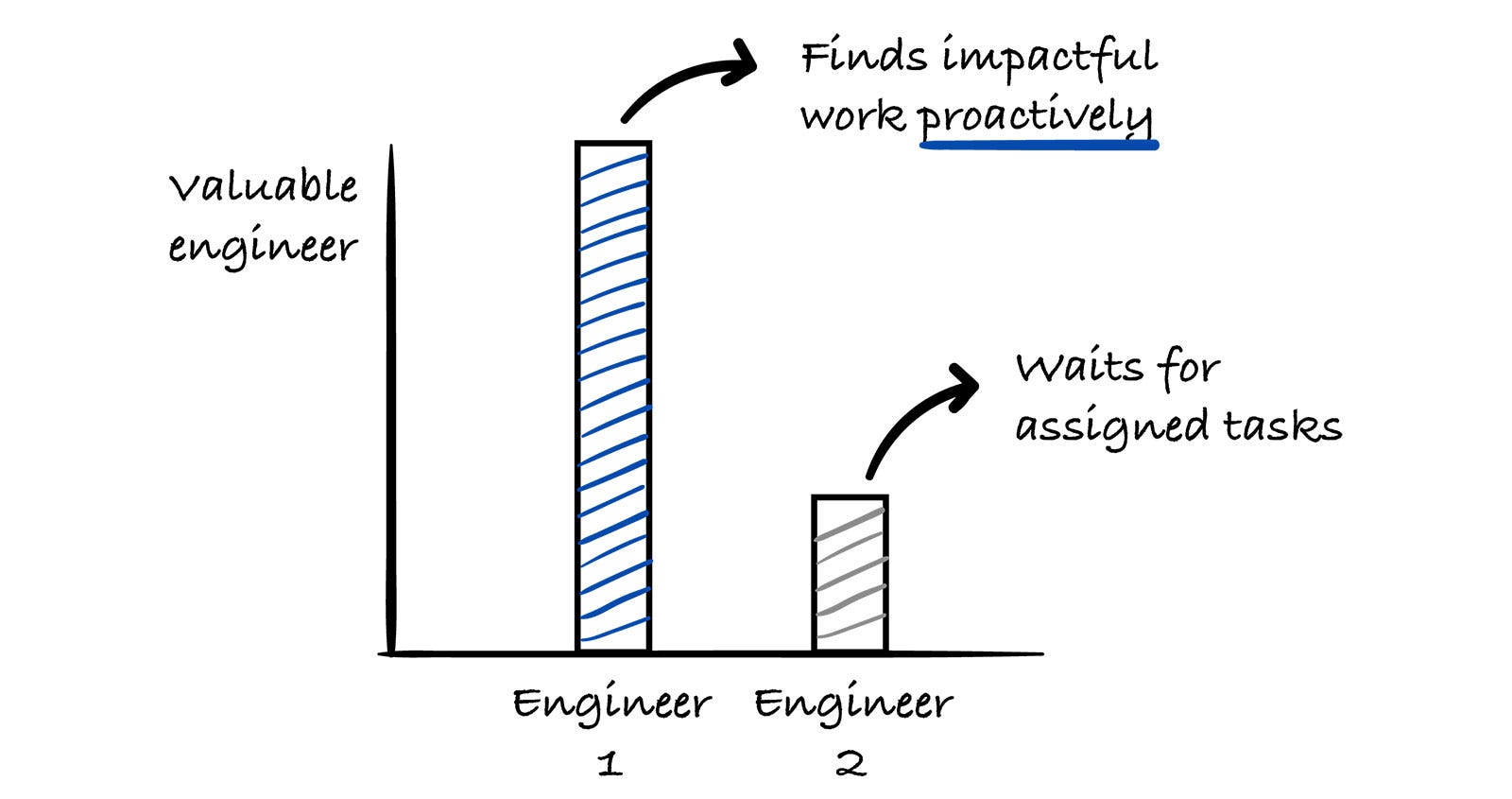
Proactive engineers don’t wait for others to tell them what to do. They look at the big picture, see problems before they happen, take the initiative, communicate early and often, and look for ways to improve things.
This becomes increasingly important as you grow in seniority. The problems become less defined, the path forward becomes less obvious, and there are fewer people telling you exactly what the right next step is.
That’s why developing a proactive mindset can be one of the biggest shifts you make in your career.
This is an article for paid subscribers, and here is the full index:
- What Does it Mean to Have a Proactive Mindset?
- Understand the Big Picture
- Get Better at Anticipating Problems
- Take Initiative to Make Improvements
- Be Curious
🔒 Communicate Well
🔒 Support Others
🔒 Simplify as Much as Possible
🔒 Avoid Perfectionism
🔒 Last words
In this article, we’ll look at practical ways to become more proactive, and develop the right mindset, let’s start!
My upcoming book “The Multiplier Mindset” published by O’Reilly
This article is an adapted version of one of the chapters of my upcoming book called “The Multiplier Mindset”, published by O’Reilly. The book will be published soon, in mid-to-late October this year.

What Does it Mean to Have a Proactive Mindset?
Being proactive means taking initiative, anticipating challenges, and driving solutions without receiving instructions or waiting for problems to arise.
A lot of engineering and business challenges are ambiguous, so you need to find out exactly what is needed and why specific problems exist.
Proactivity is a forward-thinking mindset, where you aren’t just reacting to tasks or issues as they come up but actively seeking ways to improve processes, the team, and overall outcomes.
I fully believe that proactive engineers are the best kind of engineers. They don’t need excessive instructions; they don’t need every piece of the outcome defined for them completely.
I can rely on them to ask questions, find out exactly what needs to be done, and do it the right way and on time. Such a mindset is valuable in any organization.
The more you grow in any career path, the more ambiguous the problems become. Proactive engineers thrive on such challenges, while people who are used to performing well-defined tasks have a harder time.
As a manager, I’m looking to promote people who make my role easier, reliable people who can solve problems well and inspire others to do the same. Proactivity is a key part of that.
In the next sections, we’ll look at how to develop a proactive mindset.
Understand the Big Picture
You need to know how your work fits into the big picture.
What kind of organizational goals is your work a part of?
What are the main business problems you are solving?
For example, are you building a feature to improve the user experience? What potential risks and challenges are involved with the work you’re currently doing?
Ask as many questions as you can about the product, the business, and the overall organization. Start thinking like a product manager.
Notion template: List of questions to ask before making a technical decision
Use this list of 35+ product-oriented and technical questions when making your next decision. This will help you to make an informed decision and build the RIGHT things.

Paid subscribers, you can get it here: 🎁 Premium products for paid subscribers.
Once you’ve asked your questions, your immediate next step should be to look to reduce the scope while delivering a similar value to users.
With a simpler solution, you can deliver value faster and test it earlier to see if it’s really what the users need.
The goal is to remove any overhead that might not bring value (or as much value). These are the “must haves,” not the “nice to haves”.
Get Better at Anticipating Problems
You want to get better at anticipating problems before they even happen, and you do that by thinking a few steps ahead. Some questions you can ask yourself to get you started in any given situation are follows:
How will this feature scale as the user base grows?
Could this implementation introduce security vulnerabilities?
What edge cases or unexpected inputs might cause this system to fail?
This will help you to think about alternatives and cases that may not be covered in the current implementation.
Don’t just jump on the next problem you think would be interesting to solve. Not every problem is worth solving.
Use the “You ain’t gonna need it” (YAGNI) principle: first, decide if the problem is worth solving, and then, if it is, propose your solution.
Take Initiative to Make Improvements
You don’t (usually) need permission to make things better. If you see a process improvement that could be made, a need for some documentation, or an issue in the codebase, take the initiative to improve it. Here are some examples:
Refactor code that could be better
Use meaningful variable and function names. Make a piece of code simpler and easier to understand. Find something that’s inconsistent with the rest of the codebase and bring it into alignment.
Automate a repetitive task
There might be a way to automate the start of your local environment or the creation of initial test data. The opportunities are endless here.
Keep documentation updated
If something changes inside the codebase, take the initiative to adjust the documentation.
Be Curious
With technology evolving faster than ever, it’s really important to be curious and proactively learn new things.
Don’t wait for your manager to suggest what you should learn; seek out knowledge that will help you and your team. Here are some ways to do this:
Actively read, watch, listen to, and follow the right people
Subscribe to newsletters and blogs, read books, and follow people on LinkedIn. Here is a list of 200+ resources that I curate and regularly update.
Try new tools
Especially with AI, it’s important to try new tools and see how they can help you. People who can use AI well are thriving right now.
Get better at writing prompts and comparing different AI models by getting in as much practice with them as you can.
Ask questions and build a network of experts around you
Always look to dig one level deeper. When you’re working with someone, ask questions and try to understand why the particular approach they use is the best one.