

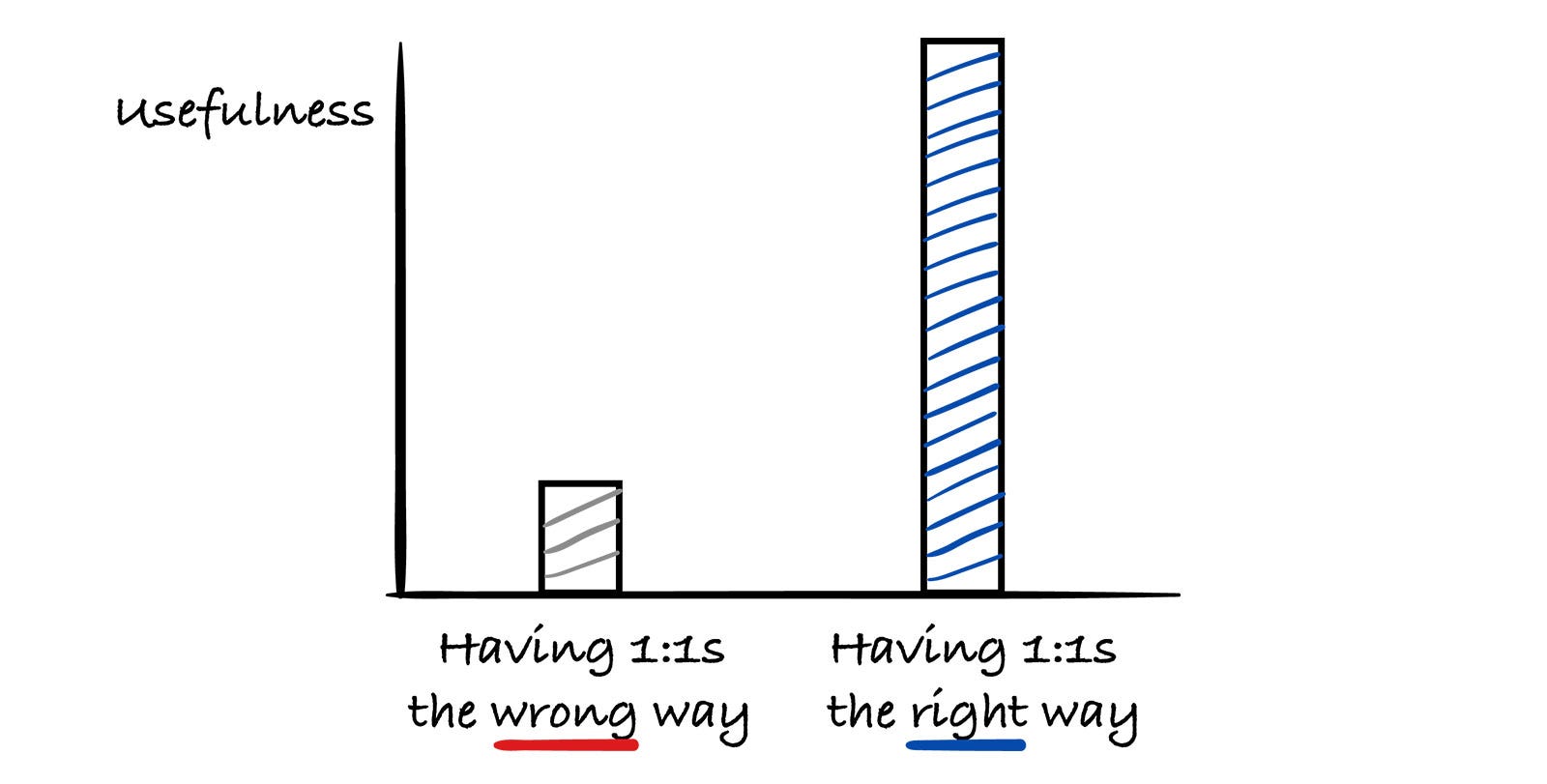
Intro
Back in December, 2022, based on your feedback, I wrote an article that has been very useful: How to have great 1:1 meetings. Also, the template included has been the most downloaded out of all.
And because the article has been helpful, I decided to do a 2026 extended version of it. So, in today’s article, I am sharing how to have great 1:1 meetings in 2026 and beyond.
This article is written from the perspective of a manager who is organizing and having 1:1 meetings with their direct reports.
It’s also important to mention that in many companies in 2026, a team lead or a tech lead may have 1:1 meetings with their team members, but they are not directly reporting to them. It works from this perspective as well.
This is an article for paid subscribers, and here is the full index:
- What has changed for 1:1 meetings in 2026?
- Make sure to schedule all your 1:1 meetings in advance
- Be on time
- Get your own 1:1 Notion template that I use
🔒 Meeting agenda
🔒 Focus on objectives, goals, and career development
🔒 Meeting notes
🔒 Last words
Let’s start!
Ready, Spec, Ship Hackathon with Kiro

I am happy to share that I will be a judge at the Ready, Spec, Ship Hackathon with Kiro.
There is a $9,600 prize pool available for the top 3 submissions. You can enter solo or form a team of up to three people. Build something ambitious, creative, useful, or completely unexpected with Kiro.
Excited to see all the great stuff being built alongside my fellow judges John Crickett and Angie Jones. Check out the details and enter here:
Looking forward to seeing what you’ll build!
What has changed for 1:1 meetings in 2026?
Well, interestingly, not that much. I still use the same template for all the 1:1 meetings I have, and that’s also what I recommend. I’ve been a big fan of Notion for a while now (dating back to 2020), so I’ve been using the same Notion template for more than 6 years now.
Additionally, what I would say has changed the most is that while I keep all the 1:1 meetings very personal and human, I’d occasionally use AI to help me generate ideas for discussion points, brainstorm action items, and help frame certain feedback better.
While I find this helpful, I wouldn’t say AI has been remotely close to an important part of the 1:1 preparation. My goal with every 1:1 meeting is that I build a better working relationship, and that we can openly talk about things. Not try to AI-generate feedback, and sound like a robot.
Additionally, an important shift I notice in comparison to having 1:1 meetings today versus in 2022 is that it’s really important to acknowledge the shift that is happening in the industry with AI.
And it’s even more important to be a good manager and a leader at this time. That’s also one of the biggest differences about how people feel at work these days, in my opinion. The team they are a part of, and the manager they have.
So, with a lot more uncertainty about the future, it’s important to really be there for your team, have great 1:1 meetings, acknowledge the uncertainties, and do your best to support everyone.
Now that we understand some of the differences, let’s start with the basics.
Make sure to schedule all your 1:1 meetings in advance
So, that’s the first thing you should do, it’s important that you have a regular cadence of 1:1 meetings, and that you don’t just schedule them sporadically.
The reason is that if a meeting just shows up in the middle of the week, your report might feel like something bad would happen in a meeting, and they would be unnecessarily worried about it, which can cause a lot of stress.
As a full-time CTO, I heavily stuck to separating my time into manager time and maker time, with the manager time used for meetings, alignments, and slack/emails, while the maker time was for head-down time for deep work.
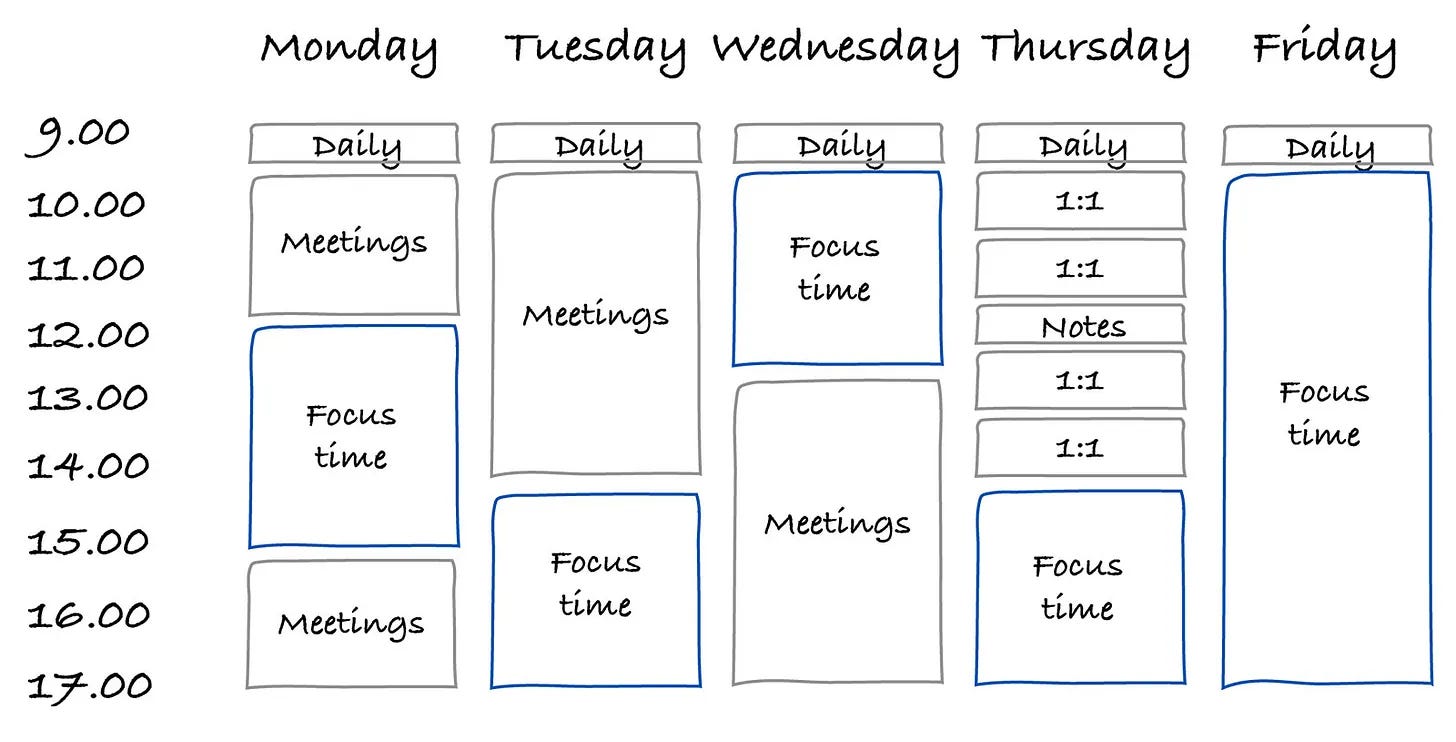
I organized all my 1:1 meetings on the same day, one after another, with a bit of a break in between. I usually prepared the day before for the 1:1 meetings the next day. A 30-minute meeting is also a standard for a 1:1 meeting.
You can read a full overview of how I organized my time as a full-time CTO in this article:

Checking in with your reports to see if that specific time works for them is also my suggestion, so it doesn’t feel like the time is forced. And in general, this meeting is for your report, not for you, so finding the right time that works for them is important.
Be on time
I’ve had a lot of 1:1s with the managers, who just showed up late to the 1:1 meeting. Sometimes, they would send a message that they’d be late, another time, they would just show up late, with just 15 minutes left in the meeting.
Experiencing that, I focus a lot on being on time as much as I can. Of course I am not always perfect, and it happened to me as well. But at least if I’m late, I send a message. But I do my very best to be on time for the meeting.
Everyone’s time is important, not only yours. And if you treat people like their time is not important, it’s not a good look, and it’s an awful way of building a good professional relationship.
Don’t try to justify that you are a “manager” and that you’re very busy. How you treat your people on a daily basis tells me everything about what kind of manager you are.
Always keep this in mind.
Get your own 1:1 Notion template that I use
This is the exact template that I have been using for the past 6 years, and it works great!
If you want to always be prepared for your 1:1 meetings and need a system to organize all of your notes, make sure to use this template.

Paid subscribers, you can get it here: 🎁 Premium products for paid subscribers.