

Intro
AI is definitely transforming the way we work, communicate, and make decisions. We use it daily for many different things, both personally and professionally.
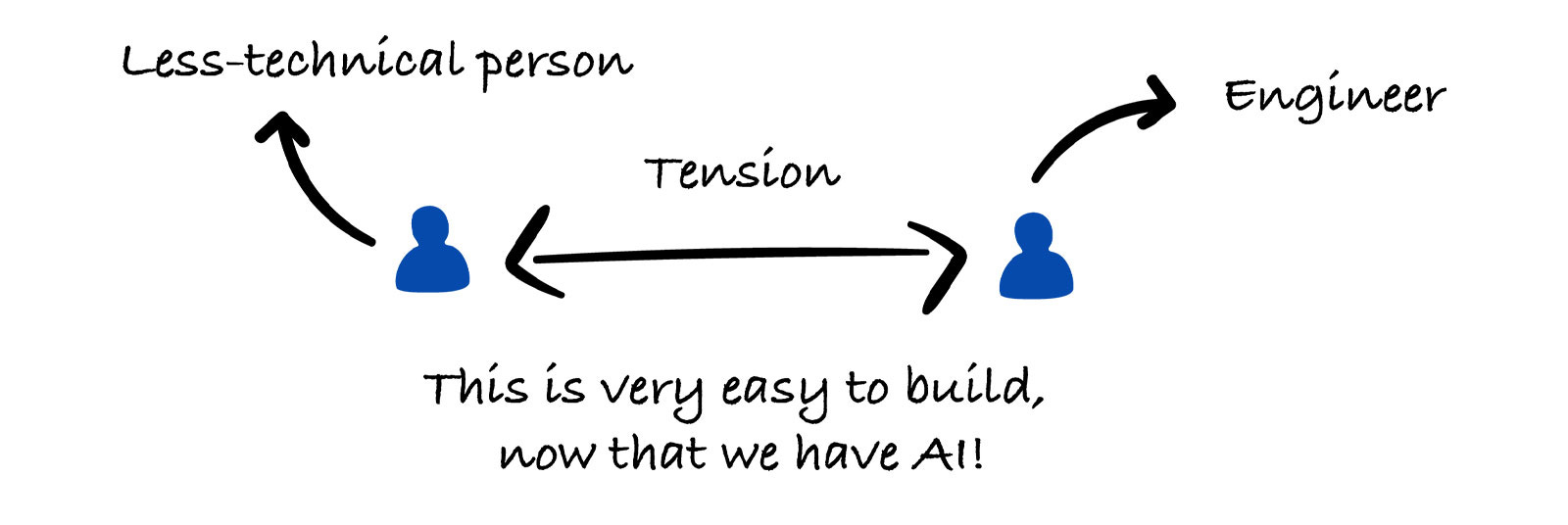
However, with every good thing, there are also downsides. And one of the downsides is the tension that AI creates between different groups of people, especially technical and less technical.
In today’s article, I’ll share 3 real-world examples of the tension I am seeing, and I’ll provide tips on how to communicate the right way, so there won’t be any friction or resentment on both sides.
This is an article for paid subscribers, and here is the full index:
- 1. Unrealistic expectations from executives to engineering leaders
- My advice to resolve such tensions
- 2. Product Managers Underestimating the Effort <> Engineers Providing Huge Timelines
- Put yourself in their shoes
🔒 My advice to resolve such tensions
🔒 3. Engineers That Focus on Speed and AI Tools <> Engineers That Rarely Use AI Tools
🔒 My advice to resolve such tensions
🔒 Last words
Let’s start!
1. Unrealistic expectations from executives to engineering leaders
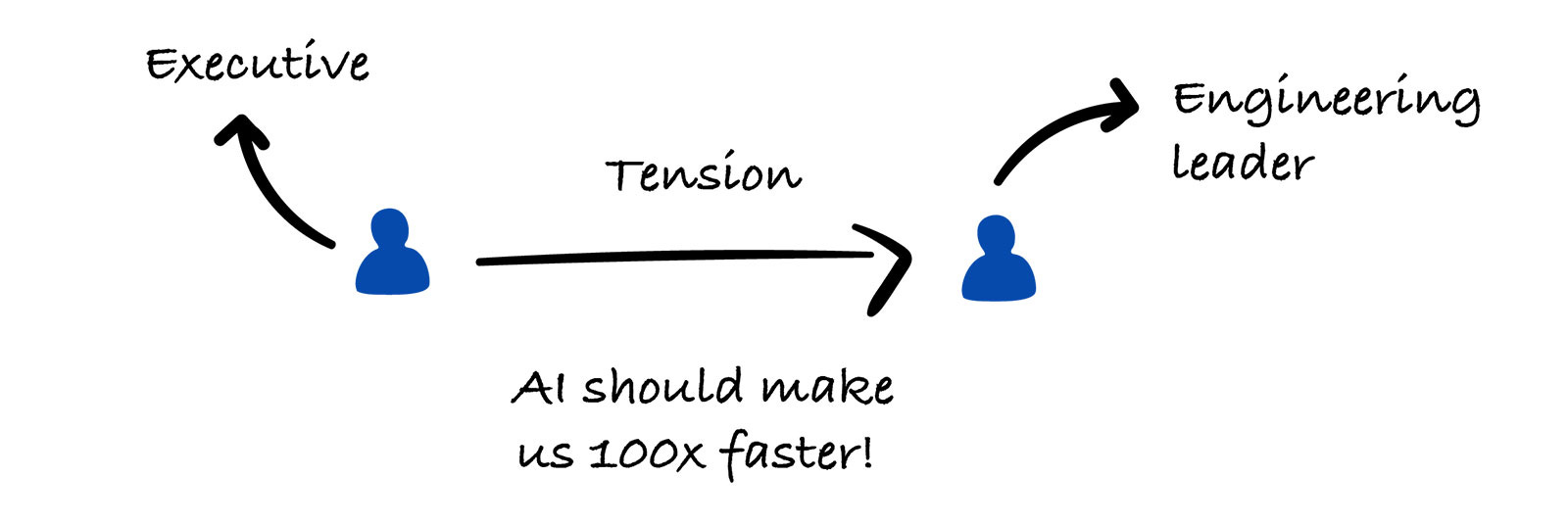
Let’s start with the first tension I am seeing, and that has been especially common in mid-to-end 2025. From my experience, it’s now getting a bit better, but I can see or hear a lot of unrealistic expectations in current times as well.
Here are some of the unrealistic expectations I have heard:
Believing AI is a “Plug and Play” solution
Expecting AI to eliminate all manual work
Underestimating the cost and complexity of building internal LLMs
Assuming AI will just magically understand the whole context of the specific domain
Expecting AI to replace entire teams
Assuming AI will just work without failures
Thinking that there are no ethical, legal, and security risks
Assuming AI will exponentially increase the performance over time
Such expectations automatically create friction because there is a clear misalignment between what actually can be achieved and the expectations.
My advice to resolve such tensions
My advice to executives
It all starts with setting the right goals and not letting FOMO (fear of missing out) get to you
Instead of: “We need to use AI for everything, or we’ll fall behind” → Define what actual business problems are or what actual inefficiencies in the process currently exist, then evaluate if AI is the best tool.
Don’t try to do a full-scale “AI transformation” all at once
I rather recommend doing small experiments, trying out different tools, and seeing how things are going. After you see it working well, you can use a certain tool on more important parts.
Focus on creating a good culture
There is no better productivity hack than a good culture. No AI can replace that. If you try to lead with fear → it will backfire in the long term.
My advice to engineering leaders
Make sure to educate yourself on how others are utilizing AI tools
These two articles will help with that:


Be confident and manage expectations correctly
Especially when executives inside the company are experiencing FOMO regarding AI, it’s really important to stay composed and not get rattled.
Make sure to educate, provide pros and cons, and don’t just go straight to saying yes to requests like “We need to start using this AI tool, or we’ll fall behind”.
These articles will help:


2. Product Managers Underestimating the Effort <> Engineers Providing Huge Timelines
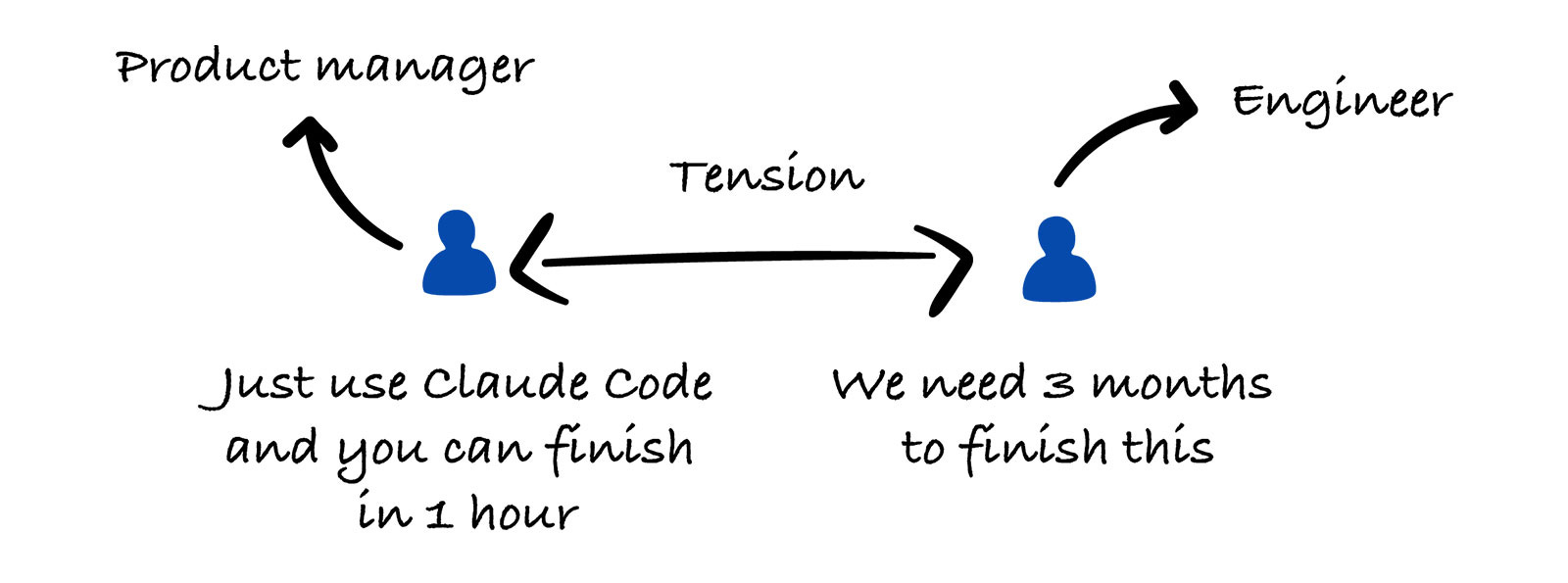
This tension has been part of the engineering industry for quite a while, but now with AI being more and more popular, it has just increased further.
The tension is that one side is being overly optimistic, and the other side is being overly pessimistic. The goal should be that both sides work together to find the best scenario for the team.
Here are some of the phrases I have heard (from PMs):
I’ve created this app in Lovable, just copy & paste this code
Here is the prompt. Just run it in your codebase, and we should be good to go
I’ve used Claude Code and was able to build this feature in minutes
Here are some of the phrases being too pessimistic (from engineers):
This is not possible
This will take 3-6 months to finish
Ahh, this is too complex
Put yourself in their shoes
For both engineers and product managers, it’s really important to try to put yourself in the position of the other and ask yourself: “How would I feel if I were on the other side?”
This is crucial because if you look at it from both perspectives, you can see what their pain points and challenges are, and you can better understand why they might be saying that. Let’s go through them:
Product managers
A lot of product managers these days are also dealing with quite unrealistic expectations (similar to what I mentioned above for engineering leaders). Often, they are working around tight deadlines, and some are expected to make miracles happen in a short amount of time.
Such expectations put product managers in a weird position where they are forced to utilize different tactics to speed up the delivery. And the problem comes especially with less technical product managers, who may have a bit of an optimistic view on how engineering really works.
Engineers
We’ve all been bitten by being too optimistic, so that’s the reason why a lot of engineers put the estimation to be a lot more pessimistic than it should be.
This is what has happened quite a few times to me personally:
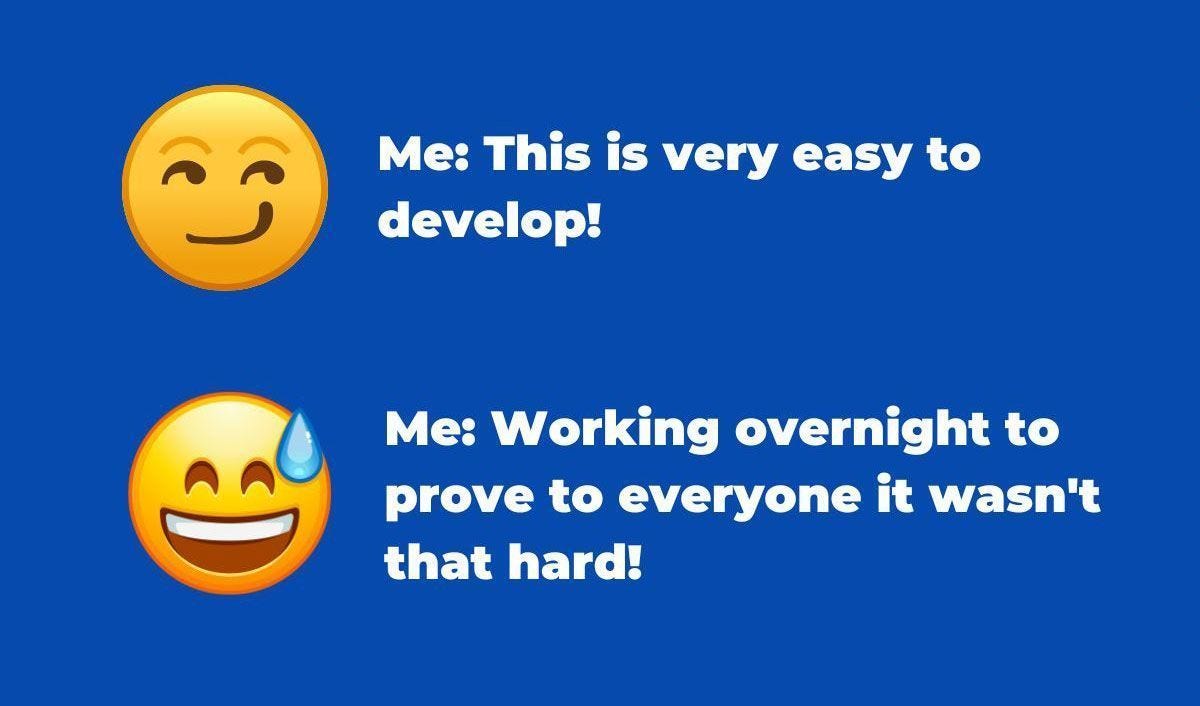
And also at the same time, as engineers, we are proud of what we do, and if someone (especially a less technical person) tries to tell us that something can be done a lot faster than it is possible, it hurts our pride.
But the important part, as I mentioned above, is to have mutual understanding. Engineers need to understand the pain points of product managers, and product managers need to understand why saying something might not be the best thing to say.