

Intro
It’s Christmas Eve today 🎄, and many of you are celebrating Christmas and enjoying the holidays, me included :) I always like to use this time to reflect, recharge, and prepare for a successful upcoming year!
In today’s article, I’ll be sharing the most important lessons and findings impacting engineering & engineering leadership this year, what I have learned, and what’s really important for you to know as an engineer or engineering leader!
In an article on Sunday, this week, we’ll also do a full recap of the year and share the most popular articles + many more interesting insights about this year.
And then at the beginning of the year 2026, we’ll also do an article on what you need to do in order to be a successful engineering leader in 2026 and beyond.
Excited to share all these insights with you all soon!
Now, let’s focus on today’s article.
Today’s article is for paid subscribers, and here is the full index:
- 2025 has been a year where AI has had a significant impact on our industry
- 1. The Narrative “AI is Replacing Software Engineers” is Simply Not True
- 2. The Negative Perception Regarding AI Was Caused by THIS
- 3. Managing Expectations Has Become THE Job for Engineering Leaders
🔒 4. The Roles are Getting Closer Together
🔒 5. Being a Multiplier is a Must in the AI-Era
🔒 Last words
Let’s get started!
2025 has been a year where AI has had a significant impact on our industry
A lot of things have changed due to the rise in the popularity of AI and AI tools. It seems like new AI tools have come out on a daily basis, and there was a sensationalistic prediction about “AI replacing software engineers” on a weekly basis.
We’ll talk more about that in a minute, but what’s important to mention is that there was a lot (still is a lot) of interest in how to actually utilize AI in your advantage both as an engineer and engineering leader.
These two articles have been some of the most popular ones this year:


In both articles, I talked to many engineers and engineering leaders about how they use AI to be more productive. If you haven’t read both, I highly recommend doing so!
Now, let’s go to the first important lesson/finding.
1. The Narrative “AI is Replacing Software Engineers” is Simply Not True
This has been a narrative that has been quite common this year, and I’ve seen it decrease in recent months. The reason why that is the case is that many people these days realize what the reality actually is.

We’ve been trying to put the work over to stakeholders for the past 50 years, with the invention of SQL and tools like MS Access, thinking that the stakeholders will be able to manage the data and build things themselves.
Well, that hasn’t yet happened, and that will never be the case. There will always be people who want some things to get done and people who actually do them. That is the reality. And Software Engineers will always exist, just the actual role is changing due to tools getting better.
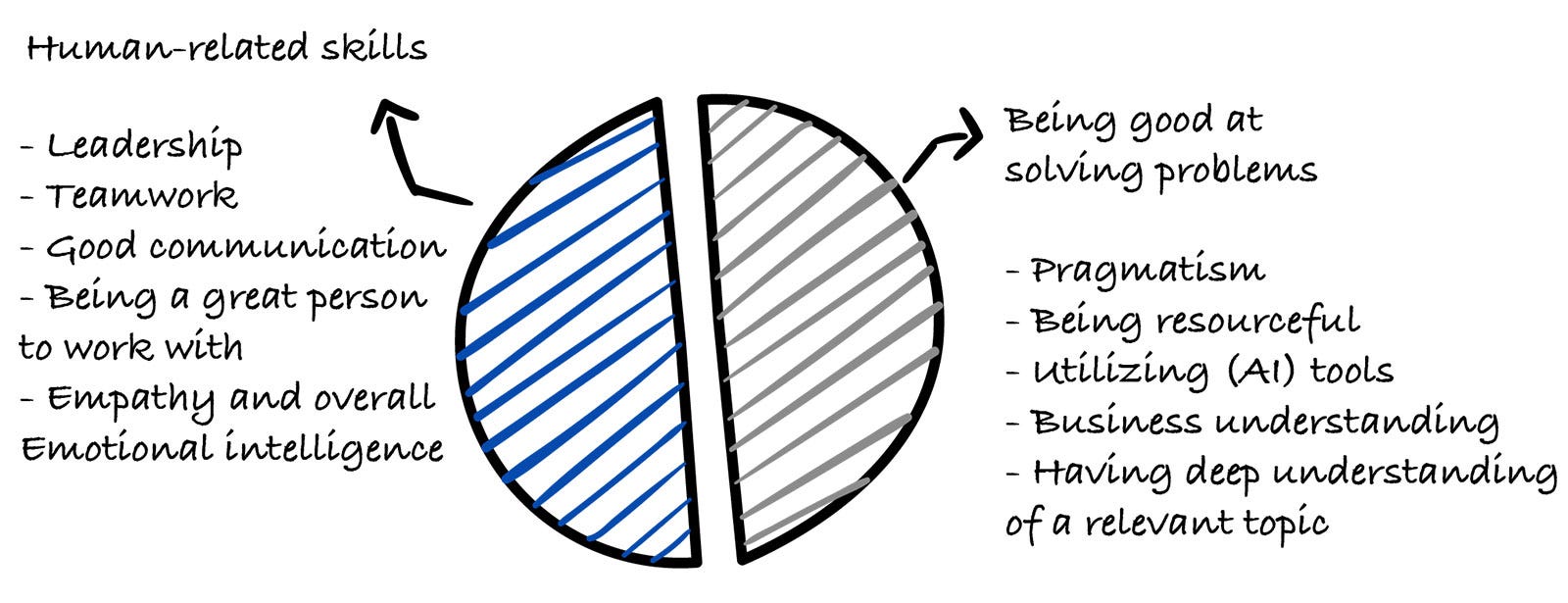
And when tools are getting better, the role shifts to the importance of overall problem-solving and human-related skills, which are the two pillars of what I believe are the most important things to focus on.
This is especially important to understand for all the engineering leaders managing teams and people. It’s important that you reassure your team and motivate your people that they are very important.
Because what happens otherwise is that when people don’t have psychological safety and when they feel like they will be replaced eventually, they start asking themselves: What’s actually the point of me doing good work?
This takes a big toll not just on that specific individual, but on the overall culture in the organization as well, and one thing that I like to say, and that it’s really important to understand, is:
There is no better productivity hack than a great culture.
No shiny AI tools can make the overall organization more productive than a great culture.
These 2 articles and the recording of my talk at the Infoshare Conference in Katowice are relevant to this:


Now, let’s talk about the next impactful thing, and that is the negative sentiment regarding AI in our industry.
2. The Negative Perception Regarding AI Was Caused by THIS
The second really important finding that made a mark on everyone in the engineering industry is the negative perception regarding AI from both engineering leaders and engineers.
I was going through the report where 600+ engineering leaders shared their views on AI and how it impacts individuals and teams, and two findings really made me wonder.
The two findings are:
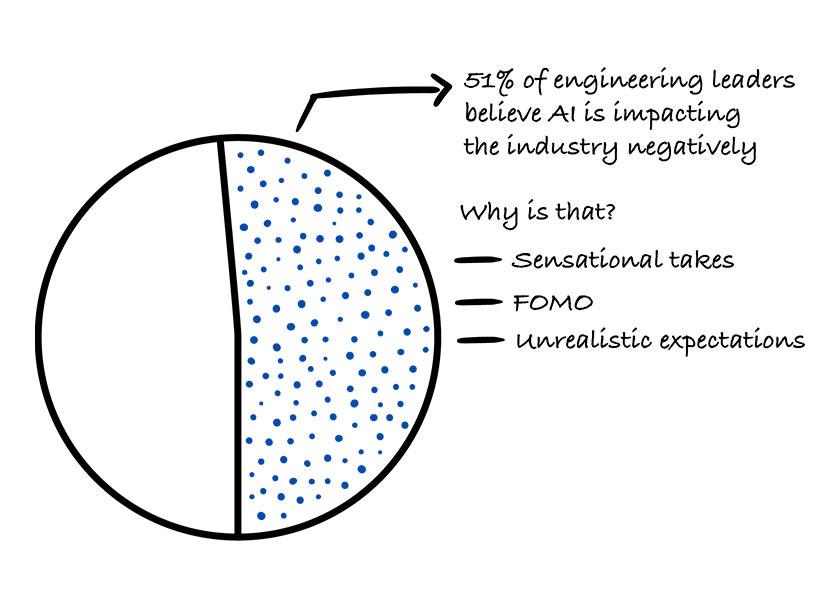
The first one is that 51% of engineering leaders believe that AI is impacting the industry negatively
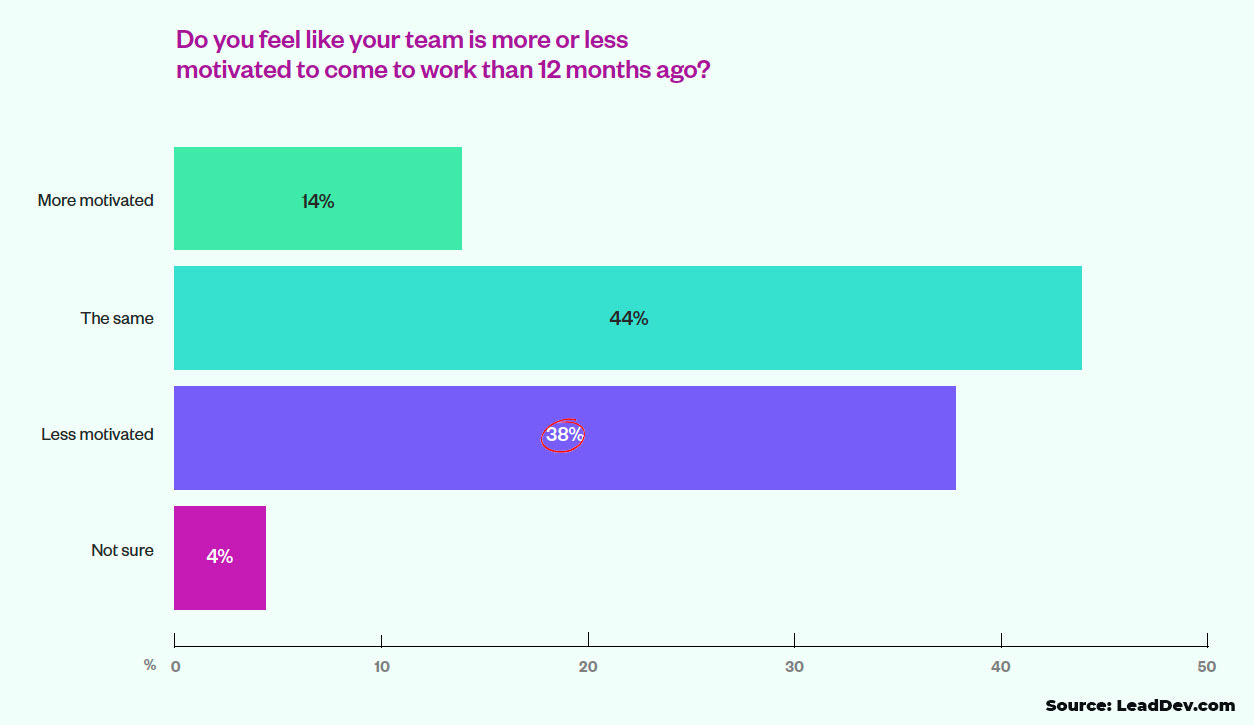
The second one is that a lot of engineering teams are less motivated these days than they were 12 months ago.
Read the full report here:

When I saw the data, I started to wonder what the reason was for it, and I talked to many engineers and engineering leaders from both Big Tech and Startups.
And this is what I found out:
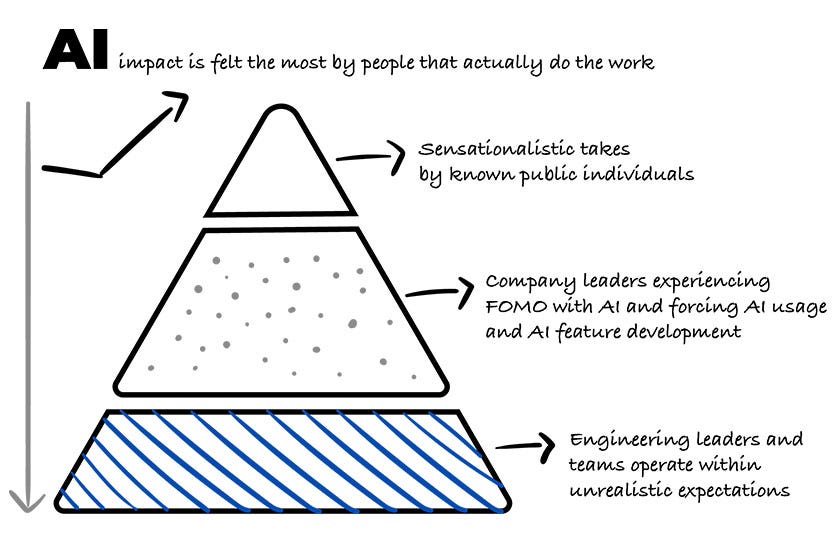
Sensationalistic predictions regarding AI replacing people from known public individuals trickles down to company leaders experiencing FOMO (fear of missing out), and they try to enforce AI usage and AI feature development.
This then trickles down to engineering leaders and engineers needing to operate within those unrealistic expectations.
You can read more about this in this article:

And I also recently talked about this in my keynote talk at the TechLead conference in London:
This is really important to understand, especially as an engineering leader, because when you are managing the expectations from the stakeholders, you understand a LOT better why they may feel about a certain AI tool so strongly.
This helps you to manage the expectations a lot better. And speaking about the expectations, that’s the next very important thing we’ll go through!
3. Managing Expectations Has Become THE Job for Engineering Leaders
I’ve seen many unrealistic expectations from different stakeholders and company leaders across the industry this year.
And a very common thing I saw is that the CEO of the company did some sort of “vibe coding” of the first page of the company’s website, and then told everyone how easy it is to build it.
Well, we all know and understand that you can get 90% of the UI close to the actual look and feel, but to make things in a maintainable and scalable way, that is a totally different thing.
Some of the other unrealistic expectations I have heard are:
Believing AI is a “Plug and Play” solution
Expecting AI to eliminate all manual work
Underestimating the cost and complexity of building internal LLMs
Assuming AI will just magically understand the whole context of the specific domain
Expecting AI to replace entire teams
Assuming AI will just work without failures
Thinking that there are no ethical, legal, and security risks
Assuming AI will exponentially increase the performance over time
And when you are dealing with such unrealistic expectations and also when the stakeholders have FOMO, you need to step up your “managing expectation” game by a LOT.
So, being able to manage these expectations well has become THE job for engineering leaders, and it’s not an easy thing to do. You need a lot of credibility, confidence, and also knowledge to do that well and develop trust.
The 5 things I highly recommend to focus on are: