OpenAI's Report: The State of Enterprise AI
There has been a big increase in enterprise usage in the last 12 months!
This week’s newsletter is sponsored by Cerbos.
One size does not fit all: A guide to multitenant authorization
When an enterprise signs up for a SaaS product, the “Admin, Editor, Viewer” model breaks. Role explosion follows - thousands of tenant-specific role variants that cripple engineering velocity and stall enterprise deals.
Static roles weren’t designed for the complexity of today’s multitenant systems. Every enterprise has unique organizational structures, matrix reporting, and regional compliance requirements that demand contextual, granular permissions.
This ebook shows you how to implement dynamic, tenant-aware authorization that scales. Without role proliferation. Inside the ebook, you will find:
Why fixed roles break at enterprise scale (and what role explosion actually looks like)
How to implement authorization that mirrors each tenant’s organizational reality
Architecture patterns for separating platform-wide rules from tenant-specific policies
How to balance central control with tenant self-service and delegated administration
The PEP/PDP/PAP pattern and policy-as-code workflows
Real examples from leading SaaS companies scaling authorization across thousands of tenants
Thanks to Cerbos for sponsoring this newsletter, let’s get back to this week’s thought!
Intro
Ever since the increase in popularity of AI tools → many people have been doubtful regarding security, sharing sensitive data, and overall compliance factors regarding the usage of such tools.
This has been especially prevalent in enterprise companies, as many have previously chosen to restrict such tools. But now we have the latest data on how enterprise companies are using AI tools, and one thing is clear:
A lot more enterprise companies are using AI tools these days.
On December 8th, 2025, OpenAI published their report on the state of enterprise AI, and I’ve taken a close look at it. Here is also the PDF of the report.
Some interesting insights:
Users report saving on average 40–60 minutes per day using AI tools
Australia, Brazil, the Netherlands, France, and Canada are above the global average in the number of paying business customers of OpenAI (Australia by far in the first place)
ChatGPT message volume grew 8x and API token consumption per organization increased 320x year-over-year (from November 2024)
In today’s article, I am going over the report and sharing my thoughts on the data.
If you like these kinds of articles, where I go over a highly relevant report and share my insights on it, you’ll also like these articles:
Let’s start!
OpenAI surveyed over 9000 people from various fields in 100+ enterprise companies
They have also shared their results from the real-world usage of data from enterprise customers.
Based on my research, OpenAI launched its ChatGPT Enterprise plan in late August 2023, so they have the data for the past 2.3 years.
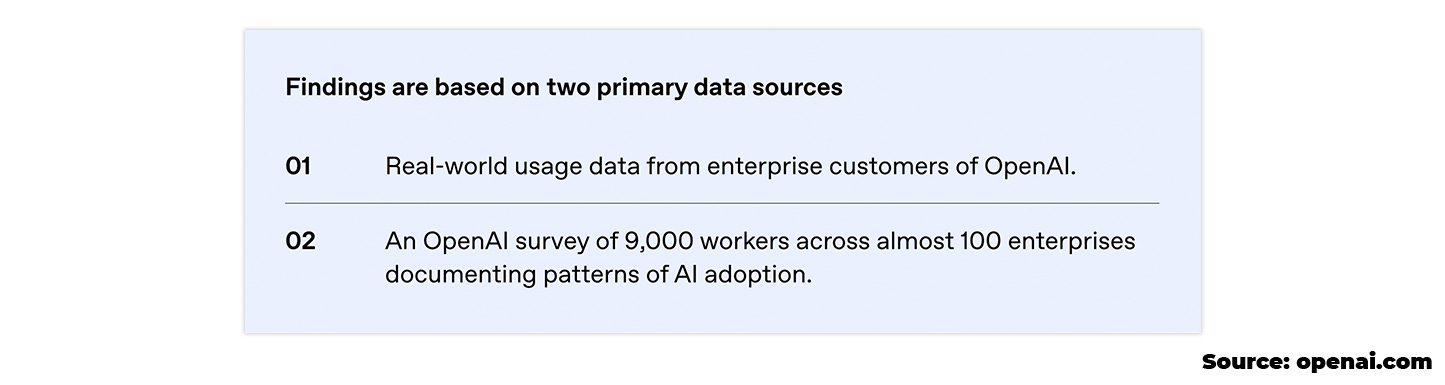
One unfortunate thing that we don’t see -> the questions of the survey and how they were framed + what options people choose from. That would bring a bit more clarifying thoughts on the results.
But no matter, we got a lot of interesting data to go through. Let’s go straight to the first set and one of the most important → Enterprise usage.
1. Enterprise Usage is Increasing
As mentioned in the Intro section, there has always been a question mark in terms of enterprise usage of AI tools. But now we have the data.
Since November 2024:
ChatGPT messages on the Enterprise plan have increased by 8x
The number of seats on the Enterprise plan have increased by 9x
These two increases tell me that many enterprise companies are making AI part of their core workflows.
1.1 Increase in Custom GPTs and Projects
Weekly users of Custom GPTs and Projects have increased by 19x from November 2024, and an interesting data point is that 20% of all the Enterprise messages were processed via Custom GPTs or Projects.

In the report, it’s mentioned that many enterprise companies have developed a culture where they put the domain knowledge of a certain topic in a custom GPT and share that with everyone, so they can ask any questions and get all the info that they need.
They also added an example from a company called BBVA (a Spanish multinational bank), where they created more than 4,000 GPTs, which indicates that the company has widely adopted the workflow that we mentioned above.
1.2 Big Increase in Reasoning Token Consumption
Also mentioned in the report is that more than 9,000 companies have exceeded the 10 billion tokens, and nearly 200 have exceeded the 1 trillion tokens. Unfortunately, we don’t get the before/after comparison on the overall token usage.
But we get the before/after comparison on the usage of reasoning tokens (tokens that are being used for more advanced models and used by the model to think before responding).
The increase in reasoning tokens usage has been approximately by 320x (from November 2024), which tells me that there’s a lot more usage of more advanced models, instead of just quick and simple asks.
2. How AI Impacts Productivity
Before we go through the data, it’s important to mention that if you are an engineer or engineering leader, these 2 articles have some good insights on how you can increase your productivity using AI:
Now, let’s go through the data on productivity.
2.1 75% of People Surveyed Mentioned Improvements in Speed or Quality
On average, the users of the ChatGPT Enterprise plan mentioned 40-60 minutes of time saved per day.
People in fields such as data science, engineering, and communications save on average 60-80 minutes per day.
Also, an interesting metric has been mentioned: Time saved per message, and particularly, accounting and finance users report the best results on that metric. So, the most time saved, while keeping the costs of usage low.
Here is also the image of some additional interesting findings from the data:
2.2 Expansion of The Tasks People Can Perform
What’s mentioned in the report as well is that 75% of people reported they can now complete tasks they couldn’t before, which makes sense, and it’s definitely not a surprise.
This is also the exact reason why I believe that engineering roles are getting closer together, the trend I already predicted at the beginning of this year, and also explained a bit more in detail in the article: How AI is Impacting Engineering Leadership.
As tools are getting better and there is an increase in the scope of work people can take, it’s natural that there will be broader expectations as well, and people will be expected to wear different hats.
2.3 Greater Productivity From More Intensive AI Use
This was also an interesting insight, and that, of course, makes sense. The more AI usage per person, the bigger the productivity increase mentioned by that person.
3. AI Usage Based on Industry and Geography
Now, let’s go through the data on industries and geography.
3.1 Rapid Growth Across Most Industries
They mentioned an average customer growth of 6x year-to-year. The technology sector is the highest (11x), followed by Healthcare (8x) and Manufacturing (7x).
While, Educational services are the lowest with 2x. That means that all the educational institutions are still quite cautious with AI usage, while the tech sector is rapidly increasing.
Here is the full chart:
3.2 Australia, Brazil, the Netherlands, France, and Canada Above the Global Average in AI Usage
Interestingly, they mentioned in the report that early AI adoption was primarily U.S.-based, while now, international growth is accelerating rapidly.
Australia is in the #1 place, followed by Brazil and the Netherlands. That tells me that these are the countries that try to innovate the most.
Here is also a full overview of countries by usage around the world:
4. Difference in AI Usage → Top Users vs Typical Users
It’s interesting to see how big a difference there is in usage in top vs typical users.
The chart below shows how much more top users (“frontier users”, the top 5%) use advanced AI tools compared to typical users (median → 50~%).
For regular tasks (like writing individual messages), top users use the tools 6x more than the median user.
For data analysis tasks, the gap is even bigger: top users send 16x more data-analysis-related messages.
And specifically, the gap is big for writing (11x), coding (17x → largest relative gap), and analysis (10x). Here is the chart:
And also, this is very important data as people who can use AI for many different task types will ultimately be more productive, as shown in this chart:
So, if there’s one takeaway here, it is that:
You should learn to use AI tools for different task types, as that prepares you to solve any problems you come across more effectively.
4.1 Difference in AI Usage → Top Companies vs Typical Companies
A very similar ratio is seen with companies as well. The chart shows how much top companies (the most active 5%) use AI tools compared to typical companies.
For overall message usage, top companies use AI 2x more than median firms.
But for messages specifically sent to GPTs, top firms use them 7x more.
5. Further Reading: Case Studies
In the report, you can also read 6 different case studies of enterprises → how they are using AI tools to solve their specific business problems.
The case studies are from companies:
Intercom
Lowe’s
Indeed
BBVA
Oscar Health
Moderna
We already mentioned a bit about BBVA and how they use over 4,000 Custom GPTs in their workflows.
I definitely recommend checking them out as they are very brief and to the point.
Last words
Based on the report, we can definitely see that the AI usage amongst enterprise companies is rapidly increasing.
So, my message is the following:
If your company hasn’t yet tried to use any of the AI tools, this is a good reminder that it’s a good time to do some experimenting.
Of course, don’t just blindly use everything that comes up. My recommendation is to pick a specific pain point for the organization and look at how a certain tool might help with it.
Liked this article? Make sure to 💙 click the like button.
Feedback or addition? Make sure to 💬 comment.
Know someone that would find this helpful? Make sure to 🔁 share this post.
Whenever you are ready, here is how I can help you further
Join the Cohort course Senior Engineer to Lead: Grow and thrive in the role here.
Interested in sponsoring this newsletter? Check the sponsorship options here.
Take a look at the cool swag in the Engineering Leadership Store here.
Want to work with me? You can see all the options here.
Get in touch
You can find me on LinkedIn, X, YouTube, Bluesky, Instagram or Threads.
If you wish to make a request on particular topic you would like to read, you can send me an email to info@gregorojstersek.com.
This newsletter is funded by paid subscriptions from readers like yourself.
If you aren’t already, consider becoming a paid subscriber to receive the full experience!
You are more than welcome to find whatever interests you here and try it out in your particular case. Let me know how it went! Topics are normally about all things engineering related, leadership, management, developing scalable products, building teams etc.


