Learning Tracks: Become an Engineering Multiplier
Learning tracks have been completely revamped to help you become an Engineering Multiplier!
This week’s newsletter is sponsored by Depot.
Legacy CI is too slow for the speed of AI
Code is now written in seconds, but Docker builds still take 20 mins. Depot’s Co-founder & CEO Kyle Galbraith on why infra is the new bottleneck for AI-driven teams and what engineering leaders must do to adapt.
Inside this article, you’ll learn:
The Velocity Gap: Why AI agents can write features in seconds, but outdated Docker build processes leave teams waiting 20+ minutes to see the results.
Agent-Centric Workflows: How the shift from human-paced coding to agent-paced iterations requires a fundamental rethink of your infrastructure.
Eliminating Idle Time: Practical insights on how moving past standard CI runners can reclaim hours of developer focus every week.
Stop waiting for your builds!
Thanks to Depot for sponsoring this newsletter. Let’s get back to this week’s thought!
Intro
As I have already mentioned in the article: Become a Great Engineering Leader in 2026, engineering roles are getting closer together. Therefore, being good at many things is where the value is, and your title means much less.
Engineering leadership roles like Architect, Staff Engineer, Team Lead, Tech Lead, and Engineering Manager, are getting closer together + the line is getting blurred more and more as time goes on.
Similar to engineers and product managers. The role of a product engineer is getting more and more popular, and it’s especially common in startups and mid-size companies.
The impact you provide is what is most important. And being an engineering multiplier is where you provide the biggest impact.
To help you ensure you’ll be able to build the right mindset and all the skills needed, I have completely revamped the learning tracks to help you with this!
You’ll find all the relevant articles that will help you become an engineering multiplier.
Before we go into the actual learning tracks, where you can find the articles, let’s go through what an engineering multiplier is and why it’s so important to be one.
What is an Engineering Multiplier?
I like the term “Engineering Multiplier” because it’s a mix of “Engineering” and “Force Multiplier”, which fundamentally connects the two together.
Being an engineering multiplier means being someone who amplifies the productivity and effectiveness of the engineers around them, not just focusing on their own output, but elevating the entire team and the organization.
An engineering multiplier doesn’t just ask, “What can I build?”, they ask, “How can I make everyone around me more effective?”.
I like to think of it like this:
If you make 5-10 people around you 20% better, it’s much bigger value than if you level up your skills by 20%.
And imagine if you make 50, 100, or even 1000 people 20% better, that’s the impact that is priceless.
Being an Engineering Multiplier is Crucial in AI Era
As tools for development have gotten better, the desired skills for engineers have moved from just pure knowing programming languages and frameworks (expected) to problem-solving abilities and people skills.
It’s less about the tasks, but how big an impact you can create. And people who can create the biggest impact have the multiplier mindset.
It’s the mindset where you focus less on just your pure individual tasks, but you focus on how you can make things better for your whole team, organization, and, of course, the customers (users).
To learn more, read these 2 articles:
Now, let’s go through the learning tracks where you can develop the right mindset and skills in order to become an engineering multiplier!
Learning Tracks to Become an Engineering Multiplier
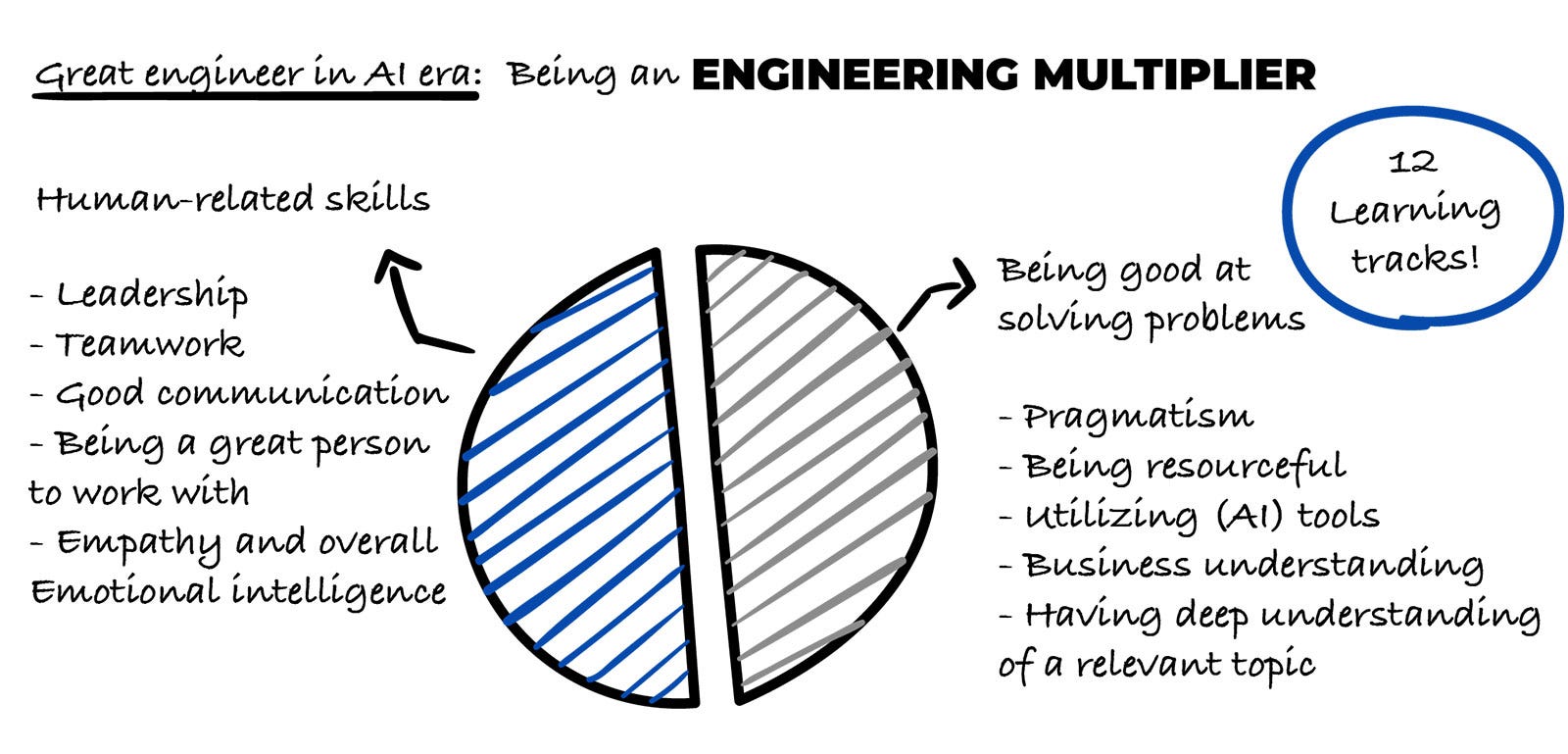
As mentioned above, the 2 main focus areas that are important in the AI era, to become an engineering multiplier, are:
Human-related skills and
Problem-solving abilities
And here is the visual of the most important areas:
Now, we’ll go over 12 learning tracks, where you’ll find all the relevant articles for the specific skills to develop, and also the mindset.
These articles are paid articles, so if you are not a paid subscriber already, you’ll need a subscription to read them fully.
Paid subscribers get:
12 learning tracks and full archive of 200+ articles
29 guides, templates and infographics for becoming a great engineering leader (worth $400)
Special deals (discounts) of personally curated courses, resources, newsletters (worth $2500)
Join 1600+ engineering leaders, who are already using all the benefits of the paid subscription.
1. Human-Related Skills
1.1 Become a better leader
Becoming a great leader is crucial to becoming an engineering multiplier. You need to be able to inspire, motivate, and also influence others. And you are only able to do that if your leadership skills are at a good level.
Here are the articles that would help you with this:
1.2 Become better at communication
Communication is crucial in the AI era, and the reason is that when the speed of building things is enhanced, focusing on building the RIGHT things is more important than ever.
Being good at challenging requirements, collaborating, managing expectations, and communicating your impact is more important than ever.
Here are the articles that would help you with this:
1.3 Become a great person to work with
Just “becoming a great person to work with” alone is how you can get many opportunities. Engineering multipliers focus on helping others and being a person that others look up to.
Here are the articles that would help you with this:
1.4 Become better at teamwork and emotional intelligence
Being a great team player is crucial, as I like to say: Great teams build great software, not individuals.
And at the same time, emotional intelligence is something that makes that possible, and it’s a skill that will just be more and more important, as that’s something you can’t expect AI to replace anytime soon.
Here are the articles that would help you with this:
1.5 Build good relationships
I like to say that relationships are the #1 most important thing at work. Having good working relationships with your colleagues and your manager enables you to collaborate well, get things done, and also ensure your initiatives get accepted.
Here are the articles that would help you with this:
1.6 Work-life balance
Doing good work long-term is where the real value is. Short spikes of great work is the opposite and in most cases lead to burning out.
And especially in current times, in the AI era, it’s more important than ever to be able to manage your time and stress levels well. And the only way to do that is to have a good work-life balance.
Here are the articles that would help you with this:
2. Being Good at Solving Problems
2.1 Become pragmatic and resourceful
Being pragmatic and resourceful enables you to solve any problem you encounter. No matter how hard or complex it is, you are able to find the right answers by utilizing tools, people, and your overall credibility.
Here are the articles that would help you with this:
2.2 Utilize AI to be a multiplier
Being able to utilize any tools that help you be more productive is what multipliers focus on. And AI is like any other tool, so it’s really important to find ways in which it can help, and once you know that, you share that with everyone else around you!
Here are the articles that would help you with this:
2.3 Become better at being product/business-minded
This is really important as roles are getting closer together, as I mentioned above. With the speed at which things are being built, the focus is a lot more on building the RIGHT things. Being product/business-minded enables that.
Here are the articles that would help you with this:
2.4 Understanding the data from industry reports
I regularly share the most important data from highly relevant industry reports, and by reading them, you see what’s happening in the industry and how other engineers/engineering leaders think.
When you understand that, you make much more accurate decisions in your own projects and teams + get the buy-in on specific initiatives as you can back them with concrete data.
Here are the articles that would help you with this:
2.5 Be productive
The goal is not to work 24/7, but to do the most as you can in the time when you actually are working. 8 hours a day is more than enough, if you are productive!
Being able to focus well, avoid multitasking, perfectionism, minimize context-switching, and procrastination, and you’re good to go.
Here are the articles that would help you with this:
2.6 Build your network
The more you grow in your career, the more important it is to focus on building your network of peers outside of the organization you are a part of.
You need people who understand the challenges you are facing, and also that you can exchange your experiences and best practices.
Here are the articles that would help you with this:
Last words
Let’s end this article with the following:
Engineers who thrive in the AI era aren’t the ones who simply know the most frameworks, memorize the most syntax, or chase every new tool. The ones who thrive are those who can create impact far beyond their individual output.
That’s the engineering multiplier.
We are not over yet!
BeSa Cloud Academy: Learn about Agentic AI on AWS
My friend Prasad Rao is hosting a free 6-week BeSA bootcamp. Check out the full agenda here. And you can register and secure your spot here.
Liked this article? Make sure to 💙 click the like button.
Feedback or addition? Make sure to 💬 comment.
Know someone that would find this helpful? Make sure to 🔁 share this post.
Whenever you are ready, here is how I can help you further
Join the Cohort course Senior Engineer to Lead: Grow and thrive in the role here.
Interested in sponsoring this newsletter? Check the sponsorship options here.
Take a look at the cool swag in the Engineering Leadership Store here.
Want to work with me? You can see all the options here.
Get in touch
You can find me on LinkedIn, X, YouTube, Bluesky, Instagram or Threads.
If you wish to make a request on particular topic you would like to read, you can send me an email to info@gregorojstersek.com.
This newsletter is funded by paid subscriptions from readers like yourself.
If you aren’t already, consider becoming a paid subscriber to receive the full experience!
You are more than welcome to find whatever interests you here and try it out in your particular case. Let me know how it went! Topics are normally about all things engineering related, leadership, management, developing scalable products, building teams etc.